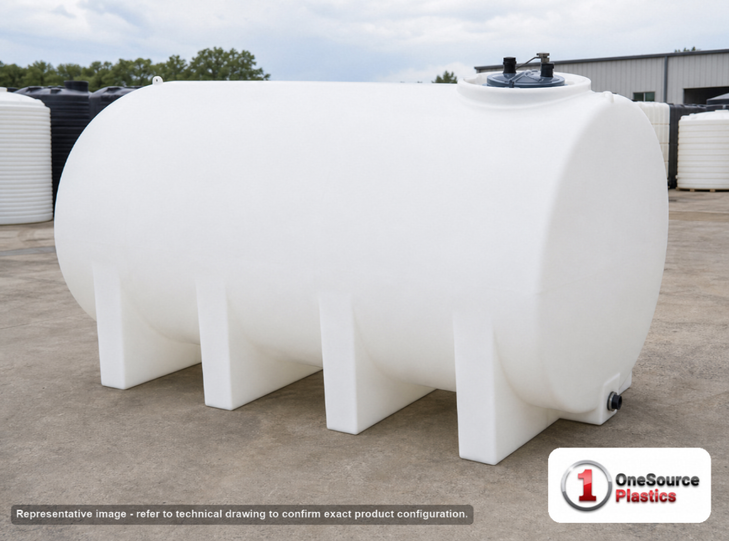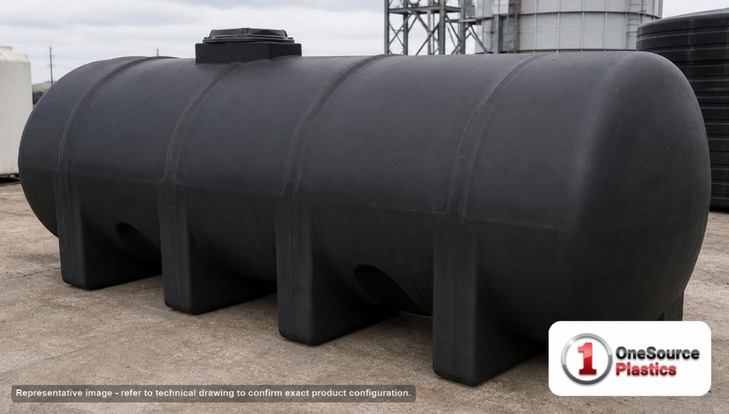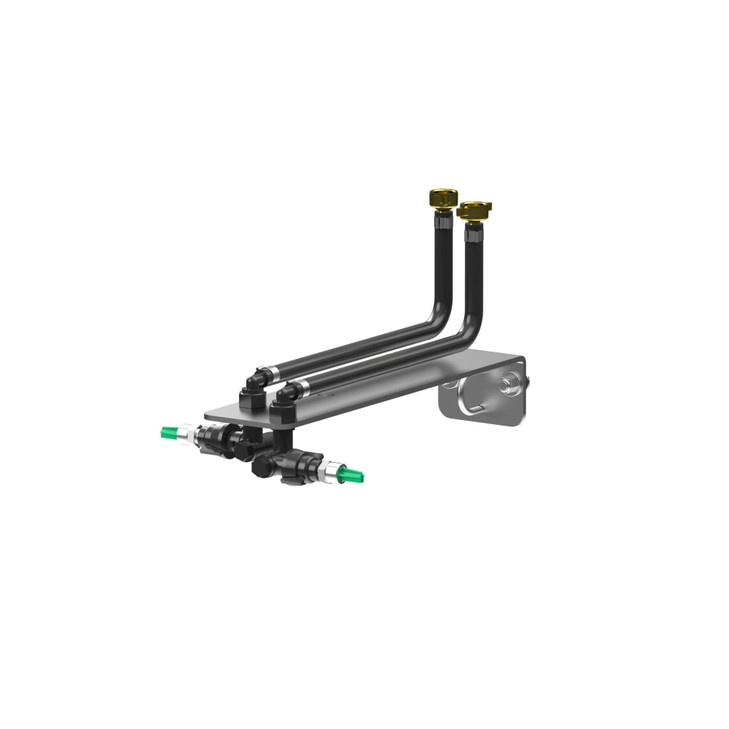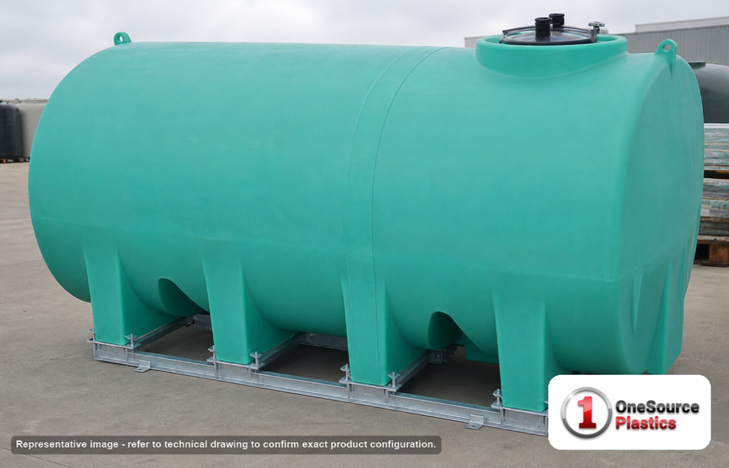
The Enduraplas 2200 Gallon Green Horizontal Sump Bottom Leg Tank ships with its own steel support frame and is built for exactly what its name says: hauling and transferring heavy liquid loads.The body holds 2,200 gallons, stands 76 inches tall, runs 130 inches long, and is 71 inches wide on a 71 x 130 inch footprint.That 71-inch width is the number to check first for transport, since it governs whether the loaded unit rides legally on a standard deck without a wide-load flag.The sump-bottom geometry pitches contents toward the outlet so the tank drains down cleanly, and the integrated frame is what lets you mount this horizontal leg tank to a skid or trailer for field use.See the technical drawing on this page for the outlet and fitting locations.
Will it work for your load?
This is a 1.9 specific-gravity-rated tank, which is the number that matters most when you spec it.Full of plain water, the contents alone weigh about 18,348 pounds.The tank is rated to carry up to 34,861 pounds of contents at its 1.9 SG ceiling, so it has real headroom for dense fertilizer blends and heavy chemistries that a 1.0 or 1.9 SG tank could not hold.Match the liquid you are actually moving against that 1.9 rating before you fill it.If you are sizing a transport or applicator setup, run the numbers through our Tank Sizing Calculator and the Tank Sizing Guide so the loaded weight stays inside both the tank rating and your trailer or vehicle width and weight limits.This unit ships from a single northern-tier plant in Neche, ND, so if you are in the South or Southwest, run the Freight Cost Estimator early rather than after you have settled on the tank.
Chemical compatibility
The tank body is polyethylene rated to 1.9 specific gravity.The resin grade on this unit is listed as HDLPE but is unconfirmed, so confirm whether it is HDLPE or XLPE before committing it to any aggressive chemical service.Compatibility also depends on choosing the right fitting and gasket materials, and on matching concentration and temperature to the OEM chemical-resistance chart, which is concentration- and temperature-specific.One named use case worth elevating: DEF at 32.5% (316SS fittings, EPDM gaskets) — diesel exhaust fluid runs cleanly in this tank, but only with 316 stainless fittings, never brass or carbon steel.The full list of chemicals listed as compatible with this resin and 1.9 SG rating: Acetic Acid at 60% (PP/PVC, EPDM), Aluminum Sulfate at 50% (PVC, EPDM), Calcium Chloride at 40% (PVC, EPDM), Ethylene Glycol at 100% (PVC, EPDM), Ferric Chloride at 50% (PVC, EPDM), Ferric Sulfate at 60% (PVC, EPDM), Ferrous Sulfate at 20% (PVC, EPDM), Hydrochloric Acid at 37% (PVC, Viton), Hydrofluoric Acid at 48% (PP/PVC, Viton), Hydrofluosilicic Acid at 26% (PP/PVC, Viton), Hydrogen Peroxide at 50% (PVC, Viton), Magnesium Chloride at 30% (PVC, EPDM), Peracetic Acid at 30% (316SS, Aflas), Phosphoric Acid at 85% (PVC, Viton), Polyaluminum Chloride (PVC, EPDM), Potassium Carbonate at 50% (PVC, EPDM), Potassium Hydroxide saturated (PVC, EPDM), Propylene Glycol (PP/316SS, EPDM), Sodium Bisulfate (PVC/PP, EPDM), Sodium Bisulfite (PVC/PP, EPDM), Sodium Carbonate at 30% (PVC, EPDM), Sodium Hypochlorite below 16.5% (PVC, Viton), Sodium Thiosulfate at 40% (PVC, EPDM), Sulfuric Acid at 98% (CPVC, Viton), Urea Solution at 50% (PP/PVC, EPDM), Zinc Orthophosphate (PP/316SS, EPDM), and Ozonated Water up to 10 PPM (PVC, EPDM).Several of these acids call for Viton or Aflas gaskets rather than EPDM, so spec the gasket to the chemical, not the other way around.Verify every selection against the concentration- and temperature-specific OEM chemical-resistance chart, and see our full chemical compatibility reference before ordering fittings.
The mistake to avoid
The most common error on a tank like this is under-rating the gasket and over-trusting the SG number.The 1.9 rating tells you the tank wall can carry the weight, but it does not mean every chemical is friendly to a standard EPDM gasket.Hydrochloric, hydrofluoric, hydrofluosilicic, phosphoric, sulfuric, hydrogen peroxide, and sodium hypochlorite all specify Viton on this tank, and peracetic acid specifies Aflas.The second mistake is sizing for water and forgetting that a heavier liquid changes both the loaded weight and your road or trailer rating.If you are blending fertilizer in this tank, watch for stratification, and our guides on applicator and leg tanks for fertilizer, portable utility tank DOT classification, and fertilizer-blend tank stratification are worth reading before the spreader runs.
This tank ships LTL freight from the Enduraplas plant in Neche, ND, with the rate quoted live to your ZIP code.Freight is quoted on the empty tank and frame only — the 18,348 lb water figure is your operating load, not the shipping weight, since contents are filled on site.Use our Freight Cost Estimator for a freight estimate, or call 866-418-1777 to lock in your order and confirm frame, fitting, and sump configuration for your application.
Freight and documents
Ships from: Neche, ND. LTL freight is quoted to your ZIP with the freight cost estimator or by phone at 866-418-1777. The listed price is before freight.
See this tank
Interactive 3D model with live fill. This tank has an interactive 3D model built to its manufacturer dimensions. Rotate it, and set a fill level to see how much liquid it holds at any height. Open the 3D view on the product photo above. Download the 3D model (GLB).
Ready to order?
Add it to your cart at the top of this page, get LTL freight to your ZIP, request a written quote, or call 866-418-1777. The listed price is before freight.