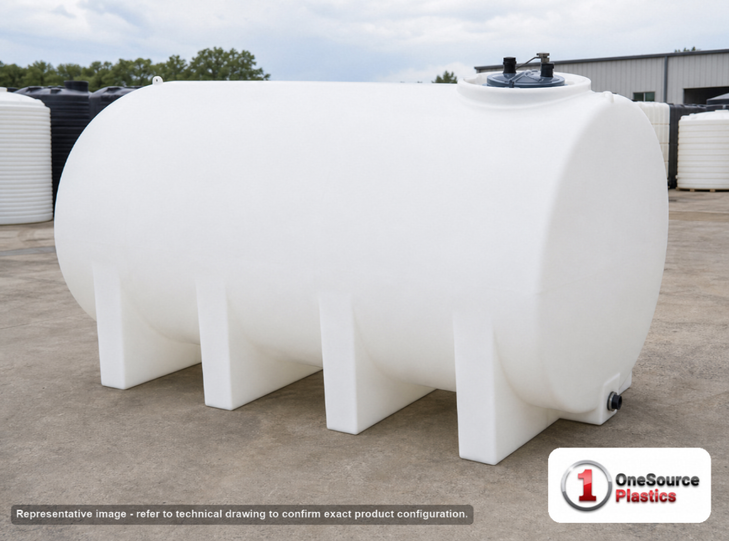
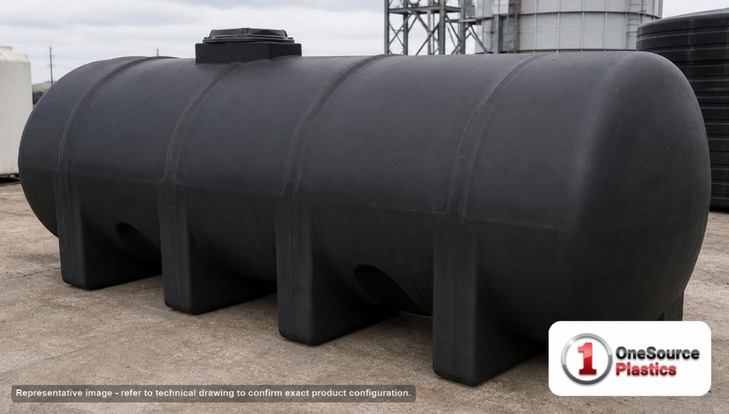
The Enduraplas 2200 Gallon White Horizontal Sump Bottom Leg Tank with frame is a transport-and-haul tank built for moving liquid where you need it, not just storing it.It holds 2,200 gallons, measures 130 inches long by 71 inches wide by 76 inches tall, and is molded in natural white polyethylene so you can read the liquid level through the wall.The integral leg-tank profile and supporting frame let it sit flat on a skid or trailer deck, and the sump bottom drains the tank fully toward the outlet instead of leaving product trapped in the belly.It carries a 1.9 specific gravity rating, the number that decides whether this tank is right for your liquid.
Will it work for your haul?
Start with weight, because a horizontal leg tank lives or dies on how its contents load the frame and the deck under it.Filled with water (1.9 specific gravity), the contents alone weigh about 18,348 pounds.At the tank's full 1.9 specific gravity rating, the contents can reach roughly 34,861 pounds, so make sure your trailer, skid, and tie-down points are rated for that load before you fill it.The footprint is 71.0 x 130.0 inches; lay that out on your deck and confirm the frame bears on solid structure, not on overhang.As a mobile leg tank with a frame, this is the kind of tank that often runs on a trailer, so if you are hauling fertilizer or other regulated product, read our guides on applicator and leg tanks for fertilizer and DOT non-roadable trailer scope and on 49 CFR 173.5 agricultural exemption and DOT classification for farm-fleet use.Use the Tank Sizing Calculator and the Tank Sizing Guide to confirm 2,200 gallons matches your batch size and towing capacity.The 1.9 specific gravity rating is already the heavy-duty maximum for this line, so if you need more volume at a dense liquid weight, go larger in footprint rather than chasing a higher SG rating that is not offered here.
Chemical compatibility
This tank is molded polyethylene with a 1.9 specific gravity rating, a heavy-duty rating suited to dense liquids.The resin is recorded as HDLPE with a question mark, so confirm whether your tank is HDLPE or XLPE before putting it into chemical service, since the two resins behave differently with certain chemistries.Always verify against the OEM chemical-resistance chart at your actual concentration and temperature before committing a tank to any chemical, and match the fitting and gasket materials to the chemical, not just the tank.The stock fitting configuration is not specified here, so confirm outlet and sump fitting locations and sizes against the technical drawing on this page or by calling 866-418-1777 before you plumb anything.
One grouping matters before you order hardware: several chemicals need metal or CPVC fittings rather than standard PVC.DEF (32.5%) and Peracetic Acid (30%) call for 316SS fittings (peracetic acid with Aflas gaskets); Sulfuric Acid (98%) calls for CPVC with Viton; and Propylene Glycol and Zinc Orthophosphate call for PP/316SS.The PVC-with-Viton group covers Hydrochloric Acid (37%), Hydrogen Peroxide (50%), Phosphoric Acid (85%), and Sodium Hypochlorite (under 16.5%).Most of the rest run on PVC with EPDM gaskets: Acetic Acid (60%, PP/PVC), Aluminum Sulfate (50%), Calcium Chloride (40%), Ethylene Glycol (100%), Ferric Chloride (50%), Ferric Sulfate (60%), Ferrous Sulfate (20%), Hydrofluoric Acid (48%, PP/PVC, Viton), Hydrofluosilicic Acid (26%, PP/PVC, Viton), Magnesium Chloride (30%), Potassium Carbonate (50%), Potassium Hydroxide (saturated), Sodium Carbonate (30%), Sodium Thiosulfate (40%), Urea Solution (50%, PP/PVC), and Ozonated Water (up to 10 PPM).For Polyaluminum Chloride (PVC, EPDM), Sodium Bisulfate (PVC/PP, EPDM), and Sodium Bisulfite (PVC/PP, EPDM), concentration is not specified here, so verify it on each chemical's page.See the full chemical compatibility reference and confirm your specific chemical, concentration, and temperature before service.
The mistake to avoid
The costliest error on a heavy-haul tank like this is filling it with a dense liquid without doing the weight math.The 1.9 specific gravity rating is a ceiling, not a target: a liquid at that gravity loads the tank, the frame, and your trailer at nearly double water weight.Confirm your contents fall at or under 1.9, verify the OEM resin (HDLPE vs XLPE) before chemical service, and size your fittings and gaskets to the chemical using the material groupings above.If you are blending or layering product on the move, our guide on fertilizer-blend tank stratification and mixing protocol covers what catches a stratified tank before it runs off-spec.See the technical drawing on this page for outlet, sump, and fitting locations before you plumb anything.
This tank ships LTL freight from Neche, North Dakota, with freight quoted live to your ZIP.Get your number with the Freight Cost Estimator, or call 866-418-1777 to talk through the haul, the frame rating, and your chemical service before you order.
Freight and documents
Ships from: Neche, ND. LTL freight is quoted to your ZIP with the freight cost estimator or by phone at 866-418-1777. The listed price is before freight.
See this tank
Interactive 3D model with live fill. This tank has an interactive 3D model built to its manufacturer dimensions. Rotate it, and set a fill level to see how much liquid it holds at any height. Open the 3D view on the product photo above. Download the 3D model (GLB).
Ready to order?
Add it to your cart at the top of this page, get LTL freight to your ZIP, request a written quote, or call 866-418-1777. The listed price is before freight.