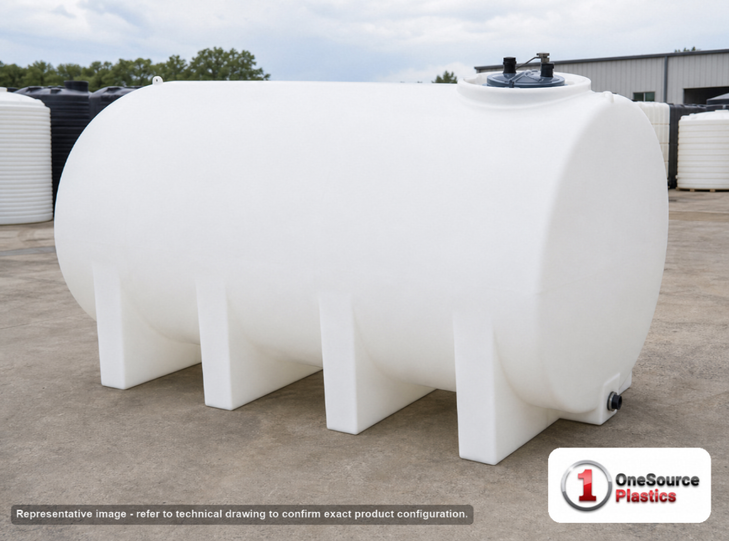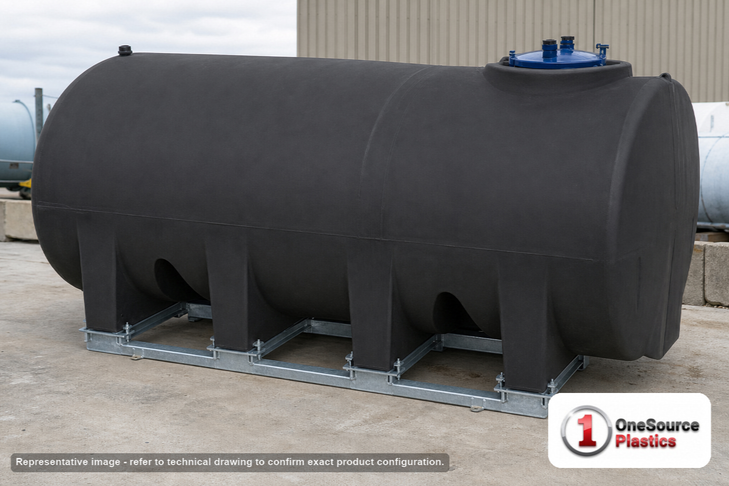
The Enduraplas 2800 Gallon Black Horizontal Sump Bottom Leg Tank is built to haul heavy liquid down the road on its frame. At 2,800 gallons in a 145-inch-long by 97-inch-wide black polyethylene body standing 76 inches tall, this is a high-density transport tank carrying an Enduraplas 1.9 specific gravity rating - the top of the density scale, so it is rated for the heaviest fertilizer blends and chemistries you are likely to haul without stepping up to a different tank.
Will it work for your job?
Plan around real loaded weight, not just gallons. Filled with plain water (SG 1.0), this tank and its contents weigh about 23,352 lb. At its maximum rated contents weight it carries up to 44,369 lb - the figure that matters when you spec a trailer, axles, and tow vehicle for a dense product. The 97 x 145 inch footprint and 76-inch height define the cradle and frame envelope you need on the deck, and the sump-bottom design directs flow toward the outlet for draining. One gap to close before you plumb a transfer pump: we do not have confirmed outlet size, fitting count, or sump-drain dimension on file for this SKU - call 866-418-1777 and we will verify those against the technical drawing before you commit to plumbing. If you are sizing this against your spreader or applicator route, run the numbers through our Tank Sizing Calculator and the Tank Sizing Guide first.
Chemical compatibility
This is a black high-density polyethylene tank carrying a 1.9 specific gravity rating, which covers dense liquids right up to that ceiling. The resin is recorded as HDLPE in our data with one open flag - do not commit this tank to acid service such as hydrochloric, sulfuric, or peracetic acid until you have confirmed HDLPE versus XLPE construction with us in writing at 866-418-1777, because crosslinked and linear polyethylene behave differently with aggressive chemistries. The default fitting/gasket pairing across most of the chart below is PVC with EPDM; the exceptions to watch are DEF and peracetic acid (316 stainless fittings), peracetic acid (Aflas gasket), and hydrochloric, hydrofluoric, hydrogen peroxide, phosphoric, sulfuric, and sodium hypochlorite (Viton gaskets rather than EPDM). With those rules in mind, this tank is rated per the OEM chemical-resistance chart (always concentration- and temperature-specific) for:
Acetic Acid (60%, PP/PVC fittings, EPDM gaskets) - see acetic acid; Aluminum Sulfate (50%, PVC, EPDM) - aluminum sulfate; Calcium Chloride (40%, PVC, EPDM) - calcium chloride; DEF (32.5%, 316SS, EPDM) - DEF; Ethylene Glycol (100%, PVC, EPDM) - ethylene glycol; Ferric Chloride (50%, PVC, EPDM) - ferric chloride; Ferric Sulfate (60%, PVC, EPDM) - ferric sulfate; Ferrous Sulfate (20%, PVC, EPDM) - ferrous sulfate; Hydrochloric Acid (37%, PVC, Viton) - hydrochloric acid; Hydrofluoric Acid (48%, PP/PVC, Viton) - hydrofluoric acid; Hydrofluosilicic Acid (26%, PP/PVC, Viton) - hydrofluosilicic acid; Hydrogen Peroxide (50%, PVC, Viton) - hydrogen peroxide; Magnesium Chloride (30%, PVC, EPDM) - magnesium chloride; Peracetic Acid (30%, 316SS, Aflas) - peracetic acid; Phosphoric Acid (85%, PVC, Viton) - phosphoric acid; Polyaluminum Chloride (PVC, EPDM) - polyaluminum chloride; Potassium Carbonate (50%, PVC, EPDM) - potassium carbonate; Potassium Hydroxide (saturated, PVC, EPDM) - potassium hydroxide; Propylene Glycol (PP/316SS, EPDM) - propylene glycol; Sodium Bisulfate (PVC/PP, EPDM) - sodium bisulfate; Sodium Bisulfite (PVC/PP, EPDM) - sodium bisulfite; Sodium Carbonate (30%, PVC, EPDM) - sodium carbonate; Sodium Hypochlorite (<16.5%, PVC, Viton) - sodium hypochlorite; Sodium Thiosulfate (40%, PVC, EPDM) - sodium thiosulfate; Sulfuric Acid (98%, CPVC, Viton) - sulfuric acid; Urea Solution (50%, PP/PVC, EPDM) - urea solution; Zinc Orthophosphate (PP/316SS, EPDM) - zinc orthophosphate; and Ozonated Water (up to 10 PPM, PVC, EPDM). Match your fitting and gasket material to your chemistry exactly as charted, and start at our full chemical compatibility reference.
The mistake to avoid
The costly error on a 1.9 SG haul tank is loading to gallons instead of weight. Two thousand eight hundred gallons of a dense fertilizer blend or chemical pushes you toward the 44,369 lb maximum rated contents weight - far past the ~23,352 lb of plain water - and that is where trailers, axles, and tow ratings get overrun. Spec the trailer and tow vehicle to the loaded weight of YOUR product, confirm the outlet and sump fittings match your transfer plumbing by phone since those dimensions are not on file, and confirm resin construction in writing before any acid fill. See the technical drawing on this page for the frame and outlet detail.
This Enduraplas horizontal leg tank ships LTL freight from the manufacturing plant in Neche, ND, on a frame that travels well by truck. Because it is a large horizontal leg tank, transport cost depends on your delivery ZIP - get an exact number from our Freight Cost Estimator or call 866-418-1777. For trailer-mounted fertilizer and applicator setups, our guide on applicator and leg tanks for fertilizer and the fertilizer-blend stratification field guide are worth reading before your first load.
Freight and documents
Ships from: Neche, ND. LTL freight is quoted to your ZIP with the freight cost estimator or by phone at 866-418-1777. The listed price is before freight.
Technical drawing (PDF) for Enduraplas THD02800KB.
See this tank
Interactive 3D model with live fill. This tank has an interactive 3D model built to its manufacturer dimensions. Rotate it, and set a fill level to see how much liquid it holds at any height. Open the 3D view on the product photo above. Download the 3D model (GLB).
Ready to order?
Add it to your cart at the top of this page, get LTL freight to your ZIP, request a written quote, or call 866-418-1777. The listed price is before freight.