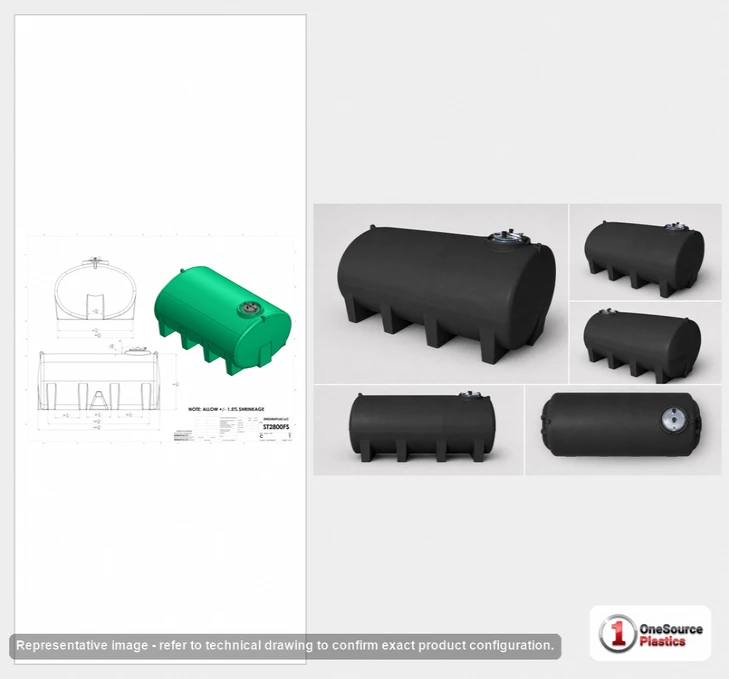
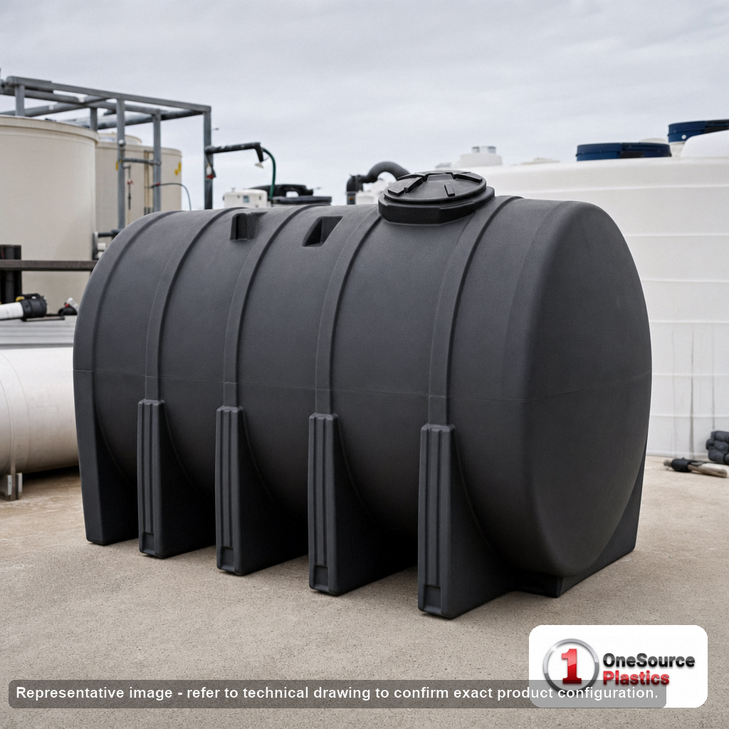
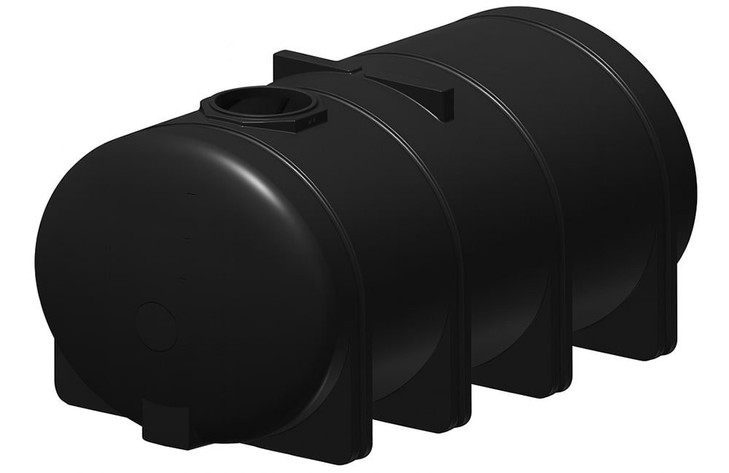
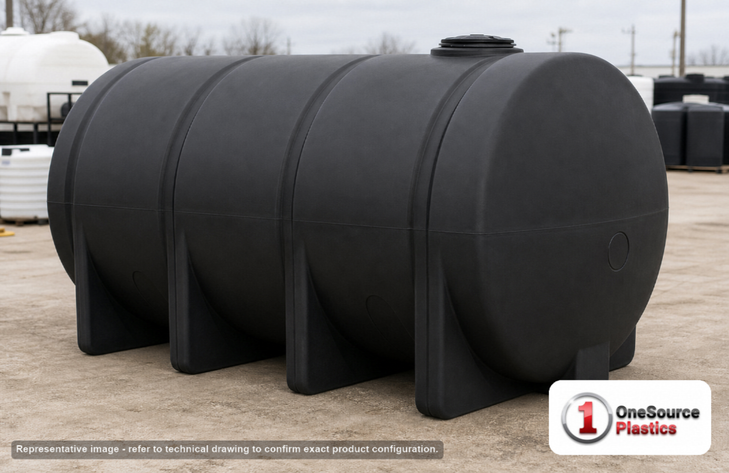
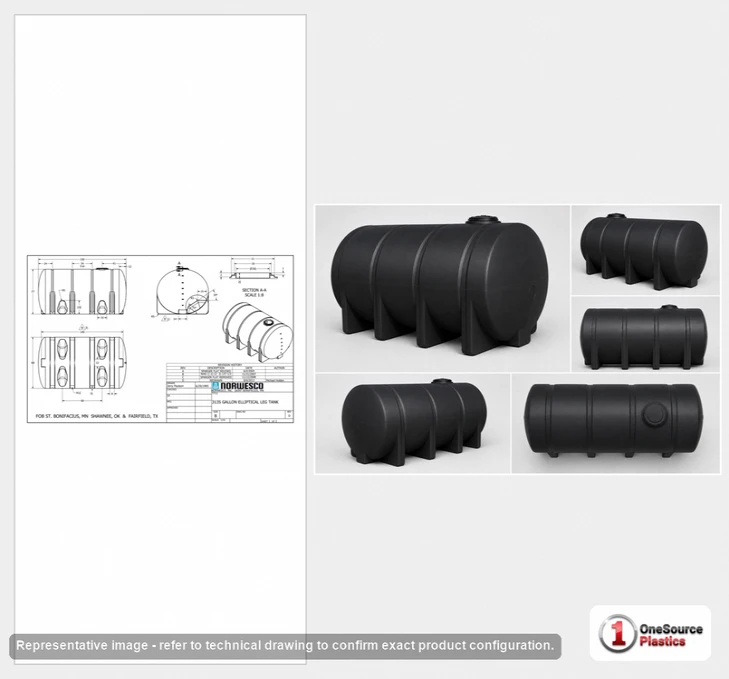
The Enduraplas 3200 Gallon Black Horizontal Leg Tank (SKU THF03200B) is a polyethylene horizontal leg tank built for hauling and field transport, where the leg-tank profile lets the tank cradle into a trailer or skid frame and ride low for stability.It holds 3,200 gallons in a footprint of 97.0 x 145.0 inches and stands 79 inches tall.The black resin blocks UV and sunlight, which keeps light out of the contents during transport and storage.This tank carries a 1.9 specific gravity rating, the top of the poly range, which is what lets it haul dense agricultural blends and heavy chemistries that a standard 1.9 SG tank cannot.One item to settle first: our source data lists the resin as HDLPE with a question mark, so before you put any aggressive chemical in this tank, confirm HDLPE versus XLPE construction with us at 866-418-1777 - the resin grade determines what it can safely hold.
Will it work for your load?
Sizing is the first thing to get right on a transport tank, because what you can legally and safely haul is governed by weight, not gallons.Filled with plain water this tank carries 26,688 pounds.At its full 1.9 specific gravity rating, the maximum rated contents weight is 50,707 pounds - that is the ceiling the tank wall and legs are rated to support.Use those two numbers to plan your trailer, axle ratings, and fill level: a dense liquid like a fertilizer blend, brine, or a high-density acid will hit a weight limit long before the tank is full to 3,200 gallons.Run your liquid and fill volume through the Tank Sizing Calculator and the Tank Sizing Guide to confirm the contents weight stays inside both the tank rating and your trailer's capacity before you load.Check the technical drawing on this page for the leg layout and outlet positions so you can match the tank to your frame and plumbing.
Chemical compatibility
This is an HDLPE-resin tank rated to 1.9 specific gravity (confirm HDLPE versus XLPE with us before any chemical service).The 1.9 rating means it can carry dense chemistries a standard 1.9 SG tank cannot.The compatibility below comes from the OEM chemical-resistance chart, which is specific to concentration and temperature - verify your exact concentration and service temperature against that chart before committing.Two things to decide before you order: gasket family and fitting material.Most listed chemistries run EPDM gaskets, but strong acids and oxidizers - hydrochloric, hydrofluoric, hydrogen peroxide, phosphoric, sodium hypochlorite, and sulfuric - require Viton, and peracetic acid specifically requires Aflas.Likewise, most use PVC or PP fittings, but DEF, peracetic acid, propylene glycol, and zinc orthophosphate call for 316SS rather than plastic - a DEF hauler in particular should not order standard PVC fittings.
Chemicals this tank can handle, with the recommended fitting and gasket materials, include: Acetic Acid (60%, PP/PVC fittings, EPDM gaskets), Aluminum Sulfate (50%, PVC, EPDM), Calcium Chloride (40%, PVC, EPDM), DEF (32.5%, 316SS fittings, EPDM), Ethylene Glycol (100%, PVC, EPDM), Ferric Chloride (50%, PVC, EPDM), Ferric Sulfate (60%, PVC, EPDM), Ferrous Sulfate (20%, PVC, EPDM), Hydrochloric Acid (37%, PVC, Viton), Hydrofluoric Acid (48%, PP/PVC, Viton), Hydrofluosilicic Acid (26%, PP/PVC, Viton), Hydrogen Peroxide (50%, PVC, Viton), Magnesium Chloride (30%, PVC, EPDM), Peracetic Acid (30%, 316SS, Aflas), Phosphoric Acid (85%, PVC, Viton), Polyaluminum Chloride (PVC, EPDM), Potassium Carbonate (50%, PVC, EPDM), Potassium Hydroxide (saturated, PVC, EPDM), Propylene Glycol (PP/316SS, EPDM), Sodium Bisulfate (PVC/PP, EPDM), Sodium Bisulfite (PVC/PP, EPDM), Sodium Carbonate (30%, PVC, EPDM), Sodium Hypochlorite (under 16.5%, PVC, Viton), Sodium Thiosulfate (40%, PVC, EPDM), Sulfuric Acid (98%, CPVC, Viton), Urea Solution (50%, PP/PVC, EPDM), Zinc Orthophosphate (PP/316SS, EPDM), and Ozonated Water (up to 10 PPM, PVC, EPDM).Match the fitting and gasket material to your chemical - the wrong gasket is the most common failure point on a chemical tank.See the full chemical compatibility resource for the complete picture.
The mistake to avoid
The single biggest error on a 1.9 SG transport tank is overfilling by volume.The 50,707-pound rated contents ceiling, not the 3,200-gallon capacity, is the real limit for any dense load - and the denser the chemistry, the sooner you reach it.A high-density acid such as 98% sulfuric hits that weight ceiling well under 3,200 gallons, and a heavy fertilizer blend can exceed both the tank's structural rating and your trailer's axle capacity at the same time if you fill to gallons.If you are running a fertilizer blend, keep the load mixed and watch for stratification; our guide on fertilizer-blend tank stratification walks through the mixing and field-verification steps that catch a stratified load before it runs off-spec.For DOT classification on applicator and leg tanks, see our notes on applicator and leg tanks for fertilizer and on portable utility tanks and the 49 CFR agricultural exemption.
This Enduraplas horizontal leg tank ships LTL freight from the plant in Neche, ND, with freight quoted live to your ZIP.Get your freight rate to your ZIP in seconds with the Freight Cost Estimator, or call 866-418-1777 and we will quote the rate and confirm resin, fittings, and lead time for your application.
Freight and documents
Ships from: Neche, ND. LTL freight is quoted to your ZIP with the freight cost estimator or by phone at 866-418-1777. The listed price is before freight.
See this tank
Interactive 3D model with live fill. This tank has an interactive 3D model built to its manufacturer dimensions. Rotate it, and set a fill level to see how much liquid it holds at any height. Open the 3D view on the product photo above. Download the 3D model (GLB).
Product video. Watch the Enduraplas 3200 Gallon Black Horizontal Leg Tank video (69 seconds) with dimensions, fittings and shipping notes.
Ready to order?
Add it to your cart at the top of this page, get LTL freight to your ZIP, request a written quote, or call 866-418-1777. The listed price is before freight.