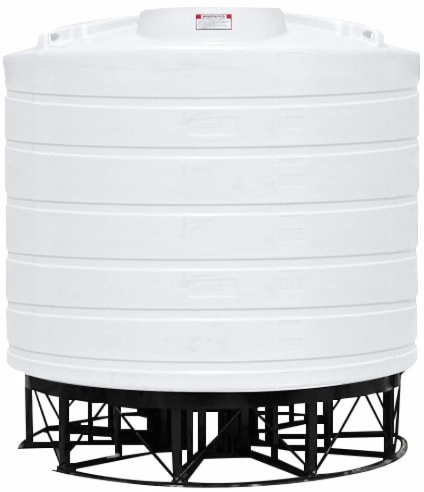
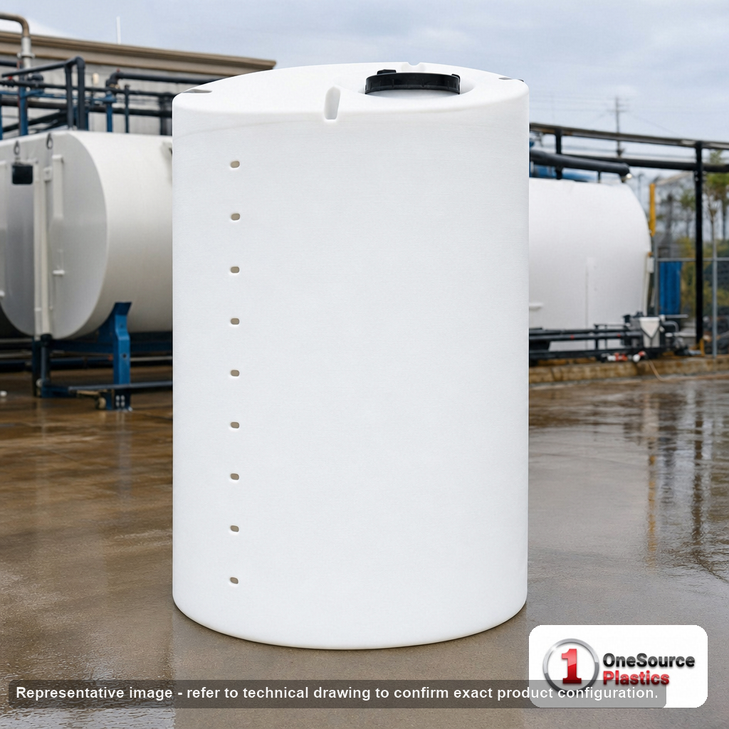
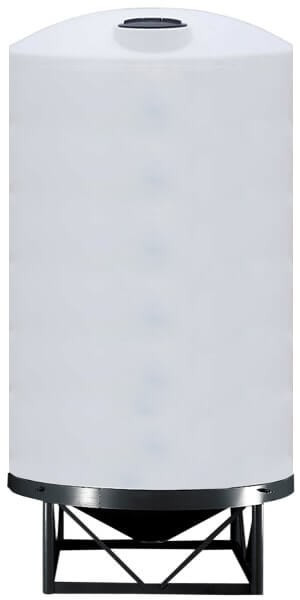
The Enduraplas 6011 Gallon White Cone Bottom Tank is built for full-drain chemical batching and storage where you need every gallon to evacuate through the cone. This is a large-format cone bottom tank molded in natural white polyethylene, rated to a 1.9 specific gravity, with a 6,011 gallon capacity standing 125 inches tall on a 144 x 144 inch footprint. The natural white wall lets you read liquid level and product clarity from outside the tank - useful when you are monitoring a settling chemical or watching a batch separate. Because the contents drain to a center outlet, this geometry is the right pick for slurries, precipitates, and any process where you cannot leave heel volume sitting on a flat floor.
Will this cone bottom tank work for your application?
Start with weight, because at 6,011 gallons the numbers drive your entire install. Filled with water (SG 1.0) the contents alone weigh 50,132 lb, and at the tank's full 1.9 SG rating the maximum rated contents weight is 95,250 lb. A cone bottom tank does not stand on its own - it must sit in an engineered steel stand or be fully supported, and that stand plus your foundation has to carry the loaded weight you actually plan to run. On a 144 x 144 inch (12 ft x 12 ft) footprint, up to ~95,250 lb of contents transfers down through the stand legs, so spec your pad and stand off the max-rated figure on that exact footprint, not the water weight. Confirm those are rated before you size anything else. The 1.9 SG rating is the maximum density rating offered for this geometry - this is the heavy-duty option, with no higher-SG step-up - but the rating is the tank's structural ceiling, not a green light for every fluid at any concentration. Use the Tank Sizing Calculator and our Tank Sizing Guide to match capacity and weight to your space, and review the Cone Bottom Tank Stand Compatibility Matrix for how Enduraplas cone tanks pair with stands. Outlet and fitting sizes are not pre-specified for this tank, so see the technical drawing on this page for fitting locations and cone angle, and confirm outlet size with us before you finalize plumbing.
Chemical compatibility
This tank is molded in polyethylene and rated to 1.9 specific gravity. Before any chemical service, confirm whether your tank is HDLPE or XLPE (cross-linked) with us, because the two resins behave differently with certain chemicals and the choice affects which fluids you can safely store. Compatibility is always concentration- and temperature-specific, so verify your exact conditions against the OEM chemical-resistance chart, and confirm the fitting and gasket materials below for each chemical you plan to run.
Chemicals compatible with this tank at the listed concentrations include acetic acid (60%, PP/PVC fittings, EPDM gaskets), aluminum sulfate (50%, PVC, EPDM), calcium chloride (40%, PVC, EPDM), DEF (32.5%, 316SS fittings, EPDM), ethylene glycol (100%, PVC, EPDM), ferric chloride (50%, PVC, EPDM), ferric sulfate (60%, PVC, EPDM), ferrous sulfate (20%, PVC, EPDM), hydrochloric acid (37%, PVC, Viton), hydrofluoric acid (48%, PP/PVC, Viton), hydrofluosilicic acid (26%, PP/PVC, Viton), hydrogen peroxide (50%, PVC, Viton), magnesium chloride (30%, PVC, EPDM), peracetic acid (30%, 316SS, Aflas), phosphoric acid (85%, PVC, Viton), polyaluminum chloride (PVC, EPDM), potassium carbonate (50%, PVC, EPDM), potassium hydroxide (saturated, PVC, EPDM), propylene glycol (PP/316SS, EPDM), sodium bisulfate (PVC/PP, EPDM), sodium bisulfite (PVC/PP, EPDM), sodium carbonate (30%, PVC, EPDM), sodium hypochlorite (under 16.5%, PVC, Viton), sodium thiosulfate (40%, PVC, EPDM), sulfuric acid (98%, CPVC, Viton), urea solution (50%, PP/PVC, EPDM), zinc orthophosphate (PP/316SS, EPDM), and ozonated water (up to 10 PPM, PVC, EPDM). Note the gasket calls: chlorinated and oxidizing chemicals such as sodium hypochlorite, hydrogen peroxide, and sulfuric acid require Viton, while peracetic acid needs Aflas - using EPDM on those will fail. Browse the full Chemical Compatibility Database for the complete, concentration-specific picture.
The mistake to avoid
The most common error on a 1.9 SG cone tank like this is treating the SG rating as a substitute for resin confirmation and gasket selection. The tank carries the structural load, but the wrong gasket on an oxidizer or acid is what actually leaks - match the gasket (Viton for sulfuric, hydrochloric, and hypochlorite service; EPDM for the salts and glycols; Aflas for peracetic acid) and the fitting material per the chart above, and confirm your HDLPE-versus-XLPE resin with us before committing to a chemical program. Whether you are searching for an Enduraplas cone bottom tank or a white cone tank for a settling process, those two checks separate a clean install from a service call.
This tank ships LTL freight, quoted live to your ZIP, from the nearer of our plants in Converse, TX or Neche, ND - a Gulf or southern ZIP typically sources Converse, TX while a northern-plains ZIP sources Neche, ND, so your estimate depends on which plant serves you. Get an exact number with our Freight Cost Estimator, or call 866-418-1777 to talk through stand pairing, fittings, and the right chemical configuration for your process. For level monitoring on a tank this size, our guide to tank level gauge selection for chemical service walks through radar, ultrasonic, hydrostatic, and magnetostrictive options.
Freight and documents
Ships from: Neche, ND; Converse, TX. LTL freight is quoted to your ZIP with the freight cost estimator or by phone at 866-418-1777. The listed price is before freight.
Technical drawing (PDF) for Enduraplas THC06011W.
See this tank
Interactive 3D model with live fill. This tank has an interactive 3D model built to its manufacturer dimensions. Rotate it, and set a fill level to see how much liquid it holds at any height. Open the 3D view on the product photo above. Download the 3D model (GLB).
Product video. Watch the Enduraplas 6011 Gallon White Cone Bottom Tank video (76 seconds) with dimensions, fittings and shipping notes.
Ready to order?
Add it to your cart at the top of this page, get LTL freight to your ZIP, request a written quote, or call 866-418-1777. The listed price is before freight.