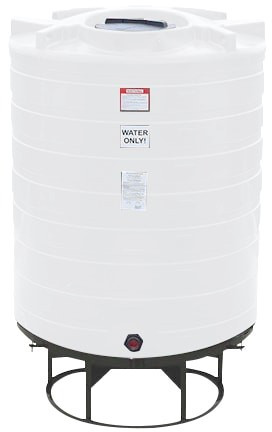
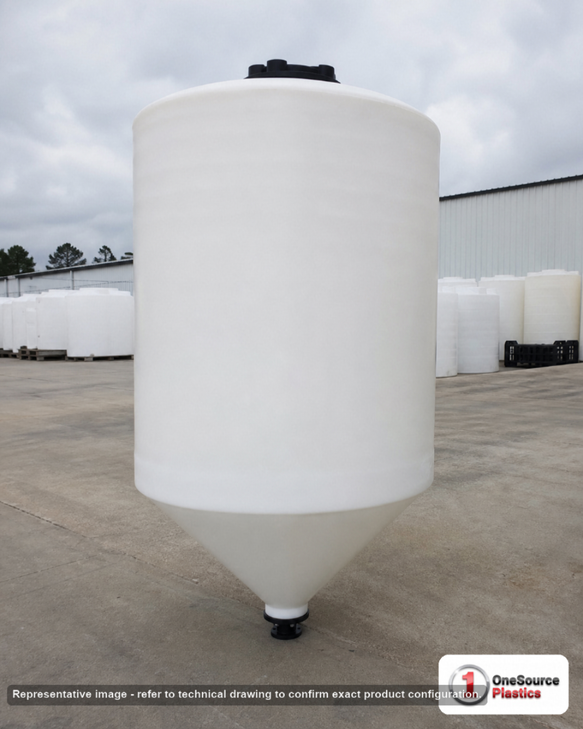
The Enduraplas 870 Gallon Black Cone Bottom Tank is built for operations that need to fully drain viscous or settling chemical batches, with a cone geometry that empties to the outlet instead of trapping product on a flat floor.Molded from black polyethylene at an 870-gallon working capacity, it stands 85 inches tall on a 60 x 60-inch footprint and carries a 1.9 specific gravity rating - the high-density rating that lets it hold dense chemistries that would overstress a standard 1.9 SG tank.If you have been searching for a black cone bottom tank or a cone tank sized for batching, dosing, or full-discharge transfer, this is the size that fits.
Will this cone bottom tank work for my job?
Match the tank to the weight of what you are storing, not just the gallons.Filled with water this tank carries about 7,256 pounds; loaded to its maximum rated 1.9 SG contents it carries roughly 13,786 pounds on that 60 x 60-inch footprint, so the support stand and the slab beneath it have to be engineered for the loaded weight, not the empty shell.A cone bottom tank cannot stand on its own - it requires a matched stand.Use the Tank Sizing Calculator and the Tank Sizing Guide to confirm the volume and weight against your batch, and the Cone Bottom Tank Stand Compatibility Matrix to pair the correct stand for an Enduraplas cone.Specific outlet size and factory fitting configuration are not listed for this SKU - call 866-418-1777 to confirm the molded outlet and any pre-installed fittings, and check the outlet and overall dimensions against the technical drawing on this page.Plan top fittings deliberately, with separate vent, fill, level, and drain paths, using the tank top fitting placement strategy.
Chemical compatibility
This is a 1.9 specific-gravity polyethylene tank.Its resin is recorded as HDLPE?- confirm whether the molded resin is HDLPE or XLPE with us before committing it to chemical service, because the resin determines long-term resistance.At 1.9 SG this is the densest-rated polyethylene class we stock, so no higher-SG upgrade is required for the chemistries listed below.Always size fittings and gaskets to the chemical, and verify every selection against the OEM chemical-resistance chart for your exact concentration and temperature.
Chemicals this tank is rated to handle from our compatibility data include Sulfuric Acid (98%) with CPVC fittings and Viton gaskets, Hydrochloric Acid (37%) with PVC fittings and Viton gaskets, Phosphoric Acid (85%) with PVC and Viton, Hydrofluoric Acid (48%) and Hydrofluosilicic Acid (26%) with PP/PVC fittings and Viton gaskets, Hydrogen Peroxide (50%) with PVC and Viton, and Sodium Hypochlorite (<16.5%) with PVC and Viton.Water-treatment coagulants and salts are well suited to this tank: Ferric Chloride (50%), Ferric Sulfate (60%), Ferrous Sulfate (20%), Aluminum Sulfate (50%), Polyaluminum Chloride, Calcium Chloride (40%), and Magnesium Chloride (30%) all run with PVC fittings and EPDM gaskets.The tank also handles Acetic Acid (60%) (PP/PVC, EPDM), Potassium Hydroxide (saturated), Sodium Carbonate (30%), Potassium Carbonate (50%), Sodium Bisulfate, Sodium Bisulfite, and Sodium Thiosulfate (40%).For fluid and glycol service it accepts DEF (32.5%) on 316SS fittings with EPDM gaskets and Urea Solution (50%) on PP/PVC with EPDM, Ethylene Glycol (100%) (PVC, EPDM) and Propylene Glycol (PP/316SS, EPDM), Zinc Orthophosphate (PP/316SS, EPDM), Peracetic Acid (30%) on 316SS with Aflas gaskets, and Ozonated Water (up to 10 PPM) on PVC with EPDM.Note that gasket material changes by chemical - bleach, peroxide, and the strong acids require Viton, while the coagulant salts use EPDM; do not standardize one gasket across every port.Peracetic acid is the exception that uses neither: it requires Aflas (not Viton) on 316SS fittings, and substituting Viton will fail.DEF runs on 316SS with EPDM and urea on PP/PVC with EPDM - keep both off carbon steel and brass.Browse the full Chemical Compatibility Database to confirm any chemical against concentration and temperature before you commit.
Specify gauges and labels correctly
On an 85-inch cone tank mounted on a stand, level instrumentation and hazard labeling matter.Choose the right level gauge for your chemistry using the level gauge selection guide for chemical service, and place NFPA 704, GHS, and DOT placarding correctly with the tank label and signage compliance guide.The most common and costly mistake on a high-SG tank is under-rating the fittings and gaskets relative to the chemical and concentration - match each to the OEM chart, not to what was on hand.
This tank ships LTL freight from the Enduraplas plant in Neche, ND, quoted live to your ZIP.Get a freight estimate with the Freight Cost Estimator, or call 866-418-1777 to confirm the resin, lock fittings and gaskets to your chemical, and arrange shipment.
Freight and documents
Ships from: Neche, ND. LTL freight is quoted to your ZIP with the freight cost estimator or by phone at 866-418-1777. The listed price is before freight.
Technical drawing (PDF) for Enduraplas THC00870B.
See this tank
Interactive 3D model with live fill. This tank has an interactive 3D model built to its manufacturer dimensions. Rotate it, and set a fill level to see how much liquid it holds at any height. Open the 3D view on the product photo above. Download the 3D model (GLB).
Ready to order?
Add it to your cart at the top of this page, get LTL freight to your ZIP, request a written quote, or call 866-418-1777. The listed price is before freight.