A thousand gallons on the same 86 inch base, 66 inches tall
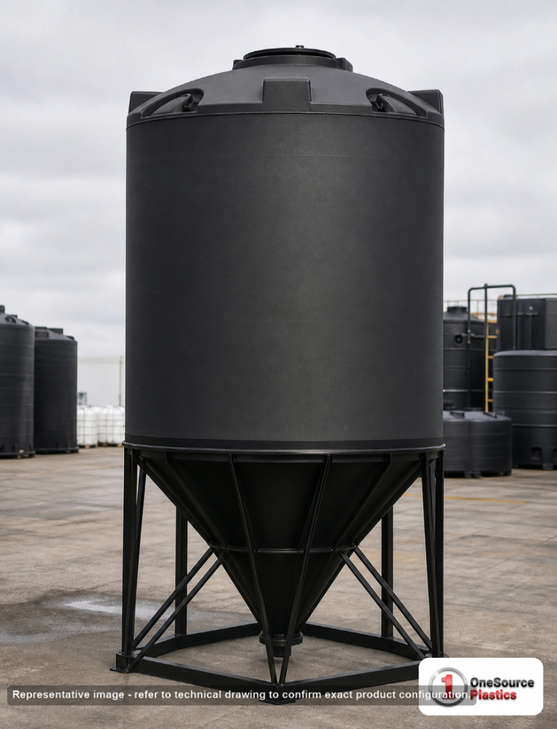
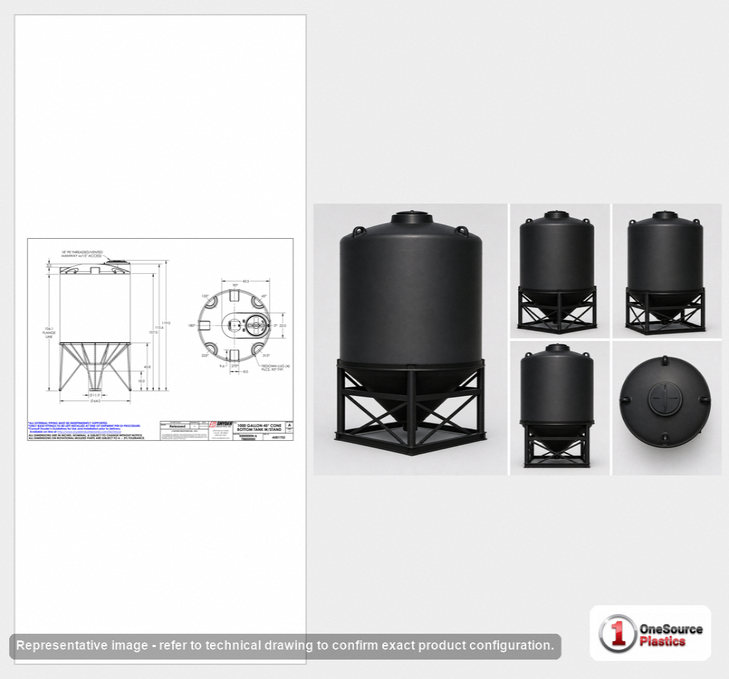
The Snyder 1890000N48 is a 1000 gallon heavy duty cone bottom tank in black crosslinked linear polyethylene, listed 86 inches across and 66 inches tall at 210 pounds empty. It is the short one in this family: a base circle wider than the tank is high, which for a cone is about as low a silhouette as the shape allows. The sheet gives the cone as 30 degrees, rates the wall at a specific gravity of 1.9, and lists 8,340 pounds for 1000 gallons of water at 8.34 pounds per gallon with 15,846 pounds of max contents. The service limit reads 100 F / 37 C. The lid and manway field reads 7 inches, the outlet field reads one manway or lid, and the structural entries give four tiedown lugs and one flange line. That is the whole published fitting picture and this page adds nothing to it. No stand, no warranty term and no certification entry is on this sheet. Freight is class 400 and the shipping size matches the tank at 86 by 86 by 66 inches.
Know your ZIP and your ceiling height? Freight to your ZIP takes seconds, and 866-418-1777 will confirm the height; then add it to your cart above.
Low enough to work under a roof, still carried clear of the floor
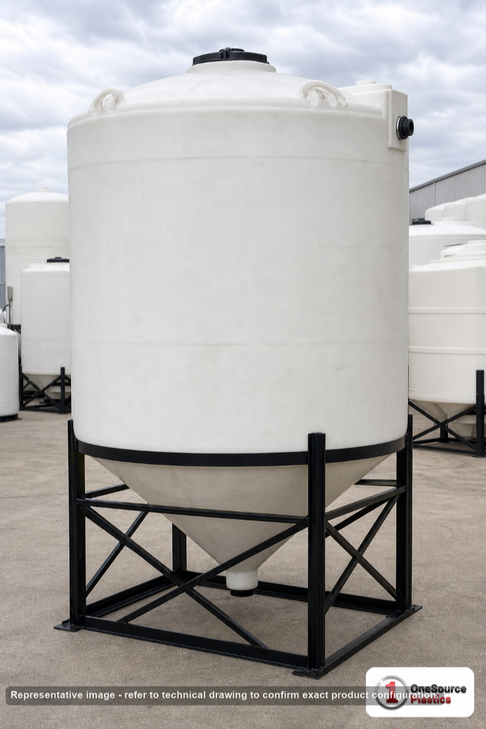
Sixty-six inches is the number that puts this tank where it goes. A cone bottom vessel cannot sit on its own bottom, so whatever building it lands in has to accommodate the tank plus the structure plus the clear space under the discharge, and that total is the figure that has to fit under a roof, a mezzanine or a set of overhead services. Start from the shortest shell that holds the volume you need and the rest of the arrangement gets easier: the manway comes down to a height a person can reach from a short platform, the fill point comes down with it, and the whole assembly sits inside a room with an ordinary eave line instead of asking for a bay. On an 86 inch circle that is exactly what this tank offers, and it is the reason to choose it over the tall 1000 gallon shell listed beside it. What the low shape asks for in return is ground. Every pound arrives through the support into a wide circle of floor, and this sheet gives 8,340 pounds of water and 15,846 pounds at the rating against an empty weight of 210 pounds. That is a concentrated load, and a cone that is out of level does not drain to its point any more, which is the entire reason the shape was bought. Treat the bearing surface as an engineered element: flat, continuous, level, and confirmed with an instrument rather than by eye. This sheet publishes no stand of its own, so the support arrangement is specified separately and before the tank is ordered, not after it is standing in the yard with nowhere to go; the stand compatibility matrix across makers is the honest starting point and we will confirm what suits this part number when you ask. The four tiedown lugs the sheet lists are worth naming here rather than in the fittings section, because they are a siting fact: the tank is listed with a way of being held down, and where a vessel is restrained is decided at the same time as where it stands. Before any of that gets drawn, run 1000 gallons against your real batch and turnover in the tank sizing calculator, and take the freeboard from the tank sizing guide. Where the vessel will stand over a floor, a yard or a drain that would have to be recovered after a release, the containment question is a separate decision from the tank decision, and the Captor containment comparison argues it out properly instead of assuming it away.
One thousand gallons two ways: wide at 66 inches, narrow at 103
| Part | Gallons | Plan x height | Empty weight |
|---|---|---|---|
| 1890000N48 (this tank, black crosslinked, heavy duty) | 1000 | 86 x 86 x 66 in | 210 lb |
| 1890000N42 (crosslinked, heavy duty, same shell) | 1000 | 86 x 86 x 66 in | 210 lb |
| 1890000N51 (heavy duty, same shell) | 1000 | 86 x 86 x 66 in | 210 lb |
| 5000000N42 (same volume, narrow and tall) | 1000 | 64 x 64 x 103 in | 210 lb |
| 6190000N42 (the step down) | 500 | 64 x 64 x 63 in | 120 lb |
| 8310000N42 (the step up, widest) | 1250 | 95 x 95 x 70 in | 300 lb |
The real decision on this sheet is the fourth row against the first three. 5000000N42 holds exactly the same 1000 gallons at exactly the same 210 pounds, but it does it on a 64 inch base standing 103 inches: twenty-two inches narrower and better than three feet taller. That is the whole trade laid out in one line. Take the narrow shell when floor is what you are short of and the roof is free, and accept a taller structure, a longer ladder and a slenderer column. Take this one when the ceiling, the overhead services or the reach of the person opening the lid is the constraint. The first three rows are the same 86 by 66 inch shell at the same weight and the sheet shows no difference between them beyond the part number and the name, so this page invents none. Either side of the group, 6190000N42 is the 500 gallon step down on that same narrow 64 inch base at 63 inches and 120 pounds, which is the tank for a small batching station rather than a bulk one, and 8310000N42 is the 1250 gallon step up on the widest plan in the family, 95 inches across and 70 inches tall at 300 pounds. That last one is the natural upgrade path from this tank: more volume for four inches of height and nine inches of radius, which on a low-ceilinged room is usually an easier change than going taller. The material distinction worth settling alongside the shape is crosslinked against linear polyethylene, and what it really buys on a given chemistry is set out in the crosslinked versus high density polyethylene comparison. Background on how the thousand gallon cone shapes compare in general, including angles other than the one on this sheet, is in the thousand gallon cone bottom buyers guide; read it as background on the family rather than as a description of this tank's own listing.
Need two of them? Request a written quote for the pair with freight to your ZIP, or call 866-418-1777 and we will price the truck once.
A seven inch lid entry, four tiedown lugs and no outlet size published
- The outlet field: this sheet's outlet entry reads one manway or lid, which is an opening count rather than a size. No bore, no bulkhead, no thread and no valve is published for this part, so none is claimed. Give us the line size, the valve and the product and we will confirm what this part number carries before it is ordered.
- The cone and its angle: the sheet gives the cone as 30 degrees. That is a shallow cone, and shallow cones move free-flowing liquid well and hold onto material that packs or settles hard. If your product is the packing kind, say so when you enquire, because the honest answer may be a steeper angle rather than this tank.
- The top opening: the lid and manway field reads 7 inches. Seven inches takes a fill hose, a lance, a dip tube and a strainer basket; it does not take a hand and a forearm, so decide how this vessel is going to be rinsed out before you decide what goes in it.
- Tiedown lugs: the sheet lists four of them. No bolt size, no lug rating and no anchor specification is published, so none is stated; what the lugs tell you is that the restraint arrangement is planned rather than improvised, and the detail is confirmed with the structure.
- Flange line: the sheet lists one. It is recorded here as a published structural entry and nothing further is read into it, because nothing further is published.
- What hangs below: whatever goes on the cone discharge is carried on its own steelwork off the support, not off the tank. A valve and the first run of full pipe are a permanent load, and on a vessel held in the air they pull rather than rest.
- Limits: 100 F / 37 C, a specific gravity rating of 1.9, and no warranty term on this sheet. Ask us and we will get Snyder's current terms in writing.
Tell us the chemistry when you order. On a seven inch opening with no published outlet, the seal at the top and the valve at the bottom are the two things your product actually touches, and both of them are chosen from what is in the tank.
Mixing, settling and the drain-down between products
A thousand gallons over a shallow cone is bought by operations that make a batch, use it and then have to get every last gallon out before the next one: chemical blending and make-up tanks, liquid fertiliser and crop protection mixing at a farm supply, settling and clarifying at a small treatment plant, brewing, distilling and food processing where the vessel is cleaned between runs, plating and metal finishing lines, and laboratory or pilot-scale production where the product changes weekly. The common thread is changeover. A flat floored tank leaves a heel behind every time; a cone sends it to a point and out. The second thing this shape is bought for is reach. At 66 inches of shell the top of the tank stays low even once it is up on a support, so the seven inch opening is something a person can service from a short platform rather than a fixed ladder with a fall arrest plan behind it. On a vessel that gets opened weekly rather than yearly, that difference is the one operators notice. Whatever the duty, check the product you mean to store against the shell in our chemical compatibility database before you commit to the part number.
Compatibility list
Liquids the maker rates this resin for, with concentration limits and the wetted fitting and gasket to specify. Confirm your own concentration and temperature on the chemical page or in the chemical compatibility database before ordering.
- Acetic Acid (60%, PP/PVC fittings, EPDM gaskets)
- Aluminum Sulfate (50%, PVC, EPDM)
- Calcium Chloride (40%, PVC, EPDM)
- DEF (32.5%, 316SS, EPDM)
- Ethylene Glycol (100%, PVC, EPDM)
- Ferric Chloride (50%, PVC, EPDM)
- Ferric Sulfate (60%, PVC, EPDM)
- Ferrous Sulfate (20%, PVC, EPDM)
- Hydrofluosilicic Acid (26%, PP/PVC, Viton)
- Magnesium Chloride (30%, PVC, EPDM)
- Polyaluminum Chloride (PVC, EPDM)
- Potassium Carbonate (50%, PVC, EPDM)
- Potassium Hydroxide (saturated, PVC, EPDM)
- Propylene Glycol (PP/316SS, EPDM)
- Sodium Carbonate (30%, PVC, EPDM)
- Sodium Thiosulfate (40%, PVC, EPDM)
- Urea Solution (50%, PP/PVC, EPDM), and Ozonated Water (up to 10 PPM, PVC, EPDM). Concentration is not specified for Polyaluminum Chloride or Propylene Gl
Lincoln and Chowchilla, two hundred and ten pounds shipped
Freight is class 400 with an LTL ship mode, and the shipping size is listed at 86 inches long by 86 inches wide by 66 inches high at 210 pounds, the same figures the sheet gives for the tank itself. Price the lane to your ZIP with the freight cost estimator; the listed price is before freight. At 210 pounds and seven feet across this is a machine unload rather than a lift, and it is wider than a standard doorway, so measure the route into the building before the delivery date rather than on it. The one instruction that matters most is that the support has to be finished and cured before the tank arrives, because there is nowhere safe to park a cone bottom vessel in the meantime. Set it, restrain it at the lugs, then fill it with clean water and hold the 8,340 pound load while somebody reads the discharge joint, the seven inch opening and the structure underneath in that order. Keep the packaging until the pipework is finished and the first working batch has been through, and write the date it went into service on the shell where the next person will find it. Photograph the outlet fitting from below before the pipe goes on; a slow weep is easier to compare against than to describe.
Freight and documents
Ships from: Chowchilla, CA; Lincoln, NE. LTL freight is quoted to your ZIP with the freight cost estimator or by phone at 866-418-1777. The listed price is before freight.
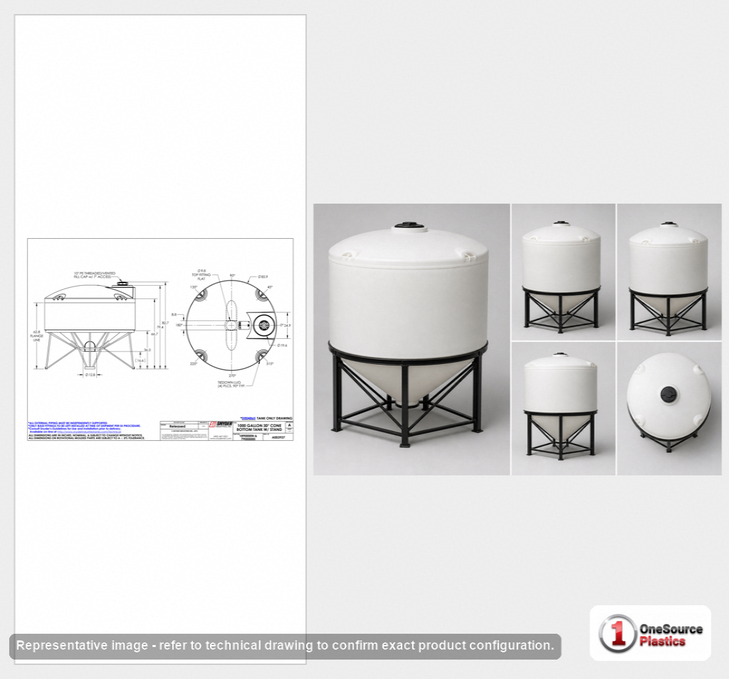
Technical drawing (PDF) for Snyder Industries 1890000N48.
See this tank
Interactive 3D model with live fill. This tank has an interactive 3D model built to its manufacturer dimensions. Rotate it, and set a fill level to see how much liquid it holds at any height. Open the 3D view on the product photo above. Download the 3D model (GLB).
Ready to order?
Add it to your cart at the top of this page, get LTL freight to your ZIP, request a written quote, or call 866-418-1777. The listed price is before freight.