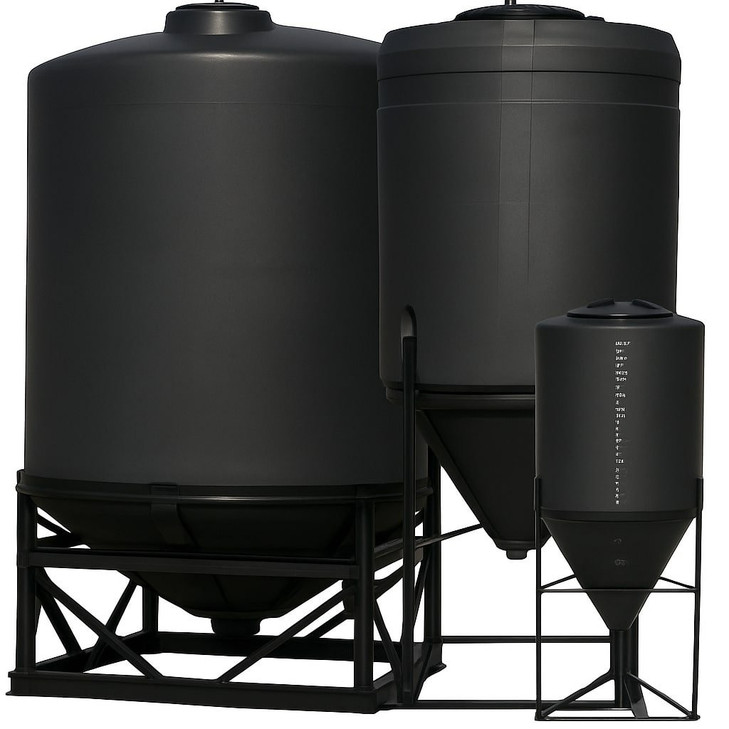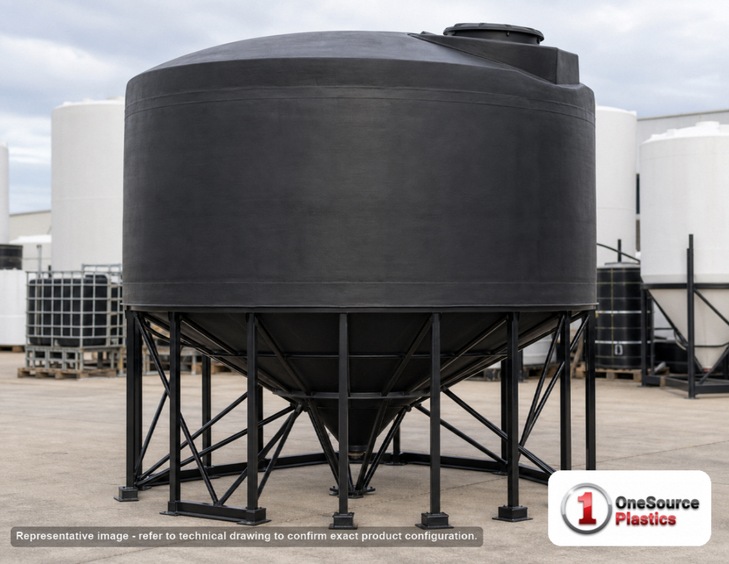
The black twelve fifty at the one point nine rating
The Snyder 8310000N51 is a 1,250 gallon heavy duty cone bottom tank, listed 95 inches long, 95 inches wide and 70 inches tall, at 300 pounds empty and 300 pounds shipping, with the colour given as black and the material field reading Polyethylene. Heavy duty is the maker's own name word, and what the sheet puts behind it are figures rather than description: the wall is rated at a specific gravity of 1.9, and the max contents figure is 19,808 pounds against 10,425 pounds of water at 8.34 pounds per gallon. The opening on top is an 18 inch threaded vented manway. The outlet field reads 1 Manway / Lid, which names an opening rather than a discharge, and no discharge size is published. The service limit is 100 F / 37 C and the freight class reads 400. The sheet gives no cone angle field, no inlet, no stand and no warranty term, and none of the four is claimed on this page.
Have the liquid and the ZIP? That is all 866-418-1777 needs to confirm the fit; or price freight to your ZIP and add it to your cart above.
Same gallons as the white listing, and the step either side
Three questions settle this purchase and the sheet answers all three. The first is colour, because 8310000N45 is the identical shell, the identical 300 pounds and the identical 1.9 rating in natural white. Nothing else separates the two listings, so pick on where the tank lives. Black is the answer outdoors, on a pad, in sun all year, where you would rather no light reached the product and nothing grew in it. White is the answer in a room where an operator wants to read the liquid line from the floor without opening anything. Neither buys or costs a gallon. The second question is the capacity step, and here the sheet is honest about a trade people miss. 1890000N42 holds 1,000 gallons on an 86 inch circle at 66 inches tall and 210 pounds; 1900000N42 holds 1,400 gallons on that same 86 inch circle at 80 inches and 245 pounds. Both sit on a smaller circle than this tank does. So moving up from 1,000 gallons to 1,250 costs you width rather than height, and moving on to 1,400 gets you more product back on the narrower circle by growing upward. If your pad is already poured, your bund walls are already up or your aisle is already fixed at around eighty-six inches, one of those two is very likely the tank that fits and this one is not. What this shell gives you in exchange is the low total: 70 inches of tank plus a stand goes under a structure that a taller vessel cannot approach, and on a site with ground to spare and a fixed ceiling that is the whole argument. The third question is the rating, and it is the same 1.9 across the group: this is a listing for product heavier than water, with 19,808 pounds of max contents, and if your product is not, a lower rated shell is the honest buy. Underneath everything sits the structure, because a cone bottom vessel has no flat floor and cannot stand on its own bottom. This sheet publishes no stand, no legs, no skirt, no support ring and no bolt pattern, so the stand is a separate item with its own lead time, and this page states no stand height, no rated load and no stand material. The loads an engineer needs are published: 300 pounds empty, 10,425 pounds of water, 19,808 pounds at the rating, arriving at stand feet rather than spreading over a slab. Work the support out with the cone bottom tank stand compatibility matrix, size the volume with the tank sizing calculator and take the freeboard from the tank sizing guide.
One shell, four codes, two eighty-six inch neighbours
| Part | Gallons | Length x width x height | Empty weight |
|---|---|---|---|
| 8310000N51 (this tank, black) | 1250 | 95 x 95 x 70 in | 300 lb |
| 8310000N45 (natural white listing) | 1250 | 95 x 95 x 70 in | 300 lb |
| 8310000N42 (XLPE heavy duty listing) | 1250 | 95 x 95 x 70 in | 300 lb |
| 8310000N48 (XLPE heavy duty listing) | 1250 | 95 x 95 x 70 in | 300 lb |
| 1890000N42 (step down, narrower circle) | 1000 | 86 x 86 x 66 in | 210 lb |
| 1900000N42 (step up, narrower and taller) | 1400 | 86 x 86 x 80 in | 245 lb |
Four rows, one set of dimensions. All four of the 1,250 gallon listings are 95 by 95 by 70 inches at 300 pounds, and the sheet separates them by the name it prints and by colour alone. It publishes no other difference and this page invents none. The practical advice inside that group is dull and correct: match whatever an existing installation, a drawing or a spares list already names, because the day somebody has to order a gasket in three years, a matching part number is worth more than any argument about codes. Where there is no precedent, pick the colour that suits the siting. The bottom two rows are the ones that change a layout. Both sit on an 86 inch circle, so both need less pad, less bund and less aisle than this tank, and the 1,400 gallon listing manages more product while doing it, by taking the height to 80 inches. That is the row to look at hardest if your site is tight on the ground, and this one is the row to take if your site is tight overhead. Measure the lowest fixed obstruction in the room, subtract the clearance a person needs above the manway, subtract the stand, and take whichever shell is left standing. One more thing belongs in this comparison and it is not a dimension: a tank that will carry different products over its working life needs labelling that survives an inspection, and the tank label and signage guide works through how the schemes are reconciled on one vessel.
Found the 1250 gallon tank in the table? Freight to your ZIP is one click; add it to your cart above, or call 866-418-1777 to check the grade.
Top access first: the eighteen inch threaded vented manway
- The manway and its vent: 18 inches, threaded and vented, and on this sheet the vent is part of the top fitting rather than a separate specification. On a tank drawn down from the bottom the air path is what stops a pump loading the shell instead of the liquid, so keep it clear, check it every time the lid comes off, and never blank, tape or wrap it to hold in an odour.
- Reaching it: the lid is at 70 inches plus whatever the stand adds under it, which puts it above head height in any real installation. A platform or a fixed ladder and a fall protection routine belong in the same drawing as the structure, and the fill should land at a coupling at working level rather than at the top of the tank.
- Seeing into it: this is a black shell, so nothing about the level is visible from outside. That makes the level instrument part of the fitting plan rather than an accessory, and choosing it late is how people end up with a gauge that reads well in a brochure and badly in the yard.
- The outlet field: it reads 1 Manway / Lid, which names an opening and not a discharge. We print the field exactly as it reads and claim no outlet size, no thread, no bulkhead and no valve. Give us the line size you need to land, the valve type and the product, and we will confirm what this part number carries before anything is ordered.
- The cone angle: no field on this sheet and no angle in the product name, so none is stated here and none is read off a photograph. Ask us if the drainage behaviour of your product is the deciding factor.
- Below the cone: valve, any reducer and the first run of pipe carried on steelwork off the stand, never on the tank, with a flexible connector at the first joint. At full load there are 19,808 pounds of rated contents above that point.
- Inlet, warranty and NMFC: none published on this sheet, none claimed. Ratings are a specific gravity of 1.9, 10,425 pounds of water at 1,250 gallons, 19,808 pounds of max contents, and a service limit of 100 F / 37 C.
Settle the level measurement while the fittings are still on paper rather than after the first season: the level gauge selection guide for chemical service compares radar, ultrasonic, hydrostatic and magnetostrictive on their failure modes rather than on their brochures, which is the comparison that matters on a vessel you cannot see into.
Outdoor duty where sunlight is on the tank all day
A black 1.9 rated cone at 1,250 gallons is an outdoor working tank. It goes into agricultural retail yards holding liquid fertiliser and crop input blends, plating and pickling solution outside a metals shop, polymer and coagulant make-up at a water or wastewater works where the vessel sits on an open pad, mineral and wash plant slurry duty on a site, concentrated brine and salt solution storage, and day-tank service feeding a process from bulk upstream. The colour is part of the specification rather than a finish: black keeps daylight out of the product, which matters for anything that grows or degrades in light, and it is the usual choice for a tank that will never be indoors. The cone is what makes the duty work, because the vessel drains toward one low point rather than leaving a layer on a flat floor at each changeover, and at this capacity that layer is a disposal cost rather than an inconvenience. Check the product in our chemical compatibility reference before any gasket or valve is chosen, because the fitting answer comes from the chemistry and not from the vessel.
Which liquids, at what concentration, with which fitting
Each entry pairs a rated liquid with its concentration limit and the fitting and gasket to order alongside the tank. The full rating sits on the linked page and in the chemical compatibility database before ordering.
- Acetic Acid (60%) - PP/PVC fittings, EPDM gaskets
- Aluminum Sulfate (50%) - PVC fittings, EPDM gaskets
- Calcium Chloride (40%) - PVC fittings, EPDM gaskets
- DEF (32.5%) - 316SS fittings, EPDM gaskets
- Ethylene Glycol (100%) - PVC fittings, EPDM gaskets
- Ferric Chloride (50%) - PVC fittings, EPDM gaskets
- Ferric Sulfate (60%) - PVC fittings, EPDM gaskets
- Ferrous Sulfate (20%) - PVC fittings, EPDM gaskets
- Hydrochloric Acid (37%) - PVC fittings, Viton gaskets
- Hydrofluoric Acid (48%) - PP/PVC fittings, Viton gaskets
- Hydrofluosilicic Acid (26%) - PP/PVC fittings, Viton gaskets
- Hydrogen Peroxide (50%) - PVC fittings, Viton gaskets
- Magnesium Chloride (30%) - PVC fittings, EPDM gaskets
- Peracetic Acid (30%) - 316SS fittings, Aflas gaskets
- Phosphoric Acid (85%) - PVC fittings, Viton gaskets
- Polyaluminum Chloride - PVC fittings, EPDM gaskets
- Potassium Carbonate (50%) - PVC fittings, EPDM gaskets
- Potassium Hydroxide (saturated) - PVC fittings, EPDM gaskets
- Propylene Glycol - PP/316SS fittings, EPDM gaskets
- Sodium Bisulfate - PVC/PP fittings, EPDM gaskets
- Sodium Bisulfite - PVC/PP fittings, EPDM gaskets
- Sodium Carbonate (30%) - PVC fittings, EPDM gaskets
- Sodium Hypochlorite (under 16.5%) - PVC fittings, Viton gaskets
- Sodium Thiosulfate (40%) - PVC fittings, EPDM gaskets
- Sulfuric Acid (98%) - CPVC fittings, Viton gaskets
- Urea Solution (50%) - PP/PVC fittings, EPDM gaskets
- Zinc Orthophosphate - PP/316SS fittings, EPDM gaskets
Seventy inches of shell on an Arkansas lane
Marked Tree, Arkansas is the plant on this sheet, which makes the Delta, the Gulf states and the lower Midwest short lanes and the far West a long one. The freight class reads 400, a numeric class rather than a mode, and no NMFC number is published. The shipping size is 95 inches by 95 inches by 70 inches at 300 pounds, which is light for its bulk: this move is priced by the space it takes on a trailer far more than by what it weighs, and a nearly eight foot width is what governs the gate and the turning circle at your end. Price the lane to your own ZIP with the freight cost estimator; the listed price is before freight. The sheet publishes no crane, rigging, permit or escort detail and none is stated here, so agree the offload equipment and the delivery window with us rather than assuming what is on site will reach it. Set, level and anchor the stand before the trailer arrives so the tank goes straight from the bed onto its structure. Sling under the body, never by the manway, and restrain it as soon as it is upright. Then prove the installation with clean water: hold the 10,425 pound load, walk the manway seal, the cone joint, the stand feet and the pad edge with a torch, and leave it standing full overnight before anything is connected. Paint a mark beside the vent while you are up there, because on a black shell in poor light that is the one opening somebody will cap by mistake. Check the strap tension a week after the first fill; a tank settles a little, and the strap that was tight is loose.
Freight and documents
Ships from: Marked Tree, AR. LTL freight is quoted to your ZIP with the freight cost estimator or by phone at 866-418-1777. The listed price is before freight.
Technical drawing (PDF) for Snyder Industries 8310000N51.
See this tank
Interactive 3D model with live fill. This tank has an interactive 3D model built to its manufacturer dimensions. Rotate it, and set a fill level to see how much liquid it holds at any height. Open the 3D view on the product photo above. Download the 3D model (GLB).
Ready to order?
Add it to your cart at the top of this page, get LTL freight to your ZIP, request a written quote, or call 866-418-1777. The listed price is before freight.