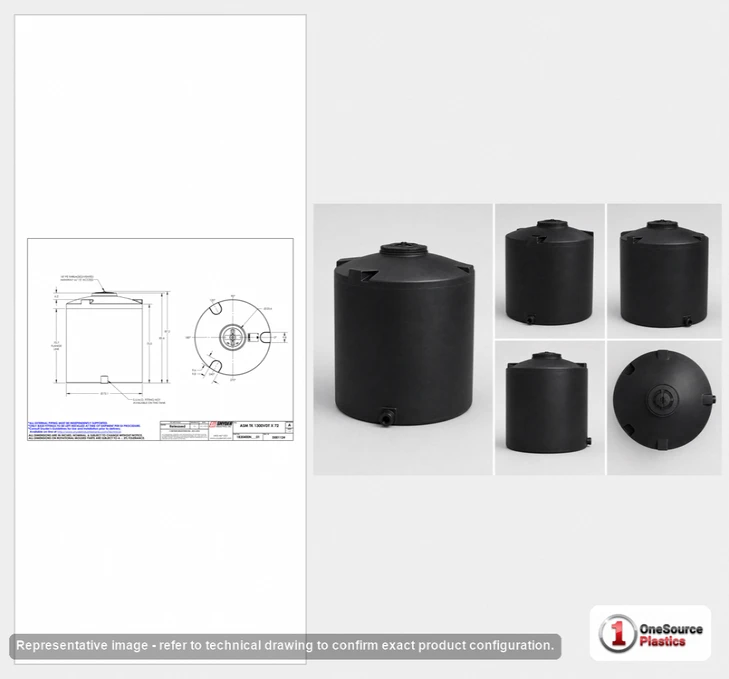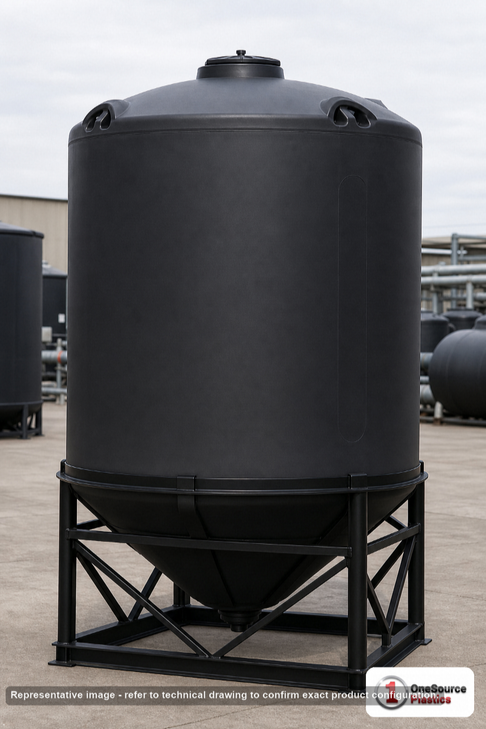
A 1,400 gallon black heavy duty cone bottom tank, 86 inches across
Snyder Industries part number 1900000N48 is the black version of the 1,400 gallon 1900000 heavy duty cone. It is moulded in crosslinked linear polyethylene (XLPE), 86 inches in diameter and 80 inches tall, and weighs 245 lb empty. The wall is rated for liquids up to 1.9 specific gravity, with a service limit of 100 F (37 C). 1,400 gallons of water weighs 11,676 lb (1,400 x 8.34); at the 1.9 rating the contents can reach about 22,184 lb. Black keeps light out of the liquid, and the cone drains to a single point at the bottom.
Outdoor chemical feed or fertilizer blend? Call 866-418-1777 with what you are storing, or get freight to your ZIP and add it to your cart above.
What this tank is for
Choose this tank for a dense liquid that will sit in daylight. The heavy duty wall takes liquids up to nearly twice the weight of water, beyond the 1.5 limit of a standard wall. The black colour stops sunlight from growing algae in water based mixes and from breaking down light sensitive products. Outdoor coagulant feeds, brine tanks and fertilizer blends at farm and treatment sites are the usual jobs, and the cone means each batch drains out completely before the next.
At 80 inches tall, the top stays reachable from a step even on a stand; the 86 inch diameter needs a walkway round it. Black hides the level, so put a gauge on the same order; the level gauge selection guide compares the four common types. Check the specific gravity on your product's data sheet, and read our article on when crosslinking matters for chemical duty.
What to check before you buy
- Openings. No outlet size and no manway size are listed for 1900000N48. Give us the line size, valve and fill method, and we will confirm the openings and gaskets before you order.
- Stand. A separate purchase, matched to the 86 inch diameter and rated for about 22,184 lb of contents; anchor it outdoors. See the cone bottom tank stand compatibility matrix and the drawing linked under Technical Drawing on this page.
- Venting. Keep the tank vented while it drains.
- Liquid. Check it in the chemical compatibility guide. For this tank, buyers most often check ferric sulfate, urea solution, calcium chloride, magnesium chloride and potassium hydroxide.
Other versions and sizes nearby
For a wall you can see through, the natural white 1900000N42 is this tank in white; the heavy duty 1900000N51 is also listed. Smaller is the 1,250 gallon heavy duty cone; larger, the 1,500 gallon heavy duty cone. Our page on the 1,400 gallon 30 degree plastic cone bottom tank covers this size, and the tank sizing calculator checks your volume.
Shipping and receiving
1900000N48 ships by freight at class 400 from Snyder's plant in Chowchilla, California or Lincoln, Nebraska, as an 86 by 86 by 80 inch load at 245 lb. The listed price is before freight; the freight cost estimator gives the cost to your ZIP. Plan the offload with us and have the stand set and anchored. At the tailgate, match the part number to the bill of lading and inspect the shell and the cone. Fill with water first and check for leaks before chemical goes in.
Ready to order? Add it to your cart at the top of this page, get LTL freight to your ZIP, or call 866-418-1777. The listed price is before freight.
Freight and documents
Ships from: Chowchilla, CA; Lincoln, NE. LTL freight is quoted to your ZIP with the freight cost estimator or by phone at 866-418-1777. The listed price is before freight.
Technical drawing (PDF) for Snyder Industries 1900000N48.
See this tank
Interactive 3D model with live fill. This tank has an interactive 3D model built to its manufacturer dimensions. Rotate it, and set a fill level to see how much liquid it holds at any height. Open the 3D view on the product photo above. Download the 3D model (GLB).
Ready to order?
Add it to your cart at the top of this page, get LTL freight to your ZIP, or call 866-418-1777. The listed price is before freight.