


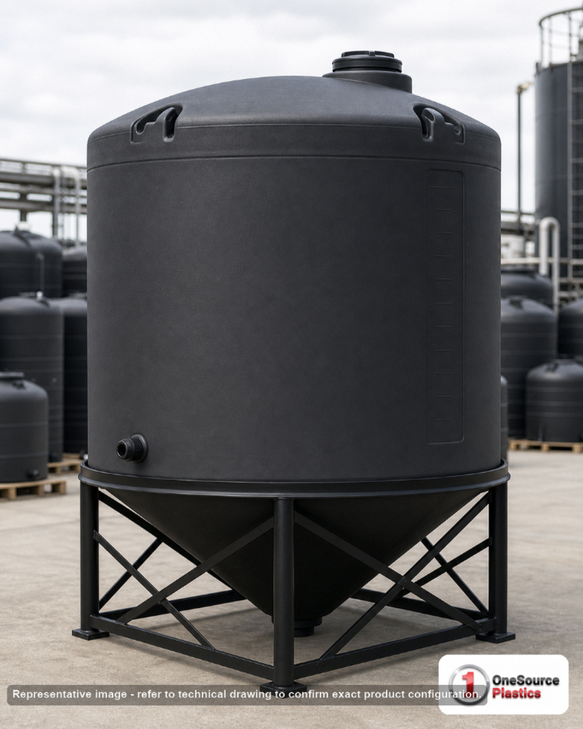
A 1400 gallon black cone bottom tank, 86 inches across and 80 inches tall
Snyder Industries part number 1900000N51 is the 1400 gallon heavy duty cone bottom tank in black high density linear polyethylene: 86 inches in diameter, 80 inches tall and 245 lb empty, made at Snyder's Chowchilla, California and Lincoln, Nebraska plants. The heavy duty wall is rated for liquids up to 1.9 specific gravity, the service limit is 100 F, and Full of water it holds 11,676 lb (1400 gallons x 8.34). The cone bottom sends the whole batch, and whatever has settled out of it, to one drain at the apex. The black wall keeps light out, which protects light sensitive chemicals and stops algae in stored water.
Matching a stand and a valve? Call 866-418-1777 with what you are draining into, or get freight to your ZIP and add it to your cart above.
Why a cone at 1400 gallons
At this size the buyer is usually filling a sprayer, a nurse trailer or a dosing system from the bottom of the tank by gravity, or settling solids out of a liquid and drawing them off. A cone lets the last gallon leave as easily as the first, so a change of product does not start with a tank to scrub, and sludge comes out through the drain rather than building up. The cone needs a stand, and none is listed with this part number. The cone tank and stand compatibility guide explains how stands are matched, and we will confirm which suits 1900000N51. The stand height decides whether a tote, a hose to a trailer or a pump suction fits under the valve, and it adds to the tank's own 80 inches, so measure the ceiling and the fill point too. Under the stand, a flat, level, continuous slab has to carry 11,676 lb of water plus the tank, more for a denser liquid.
What goes in it
Linear polyethylene handles water, most fertilizers and many treatment chemicals, up to 1.9 specific gravity and 100 F here; anything that arrives warm or heats up as it mixes needs a call first. Check the liquid in the chemical compatibility guide; buyers of this size often look up urea solution, calcium chloride, aluminum sulfate and sodium hypochlorite. For containment and labelling of a chemical tank, see the Captor containment comparison and the tank labelling and signage guide. The black wall hides the level; the level gauge selection guide helps you pick one.
What to confirm before you buy
- Openings. No outlet fitting, manway size or cone angle is listed for this part number. Tell us the drain valve and the fill you need and we will confirm what Snyder supplies.
- Stand. Not listed as included; order it with the tank.
- Potable service. Call us for the paperwork if you need it.
- Drawing. Snyder's drawing is linked under Technical Drawing on this page.
Crosslinked versions and nearby sizes
In crosslinked polyethylene, Snyder makes the 1400 gallon XLPE heavy duty cone bottom tank, 1900000N42 and the 1400 gallon XLPE heavy duty cone bottom tank, 1900000N48. Also at this volume: the 1400 gallon 30 degree plastic cone bottom tank. Either side: the 1250 gallon XLPE heavy duty cone and the 1500 gallon XLPE heavy duty cone. The tank sizing calculator and tank sizing guide help size the batch.
Shipping and receiving
The tank ships at freight class 400 from the nearer of Snyder's Chowchilla, California and Lincoln, Nebraska plants, 86 by 86 by 80 inches at 245 lb. Add it to your cart at the top of this page, get LTL freight to your ZIP, or call 866-418-1777. The listed price is before freight. Check 1900000N51 against the bill of lading, look at the cone apex for transit damage, and fill it with water first so any weep shows as water.
Freight and documents
Ships from: Chowchilla, CA; Lincoln, NE. LTL freight is quoted to your ZIP with the freight cost estimator or by phone at 866-418-1777. The listed price is before freight.
Technical drawing (PDF) for Snyder Industries 1900000N51.
See this tank
Interactive 3D model with live fill. This tank has an interactive 3D model built to its manufacturer dimensions. Rotate it, and set a fill level to see how much liquid it holds at any height. Open the 3D view on the product photo above. Download the 3D model (GLB).
Ready to order?
Add it to your cart at the top of this page, get LTL freight to your ZIP, or call 866-418-1777. The listed price is before freight.


