A hundred and fifty gallons, named for sodium hypochlorite
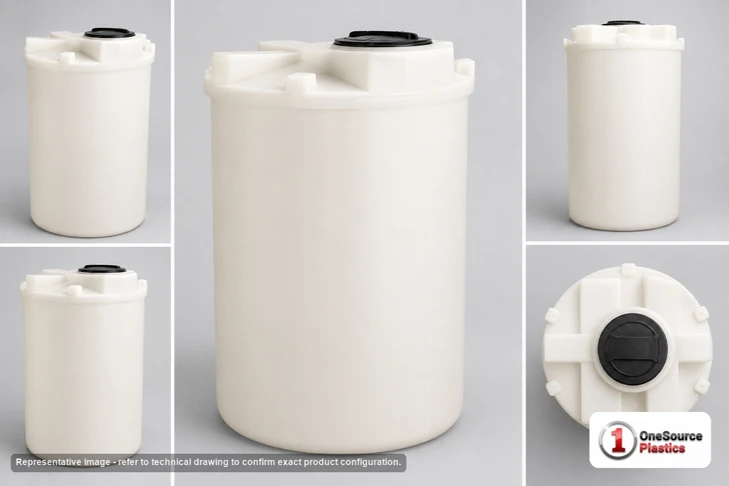
The Snyder 5710102N52 is a 150 gallon double wall tank, named by the maker as a Sodium Hypochlorite (UV) tank. That is the product's name on the sheet and it is repeated here as a name: nothing is claimed from it, with no concentration, no ultraviolet-resistance claim and no temperature figure beyond the sheet's own 120 F / 48 C. The shell is opaque white high density linear polyethylene, listed at 34 inches long by 34 inches wide by 62 inches tall and 110 pounds empty. The sheet publishes one capacity, one set of overall dimensions and one empty weight for the whole assembly; there is no separate inner tank figure, no separate outer figure and no containment percentage on it, so none appears on this page. The wall is rated at a specific gravity of 1.9, and the sheet gives 1,251 pounds for 150 gallons of water at 8.34 pounds per gallon with 2,377 pounds of max contents. The only published opening is a 14 inch threaded vented lid; the outlet field reads "1 Manway / Lid", an opening rather than a pipe size, and the inlet field is blank. The warranty is a 3 Year Warranty. Freight is LTL at class 250, moulded at Marked Tree, Arkansas.
Talk to a person first? 866-418-1777 reaches a tank specialist, not a call center; or see freight to your ZIP and add the 150 gallon tank to your cart above.
One plant, one state, and a hundred and ten pounds on the lane
The lane is short and simple on this part number, and that is worth knowing before anything else. Marked Tree, Arkansas is the only plant this sheet names and Arkansas the only ship-from state, so the mid-South and the lower Mississippi valley are close, the plains and the Southeast are routine, and the far West or Northeast is a move you plan rather than one you assume. The shipping size is 34 by 34 by 62 inches at 110 pounds on an LTL class 250 rating, which is one pallet position and a tail lift on most routes. Price your own ZIP with the freight cost estimator before you compare this against a larger vessel; the listed price is before freight. There is a second reason to look at the lane on this particular tank. At 110 pounds and under three feet square, the delivery genuinely can go to a plant room door rather than a dock, and the tank can be walked into the building on a pallet truck by two people. Sites that buy disinfectant feed equipment are often exactly the sites with no forklift and no loading bay, and that is the practical difference this size makes. Measure the door height on the way in, since five feet standing on the ground is taller again sitting on a pallet. Once it is inside, the ground under it is the thing to get right. Flat, continuous and level under the whole 34 inch footprint, no rails, no shim at a corner, nothing left on a timber pallet; above that base sits 1,251 pounds of water and 2,377 pounds at the published 1.9 rating, concentrated on under eight square feet. The framework for that surface and the point where a general recommendation stops are in the concrete pad sizing guide for above-ground polyethylene tanks. Two sizing questions belong before the order, and both have real answers. The usable volume and the actual headspace on a contained tank are not the nameplate number, which the double wall freeboard sizing guide works through on thermal expansion, chemistry and density. Then put your consumption and delivery quantity through the tank sizing calculator and take the freeboard discipline from the tank sizing guide. Where containment is being bought for a regulatory reason, the double wall compliance walkthrough takes the requirements in order rather than asserting that any product satisfies them.
The 62 inch shell and its four names
| Part | Name on the sheet | Gallons | Size and weight |
|---|---|---|---|
| 5710102N52 | this tank, Sodium Hypochlorite (UV) | 150 | 34 x 34 x 62 in, 110 lb |
| 5710102N30 | Sulfuric Acid | 150 | 34 x 34 x 62 in, 110 lb |
| 5710102N42 | ASTM XLPE | 150 | 34 x 34 x 62 in, 110 lb |
| 5710102N45 | ASTM HDPE | 150 | 34 x 34 x 62 in, 110 lb |
| 5700102N42 | ASTM XLPE, shorter on the same plan | 120 | 34 x 34 x 51 in, 100 lb |
| 5990502N42 | ASTM XLPE, taller on the same plan | 250 | 34 x 34 x 83 in, 150 lb |
Four part numbers, one shell, four names. Every published dimension and weight in the top four rows is identical, and what the sheet varies is the maker's name for the product and its material field. This page cites only the material field printed against this part number and only this sheet's own service limit; the tank listed beside it in the same shell carries its own, and we never borrow one page's figure onto another. That discipline matters more here than anywhere else in the range, because these are the listings people most often try to choose between from a table, and the table does not contain the answer. Tell us what is going in it and at what strength, and we will name the part number. What the table does tell you, usefully, is that this family scales in one direction only. All three capacities sit on the identical 34 inch plan and buy volume with height alone: 51 inches for 120 gallons at 100 pounds, 62 inches for this 150 at 110 pounds, 83 inches for 250 at 150 pounds. So you can revise the volume without re-planning the floor, the bay, the doorway or the route, and the constraint that decides the choice is the ceiling, the fill arrangement or how far an operator can reach. At just over five feet this one is the tallest of the three whose lid most people still reach standing on the floor. That, rather than the gallon figure, is why it is the size most sites settle on.
Neighboring size a better fit? Every row links to its own page; freight to your ZIP is quoted on each, or call 866-418-1777.
Loading and venting through one 14 inch lid
- The fill opening: a 14 inch threaded vented lid is the only opening this sheet publishes, and it sits at 62 inches. It is the fill point, the inspection point and the cleaning access all at once, so everything you want on top has to share it. Plan the fill arrangement before the tank is set.
- Reaching it: just over five feet puts the lid within reach from the floor for most people, which on a vessel that is opened for inspection on a schedule is a daily convenience rather than a detail.
- The vent: the lid is listed as vented, and that path is the wall's protection while a delivery pushes air out and while a pump draws the level down. Keep it clear, look at it whenever the lid is off, and never blank it.
- The outlet: the outlet field reads "1 Manway / Lid", which names an opening and not a pipe size, and the inlet field is blank. This sheet publishes no outlet dimension, no thread, no flange and no valve, so none is claimed. With the lid as the only published route in or out, the usual arrangement at this size is a suction line and strainer dropped through it to a metering pump alongside; tell us the duty and we will confirm what this part number carries.
- Pump detail: keep the suction short and the pump close, set the strainer clear of the bottom so the last settled inch is not the first thing it picks up, and support the hose off a frame rather than off the lid rim.
- The space between the walls: no monitoring port, gauge or alarm is published; that arrangement is specified separately.
- Structure: the sheet publishes no lifting lugs, no ladder lugs and no flange lines.
- Limits: 120 F / 48 C, a specific gravity rating of 1.9, and a 3 Year Warranty.
Tell us the product when you order. On a tank this size the lid seal and the suction fitting are most of the wetted system, and letting either go generic is the mistake that costs money.
Disinfection rooms at small works
A hundred and fifty contained gallons is the working quantity for a dosing point rather than a bulk store: a disinfection room at a small or package water works, a wastewater treatment skid, a pool and aquatics plant room, a food, beverage or dairy sanitising station, a cooling tower or boiler house chemical point, a laundry or vehicle wash, and any indoor feed point standing on a floor where a release would have to be recovered. It is also a common step up from carrying drums by hand: 150 gallons is enough to take a hose delivery and small enough to sit in a corner of a room that has no space for a bund. Two habits go with it. Keep the area around the base clear so the whole shell can be walked round and seen, and inspect the space between the walls on a fixed schedule with the date written down. The only thing a second barrier gives you that a single wall does not is evidence, and evidence has to be recorded to exist.
One pallet position out of Arkansas
Marked Tree, Arkansas is the plant and Arkansas the only ship-from state on this sheet. Freight is LTL at class 250 with no NMFC number, and the shipping size is given at 34 by 34 by 62 inches at 110 pounds. Price your lane with the freight cost estimator; the listed price is before freight. One pallet, a tail lift and a pallet truck covers most deliveries, which is exactly the point of buying containment at this size instead of building it. Take it under the base, never by the lid, and keep it upright through the building. Set it on the finished, level surface in its final position before anything is connected, then fill it with clean water and hold the 1,251 pound load while you read the lid seal and the base all the way round in good light. Drain it, let it dry, open the space between the walls, look into it and write the date on the shell. Label the tank with its contents in paint marker the same day the water comes out, and write the part number beside it. An unlabelled vessel in a plant room is the one that eventually gets topped up with something it was never meant to hold, and the label costs nothing. Once it is full and holding, leave it alone for a day before the plumbing goes on; a settled tank is a quiet one.
Freight and documents
Ships from: Marked Tree, AR. LTL freight is quoted to your ZIP with the freight cost estimator or by phone at 866-418-1777. The listed price is before freight.
Technical drawing (PDF) for Snyder Industries 5710102N52.
See this tank
Interactive 3D model with live fill. This tank has an interactive 3D model built to its manufacturer dimensions. Rotate it, and set a fill level to see how much liquid it holds at any height. Open the 3D view on the product photo above. Download the 3D model (GLB).
Ready to order?
Add it to your cart at the top of this page, get LTL freight to your ZIP, request a written quote, or call 866-418-1777. The listed price is before freight.