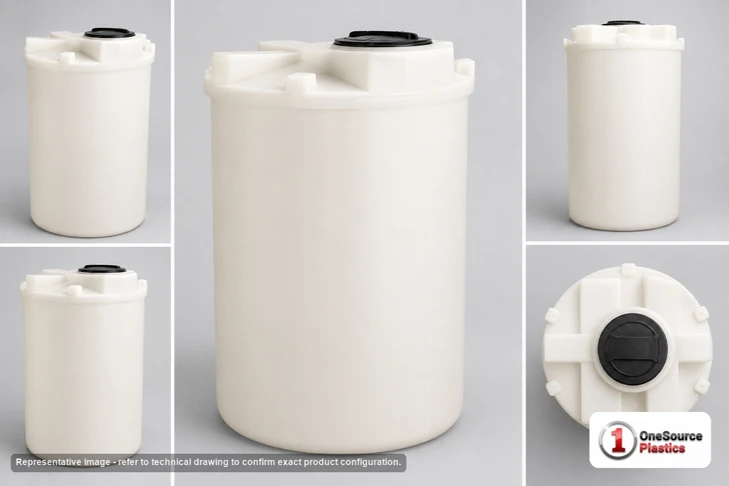
A hundred and fifty gallons in a black double wall
The Snyder 5710102N48 is a 150 gallon double wall tank, listed on its sheet as ASTM XLPE Black, molded in black cross-linked linear polyethylene at 34 inches long by 34 inches wide by 62 inches tall and 110 pounds empty. Those words in the name are the maker's name for the product and nothing further is claimed from them. The sheet publishes one capacity, one set of overall dimensions, one weight and one rating for the whole assembly: no separate inner tank figure, no separate outer figure, no annulus dimension and no containment percentage appear on it, so none appears here. The wall is rated at a specific gravity of 1.9, and the sheet gives 1,251 pounds for 150 gallons of water at 8.34 pounds per gallon with 2,377 pounds of max contents. The only opening is a 14 inch threaded vented lid, and the outlet field reads 1 Manway / Lid, which names an opening and not a pipe size. The service limit is 120 F / 48 C and the warranty is listed as a 3 Year Warranty. Freight is LTL at class 250 with no NMFC number listed, out of Marked Tree, Arkansas.
Replacing a tank that failed? Call 866-418-1777 with what it held and how long it lasted; or check freight to your ZIP and put the 150 gallon tank in your cart above.
Marked Tree, Arkansas, and what the lane costs
On a small shipped double wall the freight lane is a larger share of what it costs to get the tank on site than most buyers expect, so start there. Marked Tree, Arkansas is the only plant on this sheet and Arkansas the only ship-from state, which puts the mid-South, the lower Mississippi valley and the eastern plains on a short lane and makes the coasts a planned move. Price your own lane with the freight cost estimator before you compare this size against a larger vessel, because at 110 pounds and one pallet position the difference between two capacities is often smaller than the difference between two ZIP codes. The shape is what keeps that lane simple. Thirty-four inches square is under three feet each way, so the shipment takes a single pallet position and needs no special arrangement on the trailer, and at 62 inches it stands a shade over five feet, which clears a 96 inch ceiling with room to spare and passes under most overhead runs. What it will not do is pass a standard 36 inch doorway without care: three feet of shipment through a three foot door is a measured job rather than a casual one, so check the narrowest point on the route rather than the entrance, and remember that a five foot tank on a pallet stands taller than a five foot tank on the floor. Class 250 at 110 pounds is the useful part. A tail lift covers most deliveries, a pallet truck moves it inside, and two people set it in place without hiring equipment, which is rarely true of a contained vessel holding this much. Where it lands still needs a flat, continuous and level surface carrying the whole footprint, not two rails and not a shim at one corner, because above that base sits 1,251 pounds of water at 8.34 pounds per gallon and 2,377 pounds at the published 1.9 rating. Five feet of height on a three foot plan is a stable proportion indoors, but keep it out of a busy walkway all the same. Before you settle on 150 gallons rather than the size above or below, run your consumption and delivery quantity through the tank sizing calculator and take the freeboard discipline from the tank sizing guide. At this scale the question that decides the size is how often a delivery can reasonably come, not how much floor is free.
Three more 150s, a 120 and a 250
| Part | Gallons | Length x width x height | Empty weight |
|---|---|---|---|
| 5710102N48 (this tank, named ASTM XLPE Black) | 150 | 34 x 34 x 62 in | 110 lb |
| 5710102N30 (named sulfuric acid) | 150 | 34 x 34 x 62 in | 110 lb |
| 5710102N42 (named ASTM XLPE) | 150 | 34 x 34 x 62 in | 110 lb |
| 5710102N45 (named ASTM HDPE) | 150 | 34 x 34 x 62 in | 110 lb |
| 5700102N42 (smaller, same plan, named ASTM XLPE) | 120 | 34 x 34 x 51 in | 100 lb |
| 5990502N42 (larger, same plan, named ASTM XLPE) | 250 | 34 x 34 x 83 in | 150 lb |
Four of these six hold 150 gallons on the identical 34 by 34 by 62 inch shell at the identical 110 pounds, and what separates them is the name and the color the maker assigns each one. The sheet explains nothing about what those names imply and this page will not invent an explanation, because a name is not a specification and guessing at one is how the wrong tank ends up in a plant room. Tell us the chemistry and the duty and we will point you at the part number. Colour is the one visible difference: this black shell keeps daylight off the contents, while a natural one lets an operator read the level through the wall in a lit room, and on a tank with no published gauge that is worth thinking about. The other two rows show how cleanly this family scales, because all three capacities sit on exactly the same 34 inch square plan and the volume is bought entirely with height: 51 inches for 120 gallons at 100 pounds, 62 inches here for 150, and 83 inches for 250 gallons at 150 pounds. That is unusually convenient. You can change your mind about volume without re-planning the floor, the bay or the bund, and the constraint that decides the choice is almost always the ceiling or the fill point. It also means the tall one carries its volume high, with a lid close to seven feet up and a step no longer optional. This 150 sits in the middle at just over five feet: the largest of the three that most people can still reach the lid of standing on the floor, which is exactly why it is the one that sells.
Want the certified one or the plain one? Call 866-418-1777 and say what the inspector asks for; or request a quote on the row you need.
Filling through a 14 inch threaded vented lid
- The fill opening: a 14 inch threaded vented lid is the only opening this sheet publishes. Fourteen inches takes a delivery coupling, a fill hose, a drop pipe and a rinse lance, and at 62 inches off the floor it is reachable without a platform for most people. That combination is the single most practical thing about this size.
- The vent: the lid is listed as vented, and that path is what keeps the wall out of trouble while a pump draws the tank down or a delivery fills it. Keep it clear, look at it whenever the lid comes off, and never restrict it to control an odour.
- The outlet: the outlet field reads 1 Manway / Lid, which names an opening and not a pipe size, and no inlet, thread, flange or valve appears anywhere on this sheet. Nothing further is claimed. Tell us the duty and the line size you need and we will confirm what this part number actually carries before a pump is specified.
- Pump arrangement: with the published route in and out at the top, the common arrangement at this size is a suction line and strainer dropped through the lid to a metering pump nearby. Keep the suction short, set the strainer clear of the bottom, and support the hose off its own bracket rather than off the lid rim.
- The space between the walls: no monitoring port, gauge or alarm is published, and no stand, legs or level device either. How that space is watched and recorded is specified separately, and it is worth doing, because the whole value of a second barrier is knowing it is still empty.
- Limits: 120 F / 48 C, a specific gravity rating of 1.9, and a 3 Year Warranty. That is the whole of what this sheet publishes about service.
Name the product when you order. The lid seal, any fitting we add and the pump arrangement are chosen against that chemistry, and on a contained tank the fitting is the one part of the system a second wall does not protect you from.
Disinfection and dosing rooms indoors
A hundred and fifty gallons with containment built in is a point of use size rather than a bulk one: a disinfection or dosing room at a small water or wastewater works, a treatment skid in a food, beverage or dairy plant, a boiler house or cooling tower chemical station, a pool and aquatics plant room, a laundry or vehicle wash, a plating shop, and laboratory or pilot scale work standing on a finished floor. What those rooms share is that they are too small for a built bund and the floor is somewhere a release would be expensive. One item, one footprint, nothing to pour.
Three pieces of reading are worth the time before the order. The usable volume and the real headspace are not the nameplate figure once thermal expansion, chemistry and density are accounted for, which is what the double wall freeboard sizing guide works through. A polyethylene wall's hardest service is at the vapor line rather than under the liquid, and the wall thickness at the vapor saturated headspace guide explains why an inspection from the liquid side misses it. And where the question is how the space between two walls gets tested, the cathodic disbondment testing guide for double wall interstitial spaces sets out that methodology and where the polyethylene boundary lies. Where your site is instead planning private fire water storage, that is a different duty on a different scale and the fire water reservoir design guide for rural and remote sites is the place to start; nothing on this page is a claim about that use.
A hundred and ten pounds at class 250
Marked Tree, Arkansas is the plant, Arkansas the only ship-from state, and freight is LTL at class 250 with no NMFC number. The shipping size is given at 34 by 34 by 62 inches at 110 pounds. Price the lane to your ZIP with the freight cost estimator; the listed price is before freight. One pallet position and a tail lift covers most deliveries, so no crane and no dock appointment, but check the door height on the route before the truck is booked. Take it under the base with a pallet truck or forks, never by the lid. Set it in its final position on the finished, level surface before anything is plumbed in, then fill it with clean water and hold that 1,251 pound load while you read the lid seal and the base all the way round. Drain it, let it dry, and open the space between the walls to look at it before the working product ever arrives; record the date on the tank. That first look is the baseline every later inspection is compared against, and a tank that never had one is a tank nobody can prove anything about. Keep one spare gasket for the outlet fitting on the shelf; it is the part that fails on a holiday.
Freight and documents
Ships from: Marked Tree, AR. LTL freight is quoted to your ZIP with the freight cost estimator or by phone at 866-418-1777. The listed price is before freight.
Technical drawing (PDF) for Snyder Industries 5710102N48.
See this tank
Interactive 3D model with live fill. This tank has an interactive 3D model built to its manufacturer dimensions. Rotate it, and set a fill level to see how much liquid it holds at any height. Open the 3D view on the product photo above. Download the 3D model (GLB).
Ready to order?
Add it to your cart at the top of this page, get LTL freight to your ZIP, request a written quote, or call 866-418-1777. The listed price is before freight.