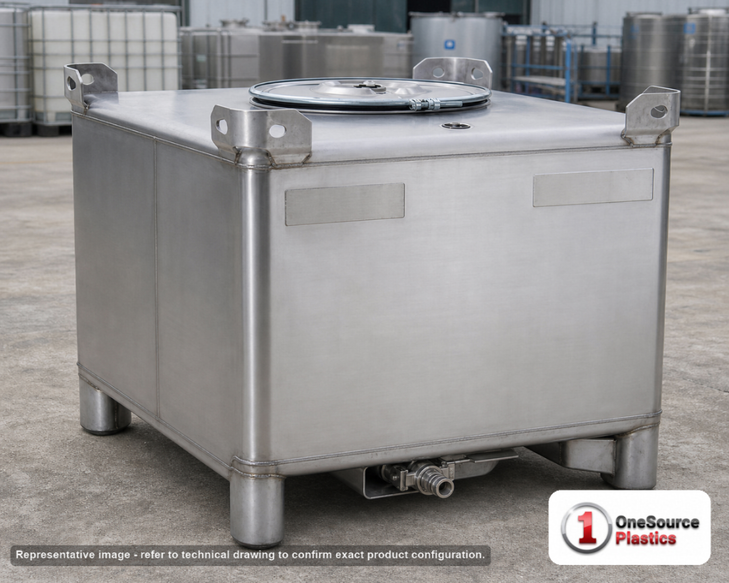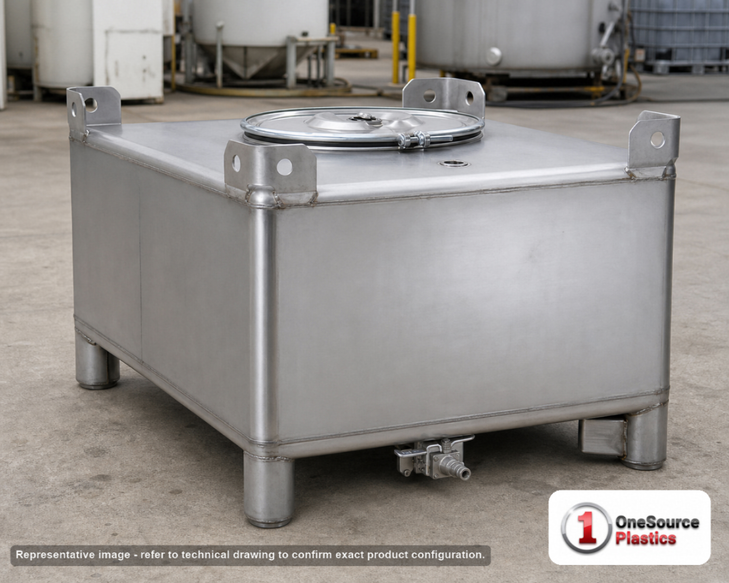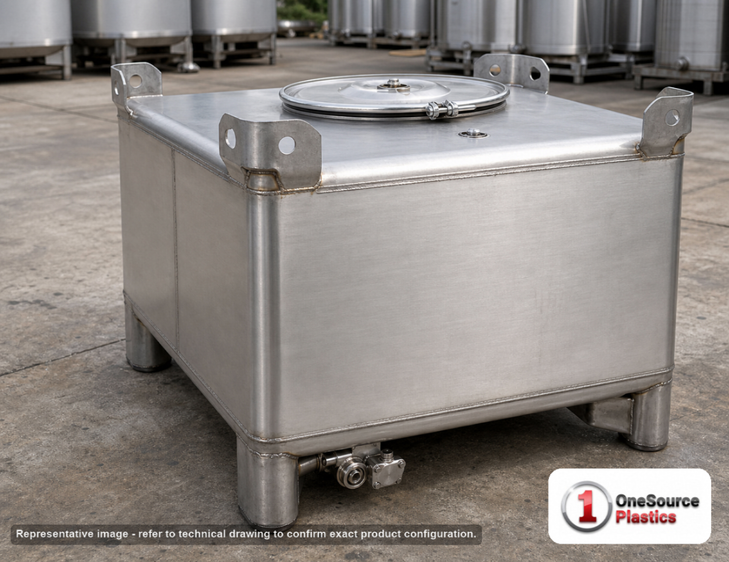
A hundred and sixty five gallons of 304, 26 inches tall
The Snyder 6984000B51319 is a 165 gallon 304 stainless steel Supertainer IBC tote tank in silver, 42 inches long, 48 inches wide and 26.25 inches tall, and 326 pounds empty. It is the shortest of the mid-size Supertainers on its own sheet, and that dimension is the reason to choose it. The sheet gives 1,376 pounds for 165 gallons of water at 8.34 pounds per gallon and publishes no other load figure; there is no specific gravity rating, no maximum operating temperature and no warranty term on it, so none is stated here. The vessel is steel throughout and carries no plastic, resin or wall-rating wording. Its published fittings are a 2 inch access port at the inlet, a 2 inch 316 stainless ball valve at the outlet and a 22 inch vented manway on top; no drain, no sump, no gauge, no sight glass and no stacking, lifting, pressure or transport rating appears on the sheet. Freight class 125, LTL, shipping from Michigan.
Have the liquid and the ZIP? That is all 866-418-1777 needs to confirm the fit; or price freight to your ZIP and add it to your cart above.
The duty that buys a short tote and builds the process around it
Think about who deliberately chooses a vessel this shallow. It is rarely someone short of volume and almost always someone short of height, reach or lifting capacity. Three duties recur. The first is manual make-up: an operator adds material by hand, mixes, checks and draws off, and every one of those actions is easier over a rim 26.25 inches off the floor than over one at chest height. The second is a fixed charge point, where the tote has to slide under a fill head, a hopper outlet, a hose reel or a conveyor that was set at a height nobody is going to change. The third is transport in a vehicle rather than on a truck deck, where the load has to sit below a sight line or under a canopy. All three are jobs where getting the height wrong makes the vessel useless no matter how good it is. The volume is a real 165 gallons and worth sizing honestly rather than accepting: run your batch quantity and your consumption rate through the tank sizing calculator, and take the freeboard from the tank sizing guide, because a shallow vessel carried by a fork is the easiest of all to spill from if it is filled to the rim. Then check the weight against what will actually move it. Three hundred and twenty six pounds empty makes this the lightest steel tote on its own sheet, and 1,376 pounds full of water is the load that goes through a floor, a rack, a scale or a vehicle deck. Neither figure is a guess on our part; both are on the sheet. Where the tote will feed a metering pump rather than a gravity transfer, lay the installation out with the pump skid design guide, which matters more than usual here because a short vessel gives a pump very little to work with. If the choice between drums, totes and a fixed tank has not really been made on your site, the container against tank guide is where to make it.
Two 165s, a 120 and a 180 on one footprint
| Part | Gallons | Height | Empty weight | Full of water |
|---|---|---|---|---|
| 6984000B51319 (this tote) | 165 | 26.25 in | 326 lb | 1,376 lb |
| 6984000B51306 (identical figures) | 165 | 26.25 in | 326 lb | not given on this sheet |
| 6984000B51305 (smaller and shorter) | 120 | 23.25 in | 315 lb | not given on this sheet |
| 6984100B51301 (larger and taller) | 180 | 29.25 in | 351 lb | not given on this sheet |
Every part in this table shares the 42 by 48 inch plan, so the only variable is height, and the table is arranged to show that. The second row is the awkward one and we will not dress it up: 6984000B51306 holds the same 165 gallons at the same 26.25 inches and the same 326 pounds, and the sheet gives no explanation of what separates the two part numbers. Order the number your specification or your existing fleet names, and where nothing does, ask us to confirm against the part before it ships. The third and fourth rows are where a real decision lives. Step down to the 120 gallon 6984000B51305 and you lose forty five gallons to gain three inches of clearance and eleven pounds, coming in at 23.25 inches and 315 pounds. Step up to the 180 gallon 6984100B51301 and you gain fifteen gallons for three inches of height and twenty five pounds, at 29.25 inches and 351 pounds. Notice what that sequence tells you: on this footprint, gallons and inches trade almost linearly and empty weight barely moves at all. A hundred and twenty, a hundred and sixty five and a hundred and eighty gallons all weigh within a few tens of pounds of each other empty, because the plan and the structure are the same and only the wall between the top and the bottom changes. So the choice is not really about weight or floor space. It is about the lowest obstruction the tote has to pass under, and about how much product you can afford to have sitting in one vessel. Measure the first, and be honest about the second.
Found the 165 gallon tank in the table? Freight to your ZIP is one click; add it to your cart above, or call 866-418-1777 to check the grade.
The valve, the port and the vent on a shallow vessel
- Where it drains: a 2 inch 316 stainless ball valve, and on a vessel 26.25 inches tall there is very little liquid head above it. A gravity transfer will start unhurried and finish slowly, and a receiving container must fit in a gap measured from the floor rather than assumed. Measure it before the tote is placed.
- The last of it: no sump and no separate drain point is published, so the ball valve is the only bottom route. In a shallow vessel the remaining film covers a wide floor, which makes a rinse straightforward and makes a long wait for a complete drain pointless.
- Raising the tote: where the discharge has to reach a drum, a pump suction or a filling head, a stand or a rack is the answer and it is a structural item. Whatever raises this tote carries 1,376 pounds when it is full of water.
- The fill route: a 2 inch access port for a closed fill, and the manway for anything that goes in by hand.
- Air and inspection: a 22 inch vented manway. That is a wide opening on a low vessel, so the inside can be seen, reached and swabbed from the floor, and the vent is the air path that keeps the wall out of trouble while a pump pulls it down. Keep it clear and check it whenever the manway is open.
- Not on the sheet: no level device, no sight glass, no dip tube, no specific gravity rating, no maximum service temperature, no warranty term, and no pressure, stacking or transport rating.
Name the product when you order so the seat and the gasket are chosen for it, and check the liquid against our chemical compatibility reference first. Where the contents are a regulated waste, the guide to secondary containment for hazardous waste tank systems sets out the leak detection options and the inspection cadence.
Bench height work: blending, decanting and drawing off
This vessel does its best work where a person is standing over it. Laboratory and pilot plant scale-up, cosmetic and personal care compounding, flavor and fragrance blending, ink and coating make-up, pharmaceutical intermediate handling, brewing and distilling ingredient work, and small-batch specialty chemical production all involve an operator adding, checking and drawing off by hand. A rim 26.25 inches from the floor is roughly bench height, which means material goes in without a step, a sample comes out without a ladder, and the inside can be seen with a torch rather than a mirror. That is not a minor convenience; it is the difference between a vessel that gets inspected every batch and one that gets inspected when somebody remembers. Label each tote with its contents and keep a cleaning record against the serial, because on a row of identical silver vessels the paperwork is the only thing that tells them apart.
Michigan, class 125 and a 326 pound shipment
The sheet lists Michigan as the state this tote ships from and names no plant town, so none is named here. It moves LTL at freight class 125 and the sheet carries no NMFC number; the shipping size is listed at 42 inches long, 48 inches wide and 26 inches high against the tote's 26.25 inch height. Price the lane to your ZIP with the freight cost estimator; the listed price is before freight. Three hundred and twenty six pounds is light for a steel tote and still far too heavy to lift by hand, so have a forklift, a pallet truck or a lift gate arranged before the truck is booked. Take it under the base. Just over two feet of shipping height is the shortest thing in most receiving bays, which means it goes almost anywhere a pallet goes and rides in a van as easily as on a trailer. Commission it before it earns anything: set it level, fill it with clean water, hold that 1,376 pound load and read the manway seal, the port and the valve joint in good light. Work the valve fully open and fully shut several times against the water. Drain, dry, then bring the product. Measure the clearance under the valve in the tote's working position and write the figure on the vessel, because that is what decides forever afterwards what can be filled from it and what cannot. Check the strap tension a week after the first fill; a tank settles a little, and the strap that was tight is loose.
Freight and documents
Ships from: Marked Tree, AR; Merced, CA; Lincoln, NE. LTL freight is quoted to your ZIP with the freight cost estimator or by phone at 866-418-1777. The listed price is before freight.
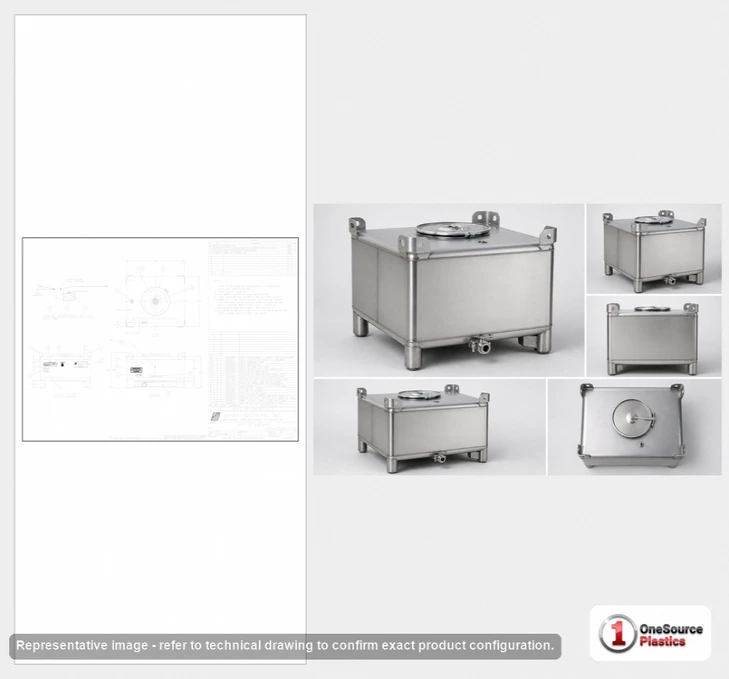
Technical drawing (PDF) for Snyder Industries 6984000B51319.
Ready to order?
Add it to your cart at the top of this page, get LTL freight to your ZIP, request a written quote, or call 866-418-1777. The listed price is before freight.