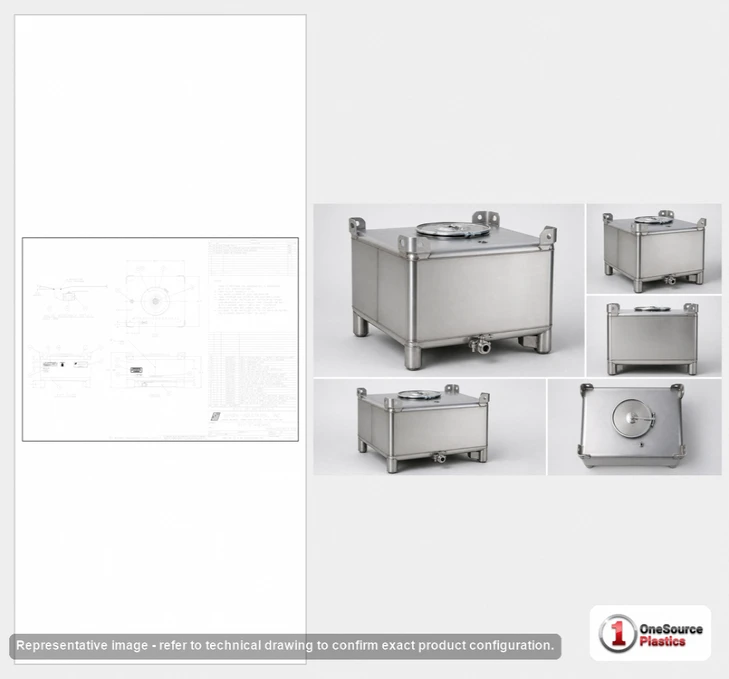
A hundred and eighty gallons under 30 inches of height
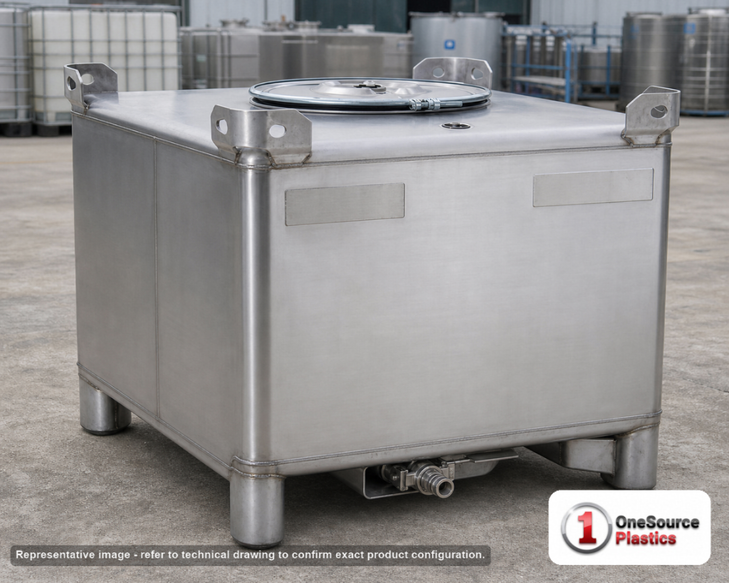
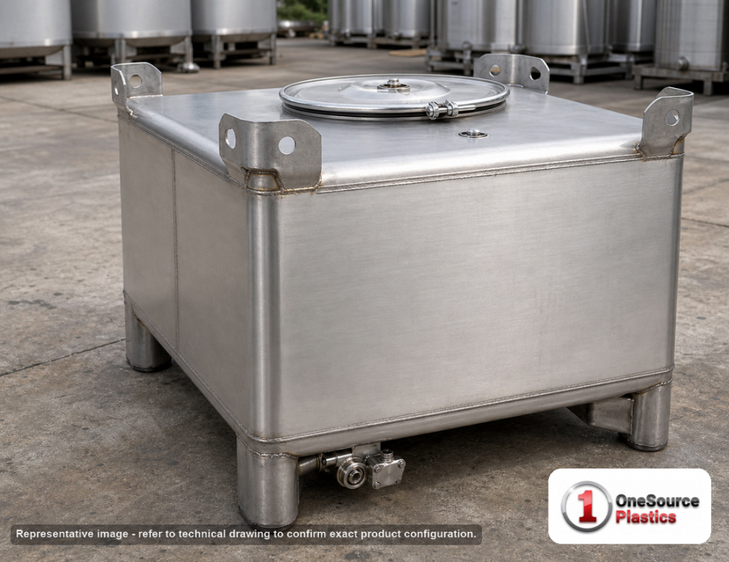
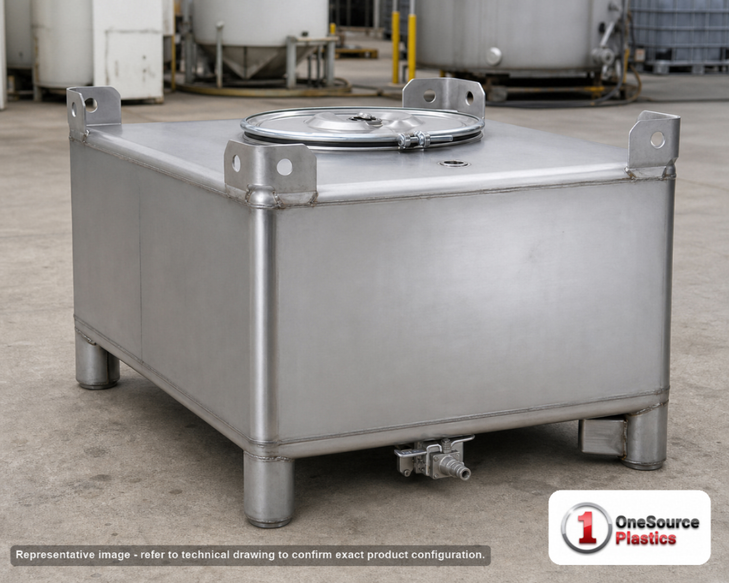
The Snyder 6984100B51302 is a 180 gallon 304 stainless steel Supertainer IBC tote tank in silver, listed at 42 inches long, 48 inches wide and 29.25 inches tall, and 351 pounds empty. Read the height before anything else: under 30 inches holding 180 gallons is a genuinely low vessel, and that is the whole reason this part number exists alongside the taller Supertainers on the same 42 by 48 inch plan. The sheet gives 1,501 pounds for 180 gallons of water at 8.34 pounds per gallon and publishes no other load figure, no specific gravity rating, no maximum operating temperature and no warranty term. It is steel and no plastic wording belongs on it. The published fittings are a 2 inch access port, a 2 inch 316 stainless ball valve and a 22 inch vented manway, and no drain, no sump, no gauge, no sight glass and no stacking, lifting or transport rating appears on the sheet, so this page asserts none of them. Freight class 125, moving LTL, shipping from Michigan.
Need the certification on file? Add the 180 gallon tank to your cart above with freight quoted to your ZIP, or call 866-418-1777 and the paperwork ships with the tank.
Low headroom duty: the tote that fits under the fill point
The job this tote is bought for is one where the ceiling, the fill head or the doorway decided the purchase and the volume came second. That sounds like a compromise and it usually is not. Plants that run under a mezzanine, in a converted building, inside a booth, under a conveyor, or beside a filling machine with a fixed charge height all hit the same wall: a tote that will not pass under the thing it has to be filled from is worthless however well it is built. At 29.25 inches this one passes under a great deal that a taller vessel does not, and it can be filled by hand from a hose, a drum or a scoop without a platform, which is a real saving in labour and in risk on a duty done several times a day. The same height helps at the receiving end of the day too, because the top of the tote sits at a height where an operator can see into the manway from the floor and check what is in there without climbing anything. There is an honest cost and it is worth stating. A hundred and eighty gallons on a 42 by 48 inch plan is less product per square foot of floor than the taller Supertainers give you, so if floor space is your binding constraint rather than height, this is the wrong end of the family to buy from. Work that out before you order rather than after: put your real batch quantity and your turnover through the tank sizing calculator, and take the headspace allowance from the tank sizing guide, because a shallow vessel filled to the brim is also the easiest one to slop when a fork lifts it. Weight still needs checking even on a small tote: 351 pounds empty and 1,501 pounds full of water goes through whatever floor, rack or deck it stands on. Where the tote feeds a metering or dosing operation, design the skid around it properly with the pump skid design guide, which covers the frame, the drip pan and the leak detection architecture. And where the underlying choice between a drum, a tote and a fixed tank is still open, the container against tank guide settles it on cost rather than habit.
The other 180, the 165 below it and a plastic 220
| Part | Gallons | Material as the sheet names it | Length x width x height | Empty weight |
|---|---|---|---|---|
| 6984100B51302 (this tote) | 180 | 304 stainless steel | 42 x 48 x 29.25 in | 351 lb |
| 6984100B51301 (identical figures) | 180 | 304 stainless steel | 42 x 48 x 29.25 in | 351 lb |
| 6984000B51306 (shorter again) | 165 | 304 stainless steel | 42 x 48 x 26.25 in | 326 lb |
| SII-6630023B97202 (plastic, stackable) | 220 | HDPE plastic | 45 x 45 x 48 in | 243.1 lb |
Take the second row first and take it at face value. 6984100B51301 holds the same 180 gallons in the same 42 by 48 by 29.25 inch envelope at the same 351 pounds, and the sheet says nothing whatever about what separates the two part numbers. We will not invent a difference. Order the number your drawing, your existing fleet or your previous purchase names; where nothing names one, ask us to confirm against the part before it ships. The third row is the genuinely useful comparison for a buyer working in a low space. 6984000B51306 gives up fifteen gallons and buys three inches of height, coming in at 26.25 inches and 326 pounds on the same plan. Three inches sounds trivial until it is the difference between passing under a fill head and not, and if you are already choosing a tote on height, that row deserves a measurement rather than a guess. The last row is a plastic tote and is named as one: SII-6630023B97202 holds 220 gallons in HDPE on a 45 inch square plan, 48 inches tall, at 243.1 pounds. It is the volume leader in this table and much the lightest empty, and it is also by far the tallest, which puts it straight back into the constraint this steel tote was chosen to get around. The comparison is honest in both directions. If the duty is cleaning, reuse and a verifiable interior over many years, the steel rows earn their cost; if it is light weight, low headroom is not an issue and the product is undemanding, the plastic row is right there on the same sheet.
Pad already poured? Send its size to 866-418-1777 or in a quote request and we will match a row to it, freight to your ZIP included.
Gravity discharge from a shallow tote
- The discharge and its head: a 2 inch 316 stainless ball valve at the outlet, on a vessel 29.25 inches tall. That height is the part people get wrong. Gravity flow depends on the liquid standing above the valve, and there is not much of it here, so a transfer from this tote runs gentler and slower than from a tall one and tails off sooner. Plan the receiving end around that, or pump it.
- What is under the valve: with the tote on the floor, the valve is low, and the receiving container has to fit beneath it. Measure that gap in the tote's final position before you buy the drum, the pail or the pump you intend to fill.
- The drain path: no sump and no separate low drain is published, so the ball valve is the entire bottom route and the residue left behind is whatever the vessel floor leaves. On a shallow tote that residue spreads wide and thin rather than pooling, so a rinse reaches it easily.
- The inlet: a 2 inch access port, which is the closed fill route when the top should stay shut.
- The top: a 22 inch vented manway. On a tote under 30 inches tall, that opening is at a height an adult can see into and reach into from the floor, which is the quiet advantage of this shape and the thing that makes cleaning verifiable. The vent is the air path while a pump draws it down; keep it clear.
- Not published: no level gauge, no sight glass, no dip tube, no specific gravity rating, no service temperature and no warranty term. Tell us your duty and we will confirm what this part number carries before anything is ordered.
Name the liquid when you order so the seat and the gasket are matched to it rather than left generic, and check it first against our chemical compatibility reference. Where a release would have to be recovered off the floor the tote stands on, the containment comparison argues the secondary containment question properly.
Sampling rooms, pilot lines and the small batch that has to be steel
A hundred and eighty gallons in steel goes where the quantity is modest but the requirements are not: pilot and scale-up manufacture, sampling and retention rooms, specialty chemical and fine chemical production, cosmetic and personal care blending, flavor and additive work, brewing and distilling ingredient handling, and dosing stations at water and wastewater plants. In all of them the vessel is bought for what it does to the product rather than for how much it holds, which is why a small steel tote is a reasonable purchase where a small plastic one would be a false economy. Where the contents are a regulated waste rather than a product, the rules governing the floor it stands on are their own subject; read the guide to secondary containment for hazardous waste tank systems before the tote is placed rather than after an inspection.
Three hundred and fifty one pounds shipping at 29 inches
Michigan is the shipping state on this sheet, no plant town is listed, and none is named here. The move is LTL at freight class 125 with no NMFC number on the sheet, and the shipping size is given at 42 inches long, 48 inches wide and 29 inches high against the tote's own 29.25 inch height. Price the lane to your ZIP with the freight cost estimator; the listed price is before freight. At 351 pounds this is well beyond a manual lift despite its size, so arrange a forklift, a pallet truck on a flat floor or a lift gate before the truck is booked, and take the load under the base rather than by the manway or the valve. The low shipment is a real advantage at the receiving end: under two and a half feet tall clears most roller doors, fits in a van, and slides under obstructions that stop a taller shipment at the threshold. Set it level in its final position, fill it with clean water and hold that 1,501 pound load while you read the manway seal, the access port and the valve joint with a light. Cycle the valve fully open and fully shut against the water before product goes near it. Then do the one check that is specific to a shallow tote: with it full, open the valve and watch how the flow behaves through the last third of the transfer, because that tail is what your process has to be timed around and it is nothing like the first minute. Tape a copy of the spec sheet inside the control panel door; the next person to touch the tank will not have the box it came in.
Freight and documents
Ships from: Marked Tree, AR; Merced, CA; Lincoln, NE. LTL freight is quoted to your ZIP with the freight cost estimator or by phone at 866-418-1777. The listed price is before freight.
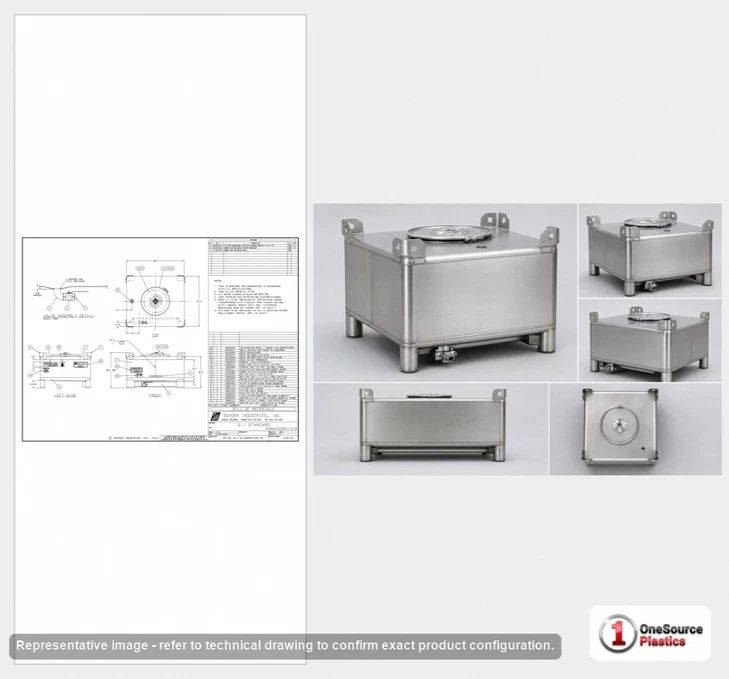
Technical drawing (PDF) for Snyder Industries 6984100B51302.
Ready to order?
Add it to your cart at the top of this page, get LTL freight to your ZIP, request a written quote, or call 866-418-1777. The listed price is before freight.