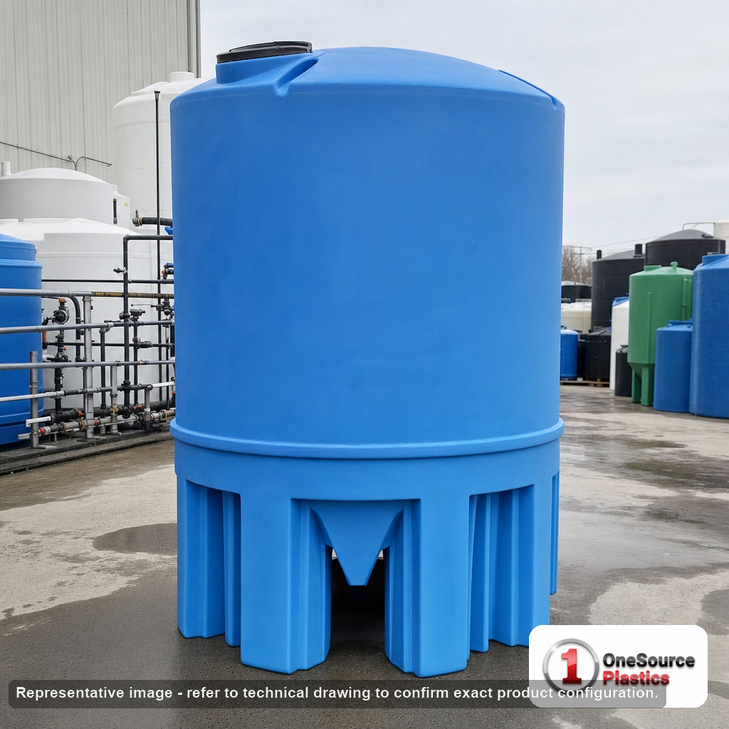
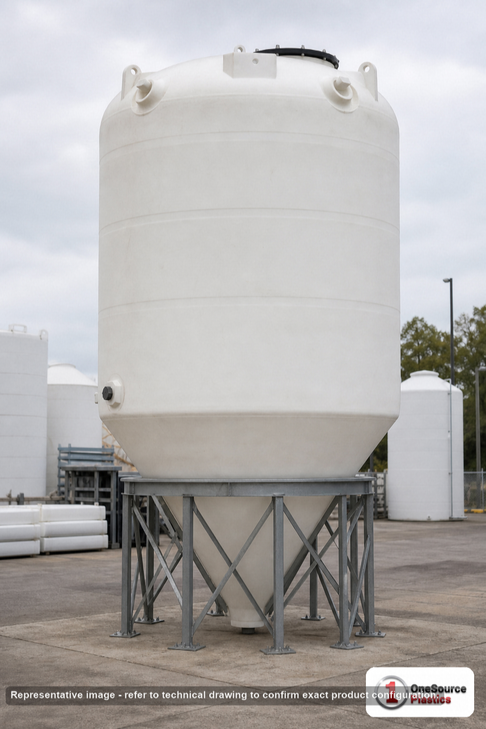
Four thousand six hundred gallons inside 123 inches of height
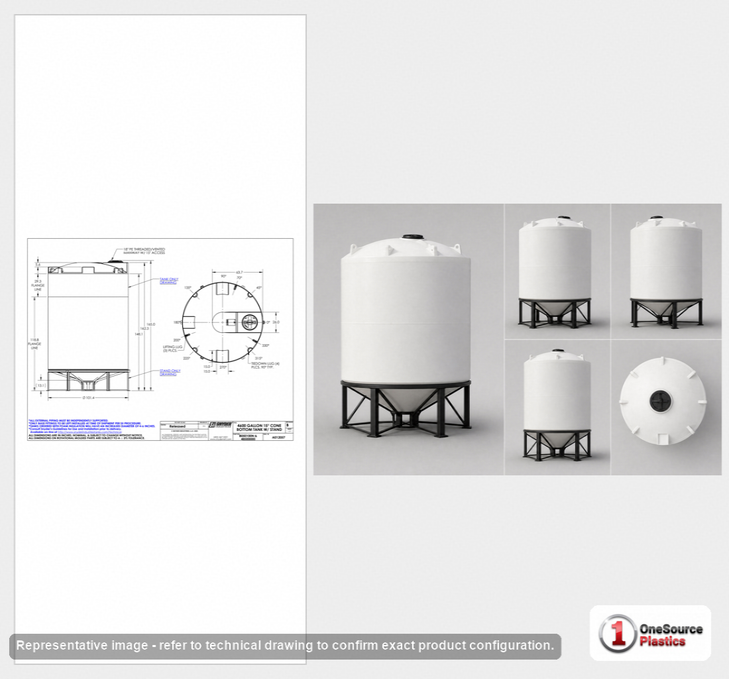
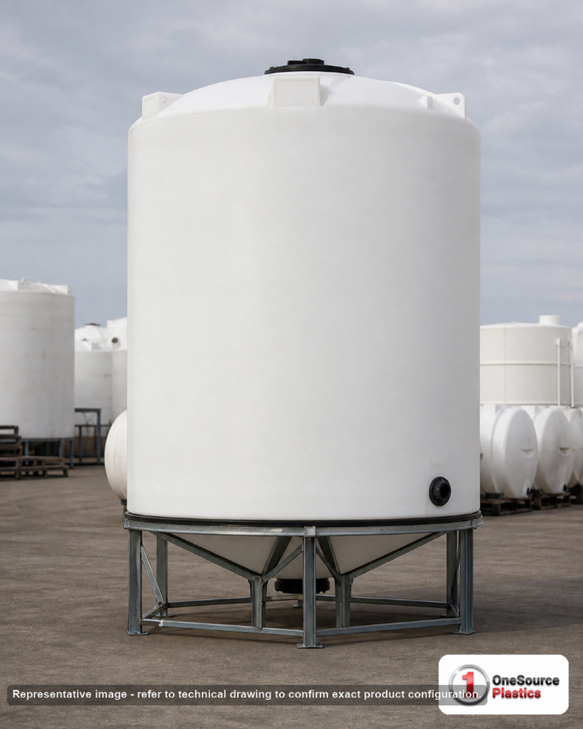
Height is what this tank is for. The Snyder SII-8050100N45 is a 4,600 gallon 15 degree cone bottom tank in white polyethylene, listed at 102 inches across and 123 inches tall, at 1,090 pounds empty. That is a wide, low vessel for the volume: eight and a half feet of diameter carrying a little over ten feet of height, with a shallow cone underneath instead of a flat floor. The wall is rated at a specific gravity of 1.9, and the sheet gives 38,364 pounds for 4,600 gallons of water at 8.34 pounds per gallon, with 72,892 pounds of max contents, which is the heaviest rated load in this batch. The opening on top is listed at 18 inches; the sheet does not carry the word vented on this one, so this page does not promise a vented manway. The service limit is 120 F / 48 C. No outlet, no inlet, no cone angle field, no stand and no warranty term appear on this sheet.
Know your ZIP and your ceiling height? Freight to your ZIP takes seconds, and 866-418-1777 will confirm the height; then add it to your cart above.
The heavy listing: the same volume in a much shorter shell
Two tanks on this sheet hold 4,600 gallons on the same 102 inch circle, and they could hardly be more different. This one is 123 inches tall and 1,090 pounds empty, rated at a specific gravity of 1.9 with 72,892 pounds of max contents. SII-8050100N43 is 164 inches tall and 470 pounds empty, and its own sheet carries a lower specific gravity rating and a smaller max contents figure. So the family question here is not which size to buy; it is which of two very different vessels holding the identical volume suits the building and the product. This is the short, heavy one, and there are two clean reasons to take it. The first is the rating. Where the product is heavier than water, the sheet answers with 1.9 and the higher max contents figure, and that is the number that picks the part; no amount of preference substitutes for it. The second is the roof. At 123 inches this tank plus its stand fits under headroom that the 164 inch listing simply will not clear, and on an indoor installation the ceiling, the crane hook and the door are usually fixed while the tank is not. Take the short vessel when either of those applies and the taller one when neither does. Underneath both sits the same structural problem: a cone bottom tank has no flat floor to stand on, and this sheet publishes no stand, no legs, no skirt and no ring. The stand is a separate item, settled before the tank is ordered, and the right place to work through what goes with what is the cone bottom tank stand compatibility matrix, which sets the makers side by side; we will confirm what fits this part number when you ask, rather than print one here. Design the foundation to the loads and not to the picture: 1,090 pounds of empty tank, 38,364 pounds of water and 72,892 pounds at the rating all arrive through that structure into a 102 inch circle. Wider is kinder here than it looks, because the load spreads over more ground than a narrow tall tank puts it through, but it is still an engineered foundation rather than a slab poured to suit. Settle the volume first with the tank sizing calculator and take the freeboard from the tank sizing guide, because on a dense product the headspace you leave is also the margin you keep.
Two 4600s, a 3000 and a 5000 on one 102 inch circle
| Part | Gallons | Diameter or plan x height | Empty weight |
|---|---|---|---|
| SII-8050100N45 (this tank, short shell, rated 1.9) | 4600 | 102 x 102 x 123 in | 1,090 lb |
| SII-8050100N43 (same volume, taller, lighter wall) | 4600 | 102 x 102 x 164 in | 470 lb |
| SII-8360037 (smaller, narrower circle) | 3000 | 95 x 95 x 135 in | 940 lb |
| SII-8050200N42 (the step up, same circle) | 5000 | 102 x 102 x 176 in | 1,300 lb |
Three of these four share the 102 inch circle, which makes the pad, the bund and the aisle the same problem across the range and the height the only thing that really moves. Read the table that way and it becomes a headroom table. This tank at 123 inches is the shortest vessel in the group by a wide margin and the only one that gets 4,600 gallons under ten and a half feet of shell. SII-8050100N43 holds the same volume at 164 inches. SII-8050200N42 steps up to 5,000 gallons at 176 inches and 1,300 pounds, which is the one to take when the extra product between deliveries is worth the extra height and the building can take it. SII-8360037 is the odd row: 3,000 gallons on a 95 inch circle at 135 inches and 940 pounds, a smaller vessel that is nonetheless taller than this one, which is a useful reminder that in cone bottom tanks volume and height are only loosely related. Weights tell their own story and the sheet explains none of it: 470 pounds, 940 pounds, 1,090 pounds and 1,300 pounds across the four, so we print what it says and leave it there. The practical sequence is to measure the lowest obstruction in the building, subtract the stand, and see which rows survive. If only this one does, the decision is made for you. If several do, go back to the rating and let the product's density choose. Where the angle itself is still an open question, settle it before the part number with the cone angle selection buyer's guide.
Need two of them? Request a written quote for the pair with freight to your ZIP, or call 866-418-1777 and we will price the truck once.
An eighteen inch opening over a shallow cone
- Headspace and breathing: the sheet lists the opening on top as 18 inches and does not describe it as vented. That is worth reading carefully rather than assuming, because on a vessel being pumped out of a shallow cone the air path is what protects the wall. Confirm the venting arrangement for your fill rate and your draw rate at order time, size it to the faster of the two, and route it where the vapour is meant to go.
- Access: 18 inches of opening at 123 inches, plus whatever the stand adds underneath. That is above head height in every installation, so a platform or a fixed ladder with fall protection belongs in the same drawing as the stand, and the fill line belongs at a coupling at working level.
- The discharge: no outlet, no inlet and no bulkhead is published on this sheet. The cone ends in a discharge and the sheet does not dimension it, so no size is claimed here. Give us the line size, the valve and the product and we will confirm what this part number carries before it is ordered.
- What hangs below: valve, reducer and the first run of pipe are carried on their own steelwork off the stand, never on the cone. With 72,892 pounds of rated contents above it, the joint at the bottom of a full column is the last place to hang dead weight.
- Angle and drainage: the name gives 15 degrees and the sheet carries no cone angle field. A shallow cone drains a free-flowing liquid perfectly well and holds onto material that packs or settles hard, so if your product is the second kind, the honest answer may be a steeper angle rather than this tank.
- Ratings: a specific gravity rating of 1.9, 38,364 pounds of water at 4,600 gallons, 72,892 pounds of max contents and a service limit of 120 F / 48 C. There is no warranty term on this sheet.
Plan the top of the tank once, on paper, before anything is drilled. A fill line, a level device, a return and a vent all want the same real estate and only one of them can have the best position: the top fitting placement guide sequences those decisions in the order that avoids rework. Name the product when you order so the gasket, the valve and any fitting we add are matched to it rather than left generic.
Dense product under a low roof
The combination this tank sells is a heavy rating and a short shell, and the buyers are the ones who have both constraints at once. Concentrated mineral and salt solutions in a process building, heavy liquid fertiliser blends inside an existing shed, thickened sludge and dewatering duty at a treatment works where the building came first and the tank came later, pickling and spent liquor in a metals plant, slurry handling at a wash plant, and process intermediates that carry solids in suspension and still have to leave through the bottom. In most of those the tank is going into a structure that already exists, which is why the 123 inch height is the specification that gets checked first and the 1.9 rating is the one that gets checked second. Get both right and the rest of the installation is ordinary. Get the height wrong and no amount of rating helps, because the vessel does not go in the door.
Which liquids, at what concentration, with which fitting
Each entry pairs a rated liquid with its concentration limit and the fitting and gasket to order alongside the tank. The full rating sits on the linked page and in the chemical compatibility database before ordering.
- Sulfuric Acid (98%, CPVC fittings, Viton gaskets)
- Hydrochloric Acid (37%, PVC, Viton)
- Phosphoric Acid (85%, PVC, Viton)
- Hydrofluoric Acid (48%, PP/PVC, Viton)
- Hydrofluosilicic Acid (26%, PP/PVC, Viton)
- Acetic Acid (60%, PP/PVC, EPDM)
- Peracetic Acid (30%, 316SS, Aflas)
- Hydrogen Peroxide (50%, PVC, Viton)
- Sodium Hypochlorite (
- Ferric Chloride (50%, PVC, EPDM)
- Ferric Sulfate (60%, PVC, EPDM)
- Ferrous Sulfate (20%, PVC, EPDM)
- Aluminum Sulfate (50%, PVC, EPDM)
- Polyaluminum Chloride (PVC, EPDM)
- Calcium Chloride (40%, PVC, EPDM)
- Magnesium Chloride (30%, PVC, EPDM)
- Sodium Carbonate (30%, PVC, EPDM)
- Potassium Carbonate (50%, PVC, EPDM)
- Potassium Hydroxide (saturated, PVC, EPDM)
- Sodium Bisulfate (PVC/PP, EPDM)
- Sodium Bisulfite (PVC/PP, EPDM)
- Sodium Thiosulfate (40%, PVC, EPDM)
- Zinc Orthophosphate (PP/316SS, EPDM)
- DEF (32.5%, 316SS, EPDM)
- Urea Solution (50%, PP/PVC, EPDM)
- Ethylene Glycol (100%, PVC, EPDM)
- Propylene Glycol (PP/316SS, EPDM), and Ozonated Water (up to 10 PPM, PVC, EPDM). Match fitting and gasket materials to the chemical exactly as listed - swap
Arkansas, oversize, 1,090 pounds
This tank is moulded at Marked Tree, Arkansas, which puts the mid-South, the Gulf and the lower Midwest on the short lane. The freight class reads OVS, an oversize mode rather than a numeric class, under NMFC 156600-03, and it shipments at 102 inches by 102 inches by 123 inches. Price the lane to your ZIP with the freight cost estimator; the listed price is before freight. Oversize means the move is booked rather than simply ordered, with the route, the window and the offload equipment agreed before the tank leaves the plant; at 102 inches across, the gate, the yard and the turning circle matter as much as the dock does. Have the machine on site and the stand set, levelled and anchored before the trailer arrives, because there is nowhere sensible to park a vessel this wide while you finish the foundation. Lift it by the body with slings, never by the top opening. Set it, restrain it, then fill it with clean water and hold that 38,364 pound load while somebody reads the top fitting, the cone joint, the stand feet and the ground around the pad. Read the pad again after the first hard rain, because a wide tank spreads its load over ground that may not be uniform underneath, and the edge is where that shows up first. Photograph the outlet fitting from below before the pipe goes on; a slow weep is easier to compare against than to describe.
Freight and documents
Ships from: Marked Tree, AR. LTL freight is quoted to your ZIP with the freight cost estimator or by phone at 866-418-1777. The listed price is before freight.
Technical drawing (PDF) for Snyder Industries 8050100N45.
See this tank
Interactive 3D model with live fill. This tank has an interactive 3D model built to its manufacturer dimensions. Rotate it, and set a fill level to see how much liquid it holds at any height. Open the 3D view on the product photo above. Download the 3D model (GLB).
Product video. Watch the Snyder Industries 4600 Gallon 15 Degree Plastic Cone Bottom Tank video (67 seconds) with dimensions, fittings and shipping notes.
Ready to order?
Add it to your cart at the top of this page, get LTL freight to your ZIP, request a written quote, or call 866-418-1777. The listed price is before freight.