The cross-linked fifty-five hundred, listed to 140 F / 60 C
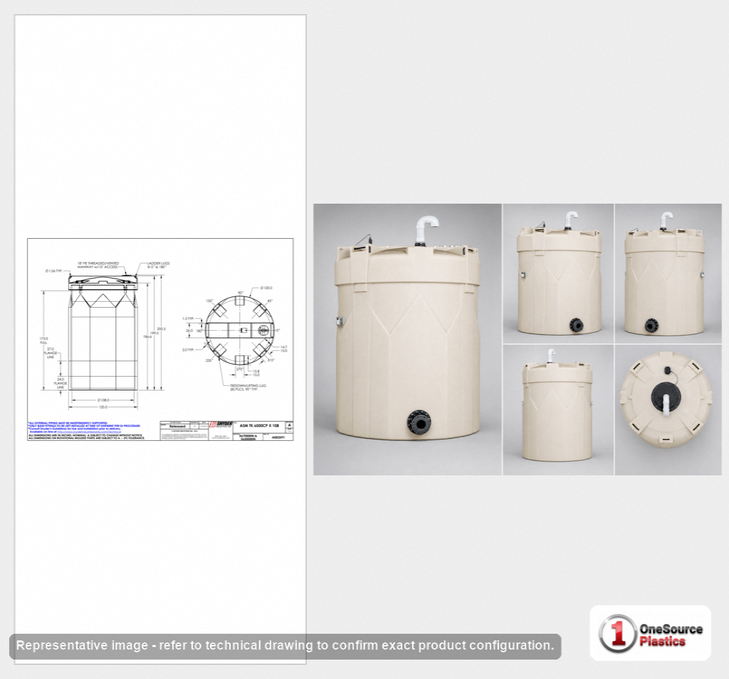
Of the 5,500 gallon listings on this 172 inch shell, this is the cross-linked one, and its sheet carries a service limit of 140 F / 60 C. The Snyder 5660000N46 is a 5500 gallon double wall tank, named by the maker as an ASTM XLPE Black double wall tank; the name words are repeated as a name and nothing is claimed from them. The material field reads crosslinked linear polyethylene and the colour field reads black. The shell is 120 inches long by 120 inches wide by 172 inches tall and 3,200 pounds empty. One capacity, one envelope, one weight and one rating are published for the assembly as a whole, with no inner tank dimension, no outer containment dimension, no annulus figure and no containment percentage anywhere on the sheet, so this page states none. The wall is rated at a specific gravity of 1.5, and the sheet gives 45,870 pounds for 5,500 gallons of water at 8.34 pounds per gallon with 68,805 pounds of maximum contents. The only opening is an 18 inch threaded vented manway; the outlet field reads "1 Manway / Lid", an opening rather than a pipe size, and the inlet field is empty. The warranty is a 3 Year Warranty, and freight is LTL at class 250 with no NMFC number out of Lincoln, Nebraska.
Ready to price it? The listed price is before freight; quote freight to your ZIP in a few seconds, then add to cart above or call 866-418-1777.
Warm service in a plant room, and the floor it stands on
Where this one goes is usually indoors, and that is the first thing worth saying about it. A plant room, a chemical bay off a process hall, a sanitation store behind a packing line: rooms with a floor that drains somewhere it should not, a roof close enough overhead to matter, and an ambient temperature that climbs all summer. Set a 120 inch square down in a room like that and the containment stops being a civil works project. There is no bund to pour around it, no bund drainage to answer for, no rainwater to pump off, and the whole assembly stands on the same slab the vessel does. What the room asks of you in return is a flat, continuous, level surface under the entire 120 inch footprint, because 45,870 pounds of water bearing on a ten foot square finds any soft edge or any packing at a corner. The reason to reach for this part number rather than a shellmate is the limit on its own sheet. This listing is published to 140 F / 60 C, which is the figure to hold against your actual worst case: caustic make-up that arrives warm, clean-in-place solution held at temperature, a bay that runs hot under a steel roof, a treatment chemical that comes off a tanker above ambient. The material field reads crosslinked linear polyethylene, which is what the sheet says and the whole of what this page will say about resin, because a resin word is not a compatibility statement. Read the rating line beside it rather than through it: at a specific gravity of 1.5 this sheet carries 68,805 pounds of maximum contents against 45,870 pounds of plain water at 8.34 pounds per gallon, so this is warm-service wall with a working margin over water, not provision for a much denser product. If your product is genuinely heavy, that is a different row and a different conversation. Colour is the third field with a daily consequence. Black keeps light off the contents and removes any prospect of reading a level through the shell, so on a tank whose only opening sits at 172 inches the level arrangement is designed before the vessel is set, not improvised afterwards. And before the capacity is fixed, settle what you can actually use: the Captor double wall freeboard sizing guide works through thermal expansion, chemistry and density, then check quantity and turnover in the tank sizing calculator against the freeboard discipline in the tank sizing guide.
Four fifty-five hundreds and the step either side
| Part | Gallons | Length x width x height | Empty weight |
|---|---|---|---|
| 5660000N46 (this tank, named ASTM XLPE Black, listed to 140 F / 60 C) | 5500 | 120 x 120 x 172 in | 3,200 lb |
| 5660000N40 (named ASTM XLPE, same listed weight) | 5500 | 120 x 120 x 172 in | 3,200 lb |
| 5660000N42 (named ASTM XLPE, heavier listing) | 5500 | 120 x 120 x 172 in | 3,800 lb |
| 5660000N48 (named ASTM XLPE Black, heavier listing) | 5500 | 120 x 120 x 172 in | 3,800 lb |
| 5630000N40 (narrower plan, taller column) | 5000 | 102 x 102 x 216 in | 3,600 lb |
| 5670000N30 (same plan, more height) | 6500 | 120 x 120 x 199 in | 5,300 lb |
Four part numbers share this exact 120 by 120 by 172 inch shell and the sheet splits them only by listed weight, two at 3,200 pounds and two at 3,800. It does not say why, so this page prints the rows and leaves the interpretation with the chemistry and the temperature you describe to us. Where a drawing, a spares list or an existing installation already names one of these part numbers, order that one and we will confirm the published figures against it before anything ships. The last two rows are the ones that change the installation rather than the paperwork. Dropping to 5,000 gallons on the 102 inch plan gives back eighteen inches in each direction on the floor and takes the column up to 216 inches, which is the wrong trade in a room with a low roof and the right one in a tight bunded corner with height to spare. Going the other way, 6,500 gallons stays on the same 120 inch square and grows to 199 inches at 5,300 pounds, so the pad and the walkway are unchanged and only the height and the lift get harder. Measure the clear height at the final position with the platform and the fill arrangement already allowed for, then count the truck drops a year you are willing to sign for, and buy the tallest row that satisfies both.
Want us to check the fit? Send the site dimensions to 866-418-1777 or through a written quote request and we will confirm the tank, the pad and the freight.
One published opening at 172 inches, and the pipework it forces
- The outlet field: it reads "1 Manway / Lid" with the inlet field empty. That is the name of an opening and not a pipe size, so no outlet dimension, thread, flange or valve is claimed on this page. Tell us the duty, the working temperature and the line size and we will confirm what this part number carries.
- The consequence: everything in and out shares one hole at 172 inches. The drop pipe for filling, the suction for the pump, the level instrument and the rinse method all have to be planned together before the tank is set, because there is no second opening to fall back on.
- Warm service at the fittings: if the product runs anywhere near the published 140 F / 60 C, say so when you order. Seals, gasket material, valve seats and any flexible connection are chosen against temperature as well as chemistry, and that combination is the usual cause of a weep on an otherwise sound tank.
- The manway: 18 inches, threaded and vented. Keep the gasket face clean, and torque it the way the maker's instruction sheet says rather than the way the last person did.
- The vent: listed as part of the manway. A warm headspace moves more air for the same change in level, so the path has to stay clear on a fast fill and a hard draw alike.
- Level and prime: the wall is black and there is no visual level at all, so a low level cut-out chosen with the pump is the only thing standing between a hard pump-down and a dry run.
- Structure: the sheet lists ladder lugs and 1 flange line and publishes no lifting lug count.
- The space between the walls: no monitoring port, gauge or alarm is published on this sheet, so that arrangement is specified separately and inspected to a written schedule.
- Limits: 140 F / 60 C, a specific gravity rating of 1.5, and a 3 Year Warranty.
Say what goes in it and how warm it runs at order time, and every wetted part gets specified once against the real duty instead of twice.
Clean-in-place and warm make-up on a contained base
This listing lands in plants that run warm and receive in bulk: sanitation and clean-in-place chemical make-up in food, beverage and dairy work, caustic and acid holding on process lines, boiler and cooling tower treatment, plating and metal finishing, laundry and industrial wash operations, and treatment chemical storage at water and wastewater works where the product does not arrive cold. In every one of them the reason for a second wall is the floor. At 5,500 gallons a release stops being a clean-up and becomes a notifiable event, and containment moulded into the vessel is the cheapest way to take that off the table. Two habits belong with the tank from the day it lands. Look into the space between the walls on a fixed schedule and record the date, because the only thing containment gives you over a single wall is evidence. And keep the vent and the headspace on the maintenance round rather than treating them as fit-and-forget, since warm service works the top of the wall hardest. Where the enquiry behind the size is private fire water rather than chemical feed, that duty is sized by different rules and the fire water reservoir design guide for rural and remote sites is the honest place to begin; this page makes no claim about it.
A fourteen foot shipment on a ten foot square footprint
The plant on this sheet is Lincoln, Nebraska, and no ship-from state field is published at all, so the plant is printed and nothing else about the lane is claimed. Freight is LTL at class 250 with no NMFC number, and the shipping load is 120 by 120 by 172 inches at 3,200 pounds. Price the lane to your own ZIP with the freight cost estimator; the listed price is before freight. No crane rating, rigging plan, permit or escort detail appears on this sheet, so none is stated here; plan the lift with the equipment you can actually source and tell us the constraints at your end early. The envelope is what needs measuring, not the weight: a ten foot square load better than fourteen feet tall finds overhead lines, gate frames and low door heads that nobody remembers until the truck is standing there, and a room whose door was sized for pallets will not take it. Take it under the base, never by the manway, and keep it upright through the site wherever the route allows. Set it on the cured, level surface in its final position, prove it plumb in two directions while it is still empty, then fill it with clean water and hold the 45,870 pound load while you read the manway seal, the base line and the slab beneath it. Drain it, dry it, open the space between the walls, look in good light and write the date and the part number on the shell. Then leave a clear walkway all the way round before the pipework goes in, because the side of a tank nobody can reach is the side nobody ever inspects. A photo of the tank on its pad, full, on day one is worth keeping; it is the baseline every later inspection is compared against.
Freight and documents
Ships from: Lincoln, NE. LTL freight is quoted to your ZIP with the freight cost estimator or by phone at 866-418-1777. The listed price is before freight.
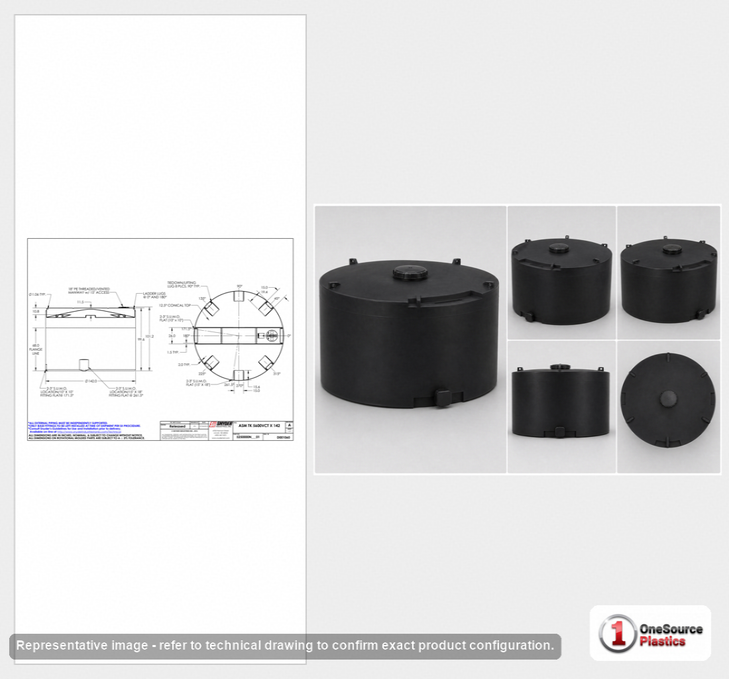
Technical drawing (PDF) for Snyder Industries 5660000N46.
See this tank
Interactive 3D model with live fill. This tank has an interactive 3D model built to its manufacturer dimensions. Rotate it, and set a fill level to see how much liquid it holds at any height. Open the 3D view on the product photo above. Download the 3D model (GLB).
Ready to order?
Add it to your cart at the top of this page, get LTL freight to your ZIP, request a written quote, or call 866-418-1777. The listed price is before freight.