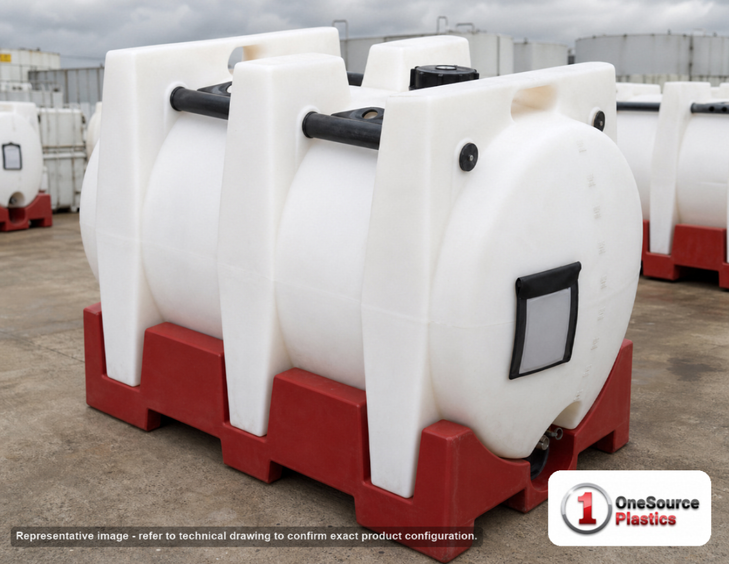
Six hundred gallons of slow product, 107 inches tall
The Snyder SII-6370721N95402 is a Flowmaster viscous hopper bin tank: 600 gallons, white polyethylene, listed 45 inches long, 48 inches wide and 107 inches tall, at 495 pounds empty. The name gives the slope as 45 degrees and this page cites it from there; the sheet's own cone field is empty and nothing further about the geometry is claimed. A viscous hopper bin is built for product that flows, but slowly: material that would sit in the corners of a flat-bottomed tank and be shovelled, pumped or hosed out at every changeover. The wall is rated at a specific gravity of 1.9, and the sheet gives 5,004 pounds for 600 gallons of water at 8.34 pounds per gallon with 9,508 pounds of max contents. The outlet is listed as 2 inches and the lid as 12 inches. The service limit is 120 F / 48 C. There is no warranty term, no discharge height and no stand on this sheet.
Want a second opinion on the size? Call 866-418-1777 with the daily draw and the delivery interval, or price freight to your ZIP and add it to your cart above.
One hundred and seven inches of standing height, and what goes beneath
Height is what this bin is for and height is what will catch you out. It stands 107 inches over a 45 by 48 inch rectangle of floor, which is close to nine feet, and that is above a standard dock door. Measure the room before the order: the ceiling, the lowest sprinkler head, the lowest duct, the crane rail, the mezzanine underside and the door the bin has to pass through to reach its position. All of that is cheaper to check with a tape than to solve with a crane. What the height buys is the working clearance beneath the discharge, because the whole reason to buy a sloped bottom is that product leaves under its own weight into something you have put under it. The sheet does not publish the floor-to-discharge height, so tell us the container, the pump inlet, the mixer or the weigh hopper that has to sit underneath and we will confirm the geometry against the drawing before anything ships. Under the base, the requirement is unglamorous and absolute: a flat, continuous, level bearing surface across the full 45 by 48 inch plan. A slab, a structural deck or a frame designed for the load. No gap in the middle, no packing under a corner, no straddling a floor joint. Empty the bin is 495 pounds, which is the heaviest of the Flowmaster bins we carry in this shape; full of water the sheet gives 5,004 pounds and at the rating it gives 9,508 pounds, and all of that arrives on fifteen square feet of floor. That concentration is the reason to look at the slab before the purchase order rather than after the first fill, and where the floor is a poured pad the concrete pad sizing guide for above-ground polyethylene tanks is where it gets sized honestly. Check 600 gallons against your real batch size and turnover in the tank sizing calculator, and take the headspace a warming or foaming product wants from the tank sizing guide, because a bin filled to the lid cannot be stirred and cannot be sampled.
The viscous 600 against the 68 cubic foot dry bin
| Part | Rated as | Length x width x height | Empty weight |
|---|---|---|---|
| SII-6370721N95402 (this bin, viscous) | 600 gal | 45 x 48 x 107 in | 495 lb |
| SII-6371307N95402 (dry hopper bin) | 68 cu ft | 48 x 45 x 102 in | 352 lb |
Two bins, five inches apart in height, and about as different in purpose as two vessels can be while sharing a plan. This one is the viscous bin, rated in gallons, for liquid and semi-liquid product. SII-6371307N95402 is the dry hopper bin, rated by its sheet at 68 cubic feet for material that is poured, tipped or augered in; its sheet also carries a 510 gallon figure, which we print as the sheet gives it and which is not a liquid duty. On a drawing the two look like near neighbours: 45 by 48 by 107 inches against 48 by 45 by 102 inches. On the floor this one weighs 495 pounds empty where the dry bin weighs 352, and that extra material in the wall is the visible part of what a bin carrying a liquid load at a specific gravity rating has to be. Buy this one when the product slumps, sticks, settles or simply refuses to be scraped out of a flat tank at the end of a batch. Buy the dry bin when the product is a powder, a pellet or a granule and the problem you are solving is the sack pile rather than the residue. Where you are running both a wet and a dry material through one station, buy both rather than compromising on one, because the cost of a changeover on the wrong vessel shows up every single week and the difference in purchase price shows up once.
Not sure which one? Tell us the liquid, the site and the ceiling height at 866-418-1777, or request a written quote with freight to your ZIP.
The 2 inch outlet at the bottom of the taper
- The outlet: the sheet lists 2 inches at the bottom of the sloped section, and on viscous product that is the number to think hardest about. Two inches moves thin liquid quickly and thick product slowly, so size the valve and the line to the material, keep the run short, straight and falling, and remember that every elbow is paid for at the end of every batch.
- The valve: a full-port valve hard against the outlet rather than a restricted one. Viscous product finds every reduction in a line and stops there, and the first place it stops is the first place it sets.
- Support: the valve, the reducer, the hose and anything downstream go on their own bracket off the frame or the wall. The outlet boss carries product, not pipework.
- Draining the last of it: a 45 degree slope gets you most of the way and no bin is self-cleaning. Decide before the first batch where the wash-out goes and how the inside gets reached, because a product change with no plan is a day with a bar and a bucket.
- The fill: a 12 inch lid at 107 inches, which is a platform, a catwalk or a fixed fill line rather than a person on a step. Twelve inches takes a hose, a wand, a lance and an arm, which is the practical difference between this and a six inch opening.
- Limits: 120 F / 48 C is the published service limit, and the specific gravity rating on this sheet is 1.9. There is no warranty term and no published level device, so the level is whatever you fit or whatever you read through the lid.
Name the material when you order. Viscosity, temperature and solids content decide the outlet size, the valve type and the gasket, and a bin plumbed for water and then fed something thick is a bin somebody stands over with a bar at four in the afternoon. Where the product also has to be contained rather than merely held, the Captor double wall freeboard sizing guide works through thermal expansion, chemistry and density to the volume you can genuinely use inside a contained vessel.
Thick product, slow draw, and the container underneath
Six hundred gallons of sloped-bottom storage gets bought where a flat tank leaves money in the corners: adhesives, resins, latex and coatings at a manufacturing plant; polymer, sludge and thickened chemical at a treatment works; syrup, fat, oil and slurry in a food plant; cutting and drilling fluid at a shop; settling and dewatering duties where solids have to come out of the bottom rather than be skimmed off the top. The economics are usually decided by the residue rather than the capacity. Product that stays in a flat vessel at every changeover is product you bought, paid freight on, and then paid again to dispose of, and at 600 gallons a batch that number is not small. The second reason people buy this shape is the one nobody writes on a requisition: at 107 inches the discharge is high enough to fill a container by gravity, so the transfer pump that used to be in the middle of the process is not there any more, and neither is the hose that used to be draped across the walkway.
Lying down at 107 inches, 495 pounds on the bill
This bin is moulded at Lincoln, Nebraska. The sheet gives the freight class as LTL, a mode rather than a numeric class, under NMFC 156600-04, and it lists the shipping dimensions as 107 inches long by 48 inches wide by 45 inches high, which is the bin travelling on its side rather than standing. That is good news for trailer height and it means the unload is a horizontal lift followed by a stand-up, so have the forklift, the straps and two people ready rather than one. Price the lane to your ZIP with the freight cost estimator; the listed price is before freight. Four hundred and ninety-five pounds is machine work at both ends. Take it under the base or under the load, never by the lid, the outlet or the taper. Stand it in its finished position, plumb the discharge with the flexible joint at the tank end, then fill it with clean water, hold the 5,004 pound load and read the outlet joint, the valve and the lid seal before anything valuable goes in. Drain it through the discharge rather than the lid so you learn how it empties with something that cannot stain. Mark the water line on the outside while it is full; every level reading afterwards gets checked against that line. Chalk the full-water line on the outside after the first fill; it is the level every later reading gets checked against.
Freight and documents
Ships from: Lincoln, NE. LTL freight is quoted to your ZIP with the freight cost estimator or by phone at 866-418-1777. The listed price is before freight.
Technical drawing (PDF) for Snyder Industries 6370721N95402.
See this tank
Product video. Watch the Snyder Industries 600 Gallon 45 Degree Plastic Flowmaster Viscous Hopper Bin Tank video (68 seconds) with dimensions, fittings and shipping notes.
Ready to order?
Add it to your cart at the top of this page, get LTL freight to your ZIP, request a written quote, or call 866-418-1777. The listed price is before freight.