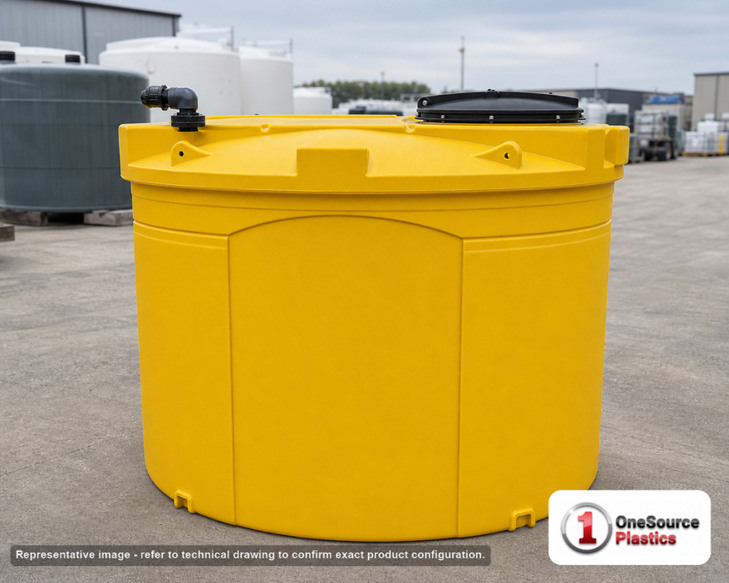
Seven hundred and fifty gallons of used oil tank, 73 inches square
The Snyder SII-5990902N95704 is a 750 gallon used oil containment tank with a level gauge, moulded in high density linear polyethylene with a colour field that reads Yellow, and listed 73 inches long, 73 inches wide and 66 inches tall at 300 pounds empty. The level gauge is in the product's own name and that is exactly how this page treats it: the sheet names a gauge and gives no type, no scale and no range, so none is claimed. The wall is rated at a specific gravity of 1.9, and the sheet gives 6,255 pounds for 750 gallons of water at 8.34 pounds per gallon with 11,884 pounds of max contents. The only opening published is an 18 inch lid. The service limit is 120 F / 48 C. No outlet, no inlet, no warranty term, no containment volume and no percentage appear anywhere on this sheet, so this page states none of them.
Replacing a tank that failed? Call 866-418-1777 with what it held and how long it lasted; or check freight to your ZIP and put the 750 gallon tank in your cart above.
Chowchilla, California, and the lane a three hundred pound tank rides
One plant is listed for this part and it is Chowchilla, California. That single fact shapes the purchase more than most buyers expect. A 750 gallon tank at 300 pounds empty is light for its volume and bulky for its weight, which is the worst combination on a long lane: you are not paying for tonnage, you are paying for the space a 73 inch square shipment occupies on a trailer, and that cost scales with distance rather than with the scale ticket. On the West Coast and through the Southwest this is a short, cheap move. Further east it is worth pricing properly before the order rather than assuming, which is exactly what the freight cost estimator is for. The shape itself is the second half of the argument. Seventy-three inches square and only 66 inches tall is a deliberately low, wide arrangement: it fits under a low roof, under a mezzanine and inside a service bay where a tall tank of the same volume would not go, and it keeps the 18 inch lid at a height a person can reach from the floor rather than from a ladder. Give it flat, continuous, level support across the whole 73 inch square. Not two rails, not a pallet, not a corner shimmed to fake level. Empty it is 300 pounds and a pallet jack moves it; the sheet gives 6,255 pounds full of water and 11,884 pounds at the rating, and that entire load stands on a plan of about thirty-seven square feet. On a poured pad rather than a structural slab, the concrete pad sizing guide for above-ground polyethylene tanks sets out how that gets sized and where the boundary of the framework lies. Check the volume against your real accumulation rate and your hauler's collection interval in the tank sizing calculator before you settle on 750 gallons, and take the freeboard from the tank sizing guide; a collection tank that is full a week before the truck is due is a tank that turns into drums on the floor.
The gravity feed five hundred, this seven fifty, and the thousand
| Part | Gallons | Length x width x height | Empty weight |
|---|---|---|---|
| SII-5990902N95704 (this tank, used oil with level gauge) | 750 | 73 x 73 x 66 in | 300 lb |
| SII-5990102N95704 (used oil with level gauge, larger) | 1000 | 80.5 x 80.5 x 69 in | 525 lb |
| SII-5780100N97208 (gravity feed tank system) | 500 | 60 x 66 x 101 in | 305 lb |
Two of these three are the same product family at two sizes and the third is something else. SII-5990102N95704 is the 1000 gallon used oil containment tank with a level gauge: 80.5 inches square, 69 inches tall, 525 pounds empty. Against this tank that is seven and a half more inches in each direction of plan, three more inches of height, and a great deal more weight on the scale for a third more volume. The height is the number that usually decides it, because both of these are bought for rooms with a ceiling, and three inches is sometimes the whole conversation. Take the thousand where the collection interval is fixed by a contract and the volume has to stretch to meet it; take this 750 where the bay is what it is and the truck comes when you call it. The third row is not a used oil tank at all. SII-5780100N97208 is a gravity feed tank system holding 500 gallons in a 60 by 66 inch plan and standing 101 inches tall at 305 pounds. It is worth reading precisely because it is the opposite shape: a third less volume than this tank, thirty-five more inches of height, and a footprint that is narrower in one direction. It solves the problem of getting liquid out under its own head, where this tank solves the problem of getting liquid in and keeping it somewhere safe until it leaves. Those are different jobs, and the tallest tank is not the answer to both.
Want the certified one or the plain one? Call 866-418-1777 and say what the inspector asks for; or request a quote on the row you need.
An eighteen inch opening on top and the gauge in the name
- The fill opening: an 18 inch lid is the only opening this sheet publishes, and on a used oil tank the opening is the whole working interface. Eighteen inches takes a funnel, a drain hose, a pump-out suction and an arm, which is why a tank like this is usually filled by hand or by hose at the top rather than through a piped inlet.
- Reaching it: the lid sits at 66 inches, which is head height on most people standing on a shop floor. A person tipping a drain pan into an opening at that height is a person who will spill, so plan a step, a platform or a hose drop at the same time as you plan where the tank goes.
- The level gauge: the product's name carries a level gauge and that is precisely what the sheet says about it. No type, no scale and no reading range is published, so we describe none. If you need the level readable from across the bay or reportable into a system, say so at order time; the level gauge selection guide compares the technologies on their real merits.
- Outlet and pump-out: there is no outlet and no inlet on this sheet. We assert neither. In practice a collection tank of this kind is emptied by a hauler's vacuum through the top opening, and if you need a bottom connection instead, that is a conversation to have before the order and not after it.
- Containment: the name says containment and the sheet publishes no containment volume, no basin capacity, no percentage and no code. We will not print one. Keep any outer space dry and treat standing liquid in it as the inspection finding it is.
- Limits: 120 F / 48 C is the service limit and the specific gravity rating is 1.9. There is no warranty term on this sheet.
Tell us what is going in it when you order. The sheet names the duty and nothing about the chemistry, and the seal and any fitting we add follow what you are actually collecting rather than a general assumption about waste oil.
Shop drain-down, collection and the hauler's visit
A used oil tank is bought by operations that generate waste faster than they can carry it out in drums: truck and fleet maintenance shops, quick-lube bays, agricultural equipment dealers, municipal vehicle yards, marinas, mining and construction workshops, and any plant with a gearbox schedule. The duty is simple and the failures are always the same three. The tank is put where the drain pan cannot reach it, so oil ends up on the floor. The level is not visible, so somebody discovers it is full while pouring. And the volume is sized to the floor space instead of to the hauler's schedule, so the tank is either always nearly empty or always over. Site it where the work actually happens, keep the level in view from the bay, and pick the volume from the collection interval. A tank sized so it is emptied on a routine is a tank nobody has to think about, and that is the whole point of buying one instead of stacking drums.
Three hundred pounds, shipped seventy-three by seventy-three
This tank is moulded at Chowchilla, California. The sheet gives the freight class as LTL, which is a mode rather than a numeric class, under NMFC 156600, and the shipping size is 73 inches long by 73 inches wide by 66 inches high, the same as the tank. Price the lane to your ZIP with the freight cost estimator; the listed price is before freight. At 300 pounds a pallet jack or a forklift takes it off at both ends, and because the shipment is wider than most doorways, measure the route from the dock to the bay before the truck arrives rather than while the driver waits. Take it from under the base and never by the lid. Set it in its final position, level, before anything is connected or any fill point is fixed, then fill it with clean water and hold that 6,255 pound load long enough to read the lid seal and to watch the pad under the base. Drain it and let it dry before the first collection goes in. The habit that pays for itself here is the one nobody bothers with: write the in-service date and the collection contact on the shell in paint marker, because when a tank is full at four on a Friday, the number on the tank is the one that gets called. Keep one spare gasket for the outlet fitting on the shelf; it is the part that fails on a holiday.
Freight and documents
Ships from: Chowchilla, CA. LTL freight is quoted to your ZIP with the freight cost estimator or by phone at 866-418-1777. The listed price is before freight.
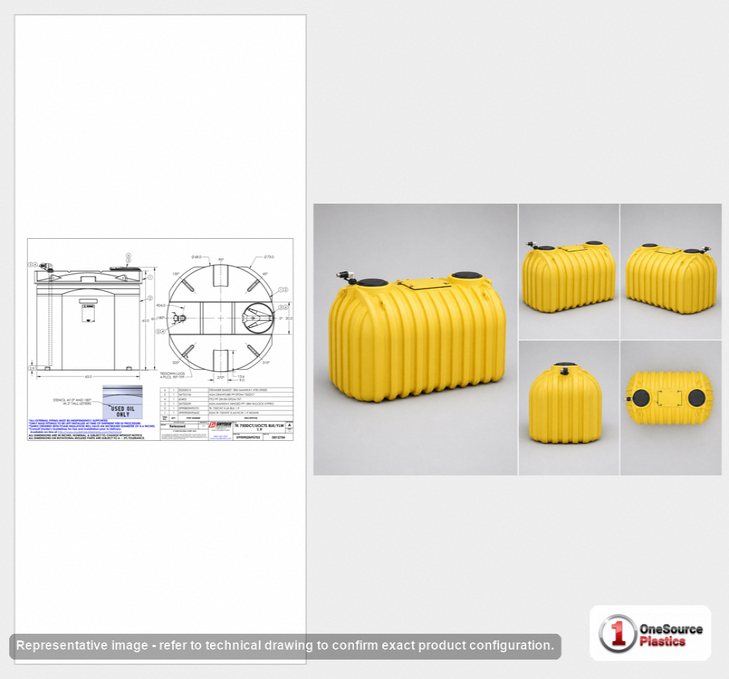
Technical drawing (PDF) for Snyder Industries 5990902N95704.
See this tank
Interactive 3D model with live fill. This tank has an interactive 3D model built to its manufacturer dimensions. Rotate it, and set a fill level to see how much liquid it holds at any height. Open the 3D view on the product photo above. Download the 3D model (GLB).
Product video. Watch the Snyder Industries 750 Gallon Used Oil Containment Tank with Level Gauge video (62 seconds) with dimensions, fittings and shipping notes.
Ready to order?
Add it to your cart at the top of this page, get LTL freight to your ZIP, request a written quote, or call 866-418-1777. The listed price is before freight.