


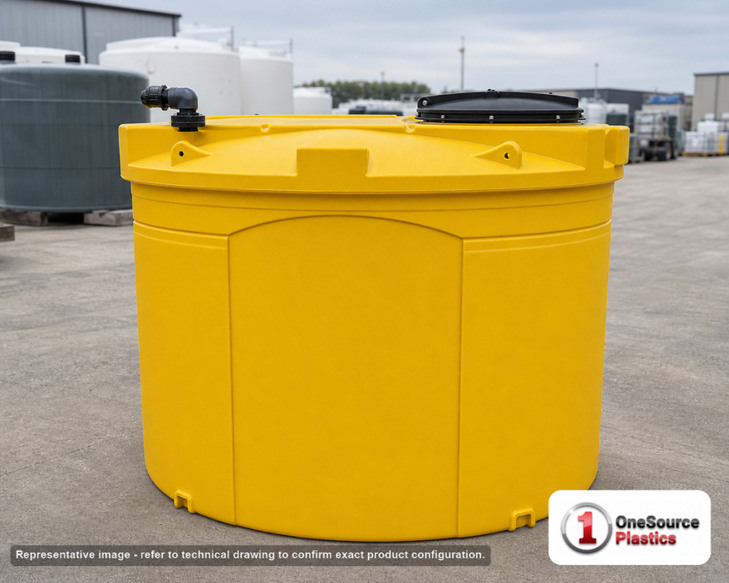
A 750 gallon used oil tank, 73 inches square and yellow
The Snyder SII-5990902N95703 is a 750 gallon used oil containment tank: yellow, 73 inches long by 73 inches wide by 66 inches tall, 300 pounds empty, and named on the sheet as a containment tank rather than a storage tank. The colour is not decoration. Yellow is what a waste oil vessel is expected to be on a shop floor, and it is the first thing that stops a fresh product going into it. The sheet lists a 2 inch male camlock outlet with an internal draw pipe and an 18 inch hinged lockable manway with a strainer basket, which between them describe the whole duty: oil goes in through a basket that catches what should not be in it, and comes out through a coupling a pump truck already carries. The wall is rated at a specific gravity of 1.9, giving 6,255 pounds for 750 gallons of water at 8.34 pounds per gallon and 11,884 pounds of maximum contents. The service limit is 120 F / 48 C and the warranty is a 3 year warranty as the sheet states it.
Spec sheet in hand? Call 866-418-1777 and read us the liquid and the pad; or get freight to your ZIP and add it to your cart above.
The shop floor, the bund and a 73 inch square of concrete
Where this tank goes decides whether it works. A 73 by 73 inch square is a little over six feet on a side, and it wants a level, finished concrete floor or a poured pad that carries the whole base, not a rim on two edges with a hollow in the middle and not asphalt that will creep under a loaded footprint in summer. Sixty-six inches of height keeps the manway reachable from the floor by anyone standing on it, which matters on a tank that people tip drain pans into all day. Set it where the fill side faces the work, leave room on the outlet side for a hose and a hand, and leave the base visible on all four sides: the reason a containment tank exists is that somebody can see a problem before it is a floor covered in oil, and a tank pushed tight into a corner defeats that on day one. Above the base there is 6,255 pounds of water at full and 11,884 pounds at the rating on this sheet, so the floor is carrying a small vehicle in one square. If the pad is being poured for it, the framework and the boundary between a slab on grade and a designed structural slab are worked through in the concrete pad sizing article, and that is the right time to argue it, not after the tank is full. Where the waste stream is a regulated one, the inspection cadence and the leak detection options are set out in the secondary containment article for hazardous waste tank systems; read it before you decide what this tank is doing in your compliance story, because the sheet describes a product and the regulation describes a system. Size it honestly as well. Seven hundred and fifty gallons is roughly the right number for a shop that fills a pump truck on a schedule rather than on a panic, and the tank sizing calculator will tell you how many oil changes that really is against your own throughput, with the ullage and temperature allowance from the tank sizing guide.
Five hundred, 750 and 1,000 gallons of waste oil storage
| Part | Gallons | Length x width x height | Empty weight |
|---|---|---|---|
| SII-5990902N95703 (this tank, square and low) | 750 | 73 x 73 x 66 in | 300 lb |
| SII-5780102N95703 (smaller, upright, named double wall) | 500 | 53 x 53 x 81 in | 280 lb |
| SII-5990102N95703 (larger, named double wall) | 1000 | 81 x 81 x 69 in | 450 lb |
The three tanks go up in volume and change shape while they do it, so the choice is usually made by the building rather than by the gallons. SII-5780102N95703 holds 500 gallons in a 53 by 53 inch plan at 81 inches tall and 280 pounds: the smallest floor area of the three and the tallest, which is the one to take when the floor is short of space and the ceiling is not. This tank holds 750 gallons in a 73 by 73 inch plan at 66 inches tall and 300 pounds, so it buys its extra gallons over the 500 by spreading out instead of going up, and it ends up lower for it. That is the reason to buy this one: it is the tank for a shop with floor to give and a low roof, a mezzanine, a door header or a sprinkler line overhead. SII-5990102N95703 goes to 1,000 gallons in an 81 by 81 inch plan at 69 inches tall and 450 pounds, the answer for a fleet shop or a quick lube chain doing enough volume that the pump truck visit is the scheduling problem. The two siblings are named double wall waste oil tanks on the sheet; this one is named a used oil containment tank, and we print those names as given rather than telling you what is inside a wall we cannot see. If the wall count is the deciding factor for your permit or your insurer, ask us and we will get it in writing from the maker before you order.
Two rows look the same? The difference is the wall; call 866-418-1777 with the liquid and we will say which, or ask for a quote on both.
A 2 inch camlock with an internal draw pipe
- The outlet: a 2 inch male camlock, which is the coupling a waste oil hauler's hose already ends in, so evacuation is a cam-and-groove connection made by hand in seconds with no threads to cross and no adapter to lose. Keep a dust cap on it between pickups and keep a drip tray under it; the last half cup out of a camlock always lands on the floor.
- The internal draw pipe: the sheet lists the outlet with an internal draw pipe, which is what lets the tank be emptied from inside rather than through a low wall penetration. Ask the hauler to pull slowly at the end of a load rather than racing the pump, because a draw pipe that is sucking air is pulling on the tank as well as on the oil.
- The manway: 18 inches, hinged, lockable, with a strainer basket. The hinge means it cannot be dropped or lost on a busy floor, the lock means the tank is closed to whatever somebody wants to get rid of after hours, and the strainer basket is the part that earns its money, catching rags, filters, caps and gasket scrap before they reach the pump truck's hose.
- The routine that goes with the basket: empty and inspect it on a schedule rather than when the fill slows down. A clogged basket is the reason a tech pours over the rim, and oil poured over a rim ends up on the floor the containment was bought to prevent.
- Venting and the limit: keep the vent path clear so the tank breathes as it is filled and drawn. The service limit on this sheet is 120 F / 48 C, which is worth knowing in a shop where drain pans arrive hot.
- Warranty: the sheet states a 3 year warranty, and that is the entire warranty text it gives.
Everything downstream of the camlock rides on its own support, never on the tank shell, with a flexible connection at the first joint. Tell us what the tank is collecting when you order, because used motor oil, used hydraulic oil, coolant and a mixed waste stream are not the same duty and the fitting, gasket and bolting answer moves with them. Label the tank in words on the side facing the work, not just on a tag by the manway.
Collection, evacuation and the inspection record
The buyers are the operations that generate oil rather than store it: truck and fleet shops, quick lube and tyre chains, municipal and school bus garages, farm equipment dealers, marinas, mines and generating stations with a maintenance building, and industrial plants with a gearbox programme. In every one of them the tank is a collection point that gets emptied by somebody else, which is why the camlock and the lockable manway matter more than any other number on the sheet. Two habits make the difference over a decade: empty the strainer basket on a schedule, and keep a written inspection record of the base and the surrounding floor. A used oil tank almost never fails suddenly. It seeps, somebody mops it, and the record is the only thing that shows when it started.
Chowchilla, California, 300 pounds on a pallet
This tank is molded at Chowchilla, California and ships from California. The sheet gives the freight class as LTL, which is a mode and not a numeric class, under NMFC 156600, and it shipments at 73 by 73 by 66 inches. That is a wide pallet: measure the door, the aisle and the turn before the truck is booked, because a little over six feet on a side does not go through a standard personnel door and will not turn a tight corner in a corridor. The freight cost estimator prices the lane to your ZIP, and the listed price is before freight. Take the 300 pounds off with a forklift under the base, never by the manway and never with a sling around the shell. Set it on the finished floor or pad in its final position before you plumb the camlock, then fill it with clean water, hold it long enough to read the base, the outlet and the manway seal, and drain it dry before the first oil goes in. Write the in-service date on the tank next to the manway with a paint marker; on a tank that will still be working in fifteen years, that date is the only history anybody keeps. Mark the vent and the outlet on the outside of the shell so nobody caps the wrong one in the dark.
Freight and documents
Ships from: Chowchilla, CA. LTL freight is quoted to your ZIP with the freight cost estimator or by phone at 866-418-1777. The listed price is before freight.
Technical drawing (PDF) for Snyder Industries 5990902N95703.
See this tank
Interactive 3D model with live fill. This tank has an interactive 3D model built to its manufacturer dimensions. Rotate it, and set a fill level to see how much liquid it holds at any height. Open the 3D view on the product photo above. Download the 3D model (GLB).
Product video. Watch the Snyder Industries 750 Gallon Used Oil Containment Tank video (75 seconds) with dimensions, fittings and shipping notes.
Ready to order?
Add it to your cart at the top of this page, get LTL freight to your ZIP, request a written quote, or call 866-418-1777. The listed price is before freight.


