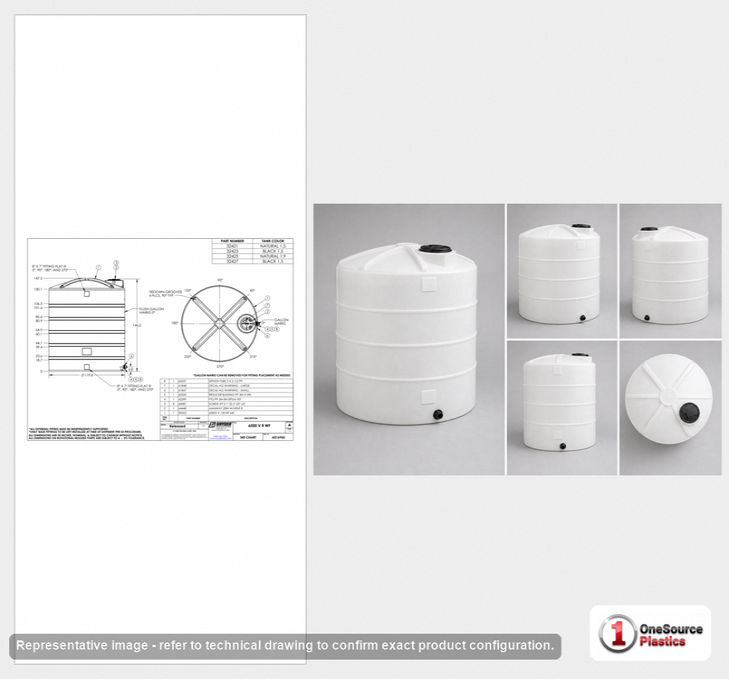
200 gallons on a 40 inch square footprint, 42 inches tall
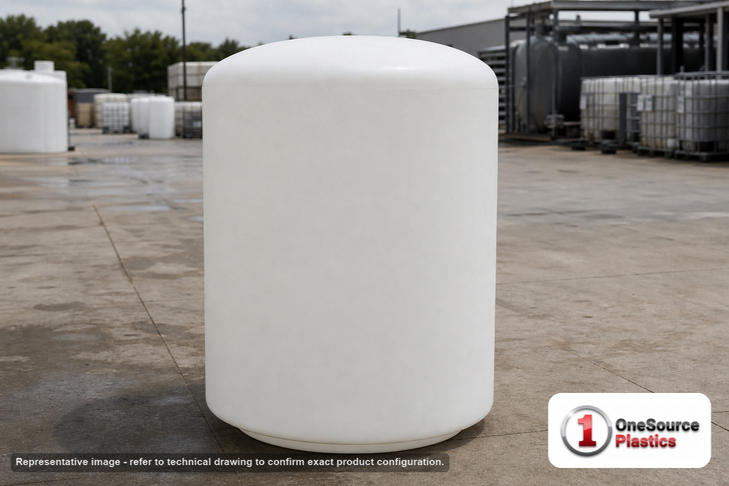
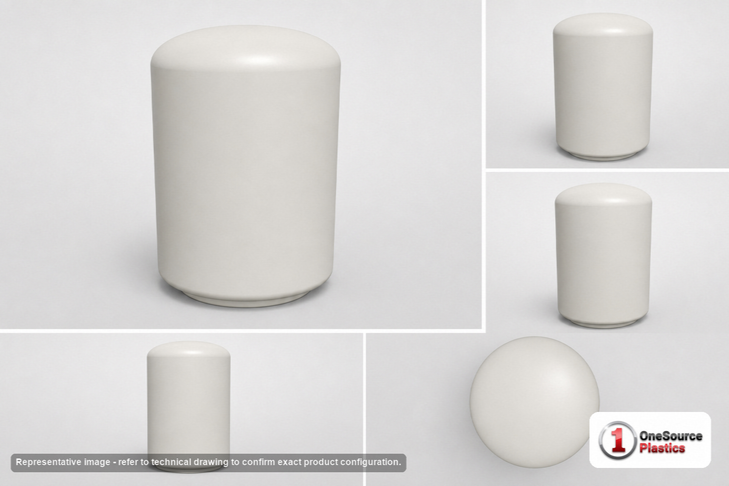
The Snyder SII-32154 holds 200 gallons of liquid in a white polyethylene shell 40 inches across and 42 inches tall, weighs 60 pounds empty, and is molded at Merced, California and Albertville, Alabama. The sheet rates the wall at a specific gravity of 1.9, and states the numbers behind it: 200 gallons of water is 1,668 pounds at 8.34 pounds per gallon, and the contents figure the sheet publishes against that wall is 3,169 pounds. It is fitted with a 20 inch threaded vented manway, a lid size given as 8 inches, and a 2 inch polypropylene female NPT bulkhead outlet with a siphon tube. Freight is class 400 and it moves as ordinary LTL freight rather than as an oversize load. This sheet publishes no temperature limit and no warranty term, so this page states neither; ask us and we will get Snyder's current terms from Snyder in writing.
Spec sheet in hand? Call 866-418-1777 and read us the liquid and the pad; or get freight to your ZIP and add it to your cart above.
The day tank a plant fills from a drum, not a tanker
Start with the duty, because at 200 gallons the duty is unusually specific. Nobody takes a tanker delivery into this tank. It is bought as a day tank on a chemical feed skid, as the mix and hold vessel beside a metering pump in a water or wastewater plant, as the tank that replaces a rack of drums in a maintenance shop, as a rinse or neutralising reservoir in a plating or food plant, as a small batch vessel in a laboratory building or a pilot line, and as the tank a farm or a spray contractor keeps under cover for a concentrate that gets drawn a few gallons at a time. The delivery is a drum pump, a hose off a larger tank, a tote decanted down, or a bucket. That changes what matters. The 40 inch square footprint is the number to check first, because this tank is bought to live indoors: 40 inches fits on a pallet-sized area of floor, inside a diked curb, in the corner of a chemical room, on a mezzanine, or beside a skid without blocking the aisle. At 42 inches tall the top of the tank is near bench height, which is what makes it a tank a person can work on: you can look into the manway without a ladder, take a sample from the top, and open the lid without standing on anything. At 60 pounds empty it is set by hand rather than by machine, which is the other reason it goes indoors where a bigger tank cannot. What the shape costs is head and reserve. There is very little vertical column above the outlet, so gravity does almost nothing for you, and 200 gallons goes fast on any real feed rate. Run the real consumption and the real refill interval through the tank sizing calculator before you commit to it, and take the working reserve you should never draw into, plus the freeboard a liquid needs as it warms, from the tank sizing guide. Under it, set it on something flat and continuous. A rotationally molded floor bears on the whole surface it touches and nothing else, so a wooden pallet with a broken slat, a grating, or a curb edge under one side of the base is a bearing point rather than a cosmetic problem, and 1,668 pounds of water finds it.
Four ways Snyder holds about 200 gallons
| Part | Gallons | Diameter x height | Empty weight |
|---|---|---|---|
| SII-32154 (this tank, white, widest and lowest) | 200 | 40 x 42 in | 60 lb |
| 1008000C26 (narrower, taller) | 200 | 36 x 53 in | 65 lb |
| 1008000C34 (black, narrower, taller) | 200 | 36 x 53 in | 65 lb |
| 1008000N42 (cross-linked, narrower, taller) | 200 | 36 x 53 in | 65 lb |
| 1540400N42 (smaller, cross-linked) | 190 | 42 x 47 in | 60 lb |
| 1012900C26 (larger, narrow) | 210 | 36 x 55 in | 65 lb |
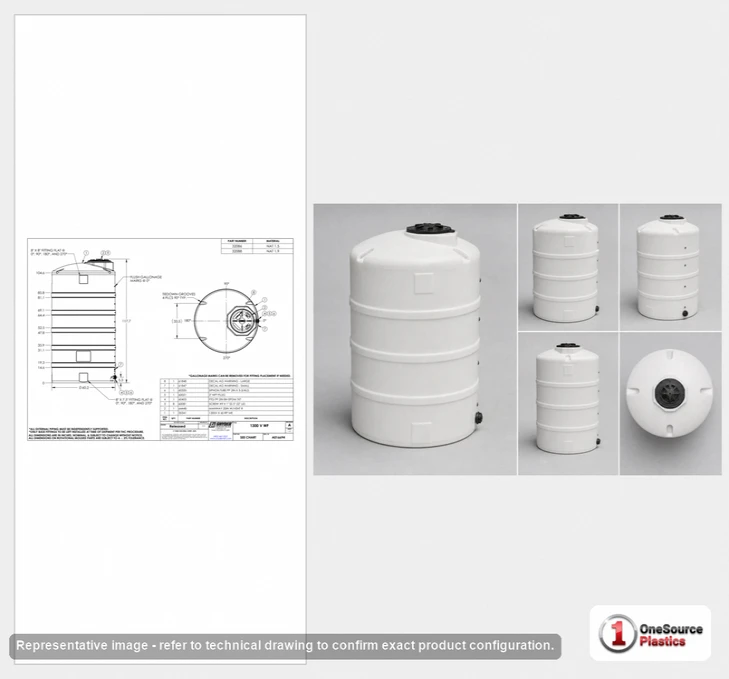
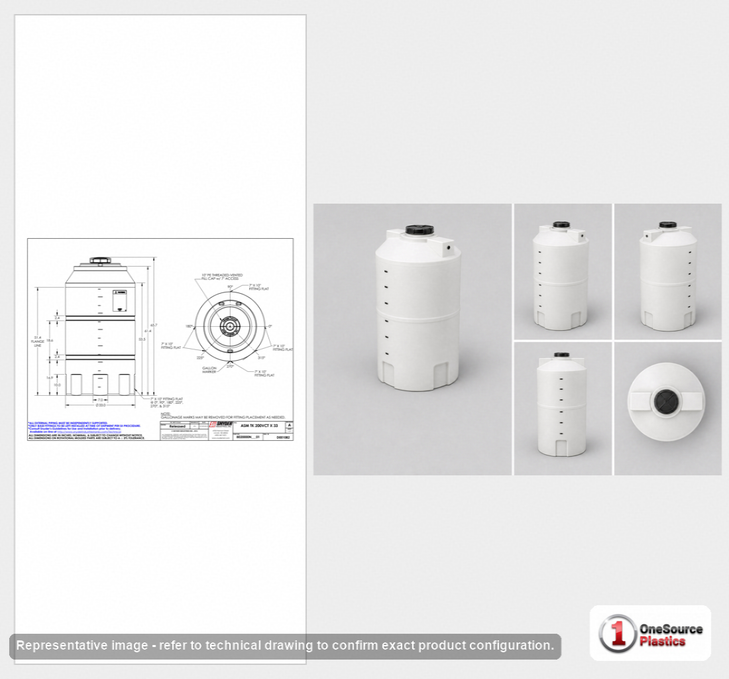
The reason to take this one rather than any of the 36 inch tanks is that it is the short one. The three 1008000 shells put the same 200 gallons on a 36 inch base and stand 53 inches, eleven inches taller than this tank, which is the buy when floor is the scarce thing and the ceiling is not, and which also puts the manway above easy reach for a shorter operator. This shell trades four inches of width for that eleven inches of height, and in a chemical room that is the difference between a tank you work over and a tank you work around. Among those three the choice is wall rather than shape: 1008000C34 is the black wall for a liquid that daylight degrades, 1008000N42 is the cross-linked one, and 1008000C26 is the plain white. Either side of 200 gallons, the 1540400N42 is the closest match to this tank's own low, wide silhouette at 190 gallons on a 42 inch base and 47 inches tall in a cross-linked wall, and the 1012900C26 adds ten gallons by going up to 55 inches on the narrow base. If the ten gallons matter more than the height, that is the one; if the bench height matters, this is.
Two rows look the same? The difference is the wall; call 866-418-1777 with the liquid and we will say which, or ask for a quote on both.
The pump comes first: a siphon tube and a 2 inch bulkhead
- The pump: with only 42 inches of shell there is barely three and a half feet of liquid above the base, so there is almost no suction head to work with and the pump layout is the whole installation. Put the pump below the level of the outlet, on its own base, with the shortest and straightest suction run you can manage. A metering or diaphragm pump that has to self prime will do it from here, but only if the line does not lift anywhere along its length; one high spot holds an air pocket that never clears.
- Prime and low level protection: fit a cleanable strainer at the pump rather than in a box, a foot valve or check where the pump must hold prime between calls, and a low level float, probe or run-dry cut-out that stops the pump with liquid still over the fitting. On a 200 gallon tank the bottom of the shell arrives quickly, and a metering pump that loses suction keeps running and keeps reporting that it is dosing.
- Outlet: a 2 inch polypropylene female NPT bulkhead fitting with a siphon tube, as the sheet lists it. The siphon tube takes the draw from inside the tank rather than straight out through the wall, which is what lets a small tank be emptied down without a bottom-of-wall connection doing the work. Make the thread up once, properly, and put a union or a flange a short way downstream so any valve or pump change happens there and never on the tank fitting.
- Access: a 20 inch threaded vented manway on top, with a lid size given on the sheet as 8 inches; both figures are the sheet's and we print them as they are given. Keep the lid closed between fills, keep the vent clear, and never let a pump draw against a blocked vent, because that is how a polyethylene wall gets pulled inwards.
The first joint off the outlet is flexible, always. A rigid line bolted to the fitting and then clamped to a wall puts every degree of thermal movement and every pump start into the bulkhead, and on a 60 pound tank the pipe wins. Carry the first valve on its own support rather than on the tank. Where the tank stands in a room with other vessels, label the wall with the one liquid inside it and nothing else, and read the level with an instrument rather than by opening the lid; the level gauge selection guide for chemical service works through which sensing technology suits which liquid, and on a tank this short the difference between a good gauge and a bad one is most of the usable range.
Dosing rooms, rinse stations and small batch work
The jobs this tank does are the small, repetitive, indoor ones: chemical feed and day storage beside a metering pump at a water or wastewater plant, a mix and hold vessel for a diluted concentrate, rinse and neutralising duty in a plating, dairy or food plant, a drum replacement in a maintenance shop where the same liquid is drawn every shift, small batch and pilot line work in a process building, coolant or cleaner storage in a machine shop, and covered concentrate storage on a farm or at a spray contractor. What decides suitability is the liquid rather than the volume, so check it against the chemical compatibility work before you order; the wall is polyethylene rated on this sheet at a specific gravity of 1.9 and nothing about that rating speaks to how a given liquid behaves against the resin over years. The size-specific argument for this tank against the other 200 gallon shells, including the fittings and the room it wants, is laid out in the complete buyers guide to the white vertical tank at this capacity.
Compatibility list
Liquids the maker rates this resin for, with concentration limits and the wetted fitting and gasket to specify. Confirm your own concentration and temperature on the chemical page or in the chemical compatibility database before ordering.
- Acetic Acid (60%) - PP/PVC fittings, EPDM gaskets
- Aluminum Sulfate (50%) - PVC fittings, EPDM gaskets
- Calcium Chloride (40%) - PVC fittings, EPDM gaskets
- DEF (32.5%) - 316SS fittings, EPDM gaskets
- Ethylene Glycol (100%) - PVC fittings, EPDM gaskets
- Ferric Chloride (50%) - PVC fittings, EPDM gaskets
- Ferric Sulfate (60%) - PVC fittings, EPDM gaskets
- Ferrous Sulfate (20%) - PVC fittings, EPDM gaskets
- Hydrochloric Acid (37%) - PVC fittings, Viton gaskets
- Hydrofluoric Acid (48%) - PP/PVC fittings, Viton gaskets
- Hydrofluosilicic Acid (26%) - PP/PVC fittings, Viton gaskets
- Hydrogen Peroxide (50%) - PVC fittings, Viton gaskets
- Magnesium Chloride (30%) - PVC fittings, EPDM gaskets
- Peracetic Acid (30%) - 316SS fittings, Aflas gaskets
- Phosphoric Acid (85%) - PVC fittings, Viton gaskets
- Polyaluminum Chloride - PVC fittings, EPDM gaskets
- Potassium Carbonate (50%) - PVC fittings, EPDM gaskets
- Potassium Hydroxide (saturated) - PVC fittings, EPDM gaskets
- Propylene Glycol - PP/316SS fittings, EPDM gaskets
- Sodium Bisulfate - PVC/PP fittings, EPDM gaskets
- Sodium Bisulfite - PVC/PP fittings, EPDM gaskets
- Sodium Carbonate (30%) - PVC fittings, EPDM gaskets
- Sodium Hypochlorite (
- Sodium Thiosulfate (40%) - PVC fittings, EPDM gaskets
- Sulfuric Acid (98%) - CPVC fittings, Viton gaskets
- Urea Solution (50%) - PP/PVC fittings, EPDM gaskets
- Zinc Orthophosphate - PP/316SS fittings, EPDM gaskets
LTL at class 400 from Merced or Albertville
The SII-32154 is molded at Merced, California and Albertville, Alabama and ships from the plant that serves your lane at class 400 as the sheet lists it, shipped 40 inches by 40 inches by 42 inches, and it moves as ordinary LTL freight rather than as an oversize load, which is the practical advantage of the short shell. The freight cost estimator prices the lane to your ZIP, and the listed price is before freight. At 60 pounds it comes off the truck without a machine, but decide before delivery day whether it is going through a door, because 40 inches across needs a double door or a wide single and it will not turn a tight corner on a stair. Then accept it properly: fill it with clean water to the manway, hold it, and read the base, the outlet fitting and the thread through the hold before the real liquid goes anywhere near it. Drain it and dry it afterwards. The cheapest hour this tank will ever get is the one where it is full of water and somebody is watching the floor around it. Mark the vent and the outlet on the outside of the shell so nobody caps the wrong one in the dark.
Freight and documents
Ships from: Merced, CA; Albertville, AL. LTL freight is quoted to your ZIP with the freight cost estimator or by phone at 866-418-1777. The listed price is before freight.
See this tank
Interactive 3D model with live fill. This tank has an interactive 3D model built to its manufacturer dimensions. Rotate it, and set a fill level to see how much liquid it holds at any height. Open the 3D view on the product photo above. Download the 3D model (GLB).
Product video. Watch the 200 Gallon Plastic Vertical Chemical Storage Tank in White video (69 seconds) with dimensions, fittings and shipping notes.
Ready to order?
Add it to your cart at the top of this page, get LTL freight to your ZIP, request a written quote, or call 866-418-1777. The listed price is before freight.