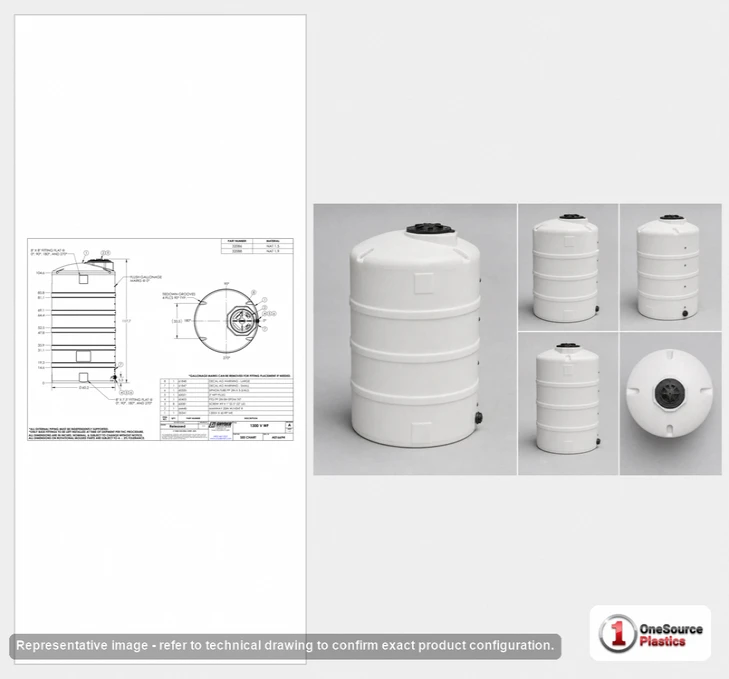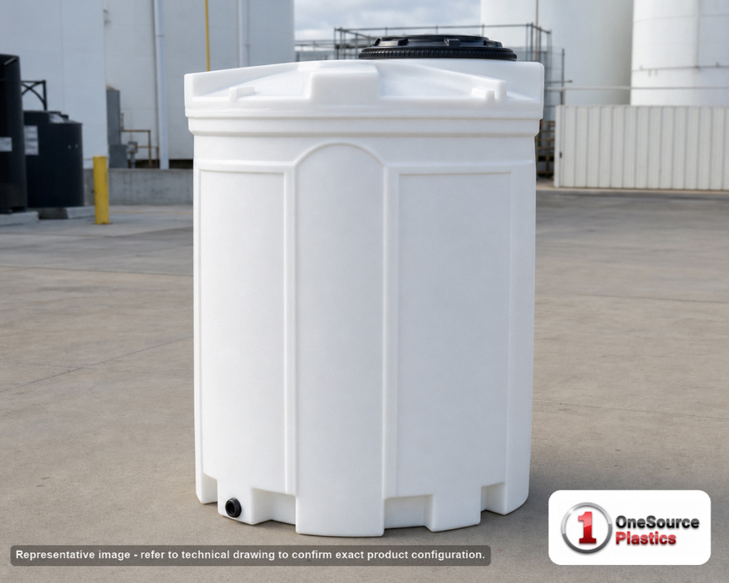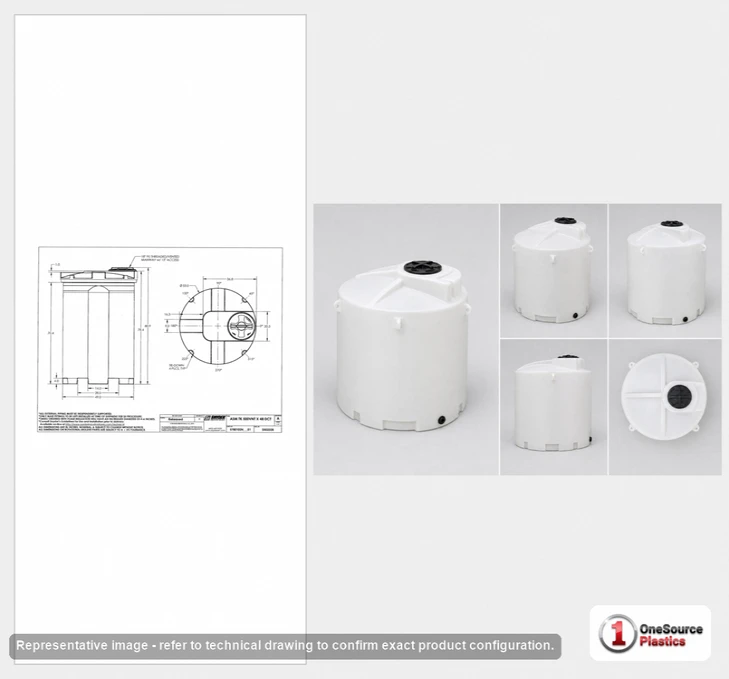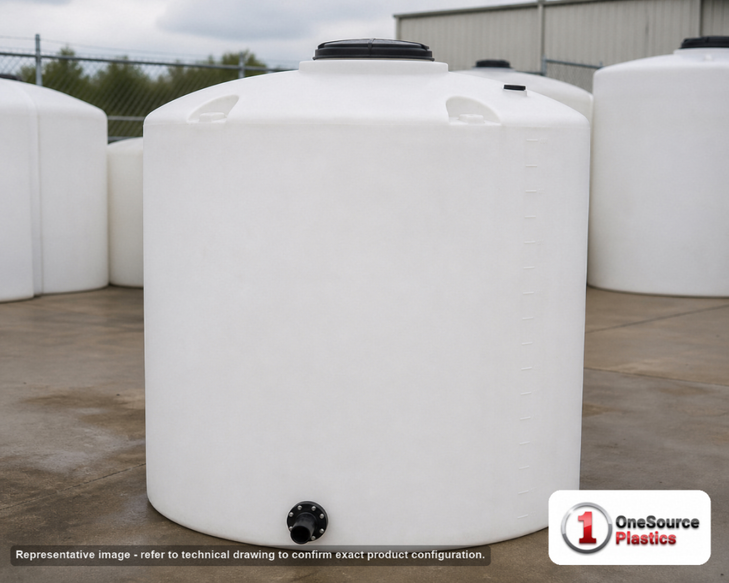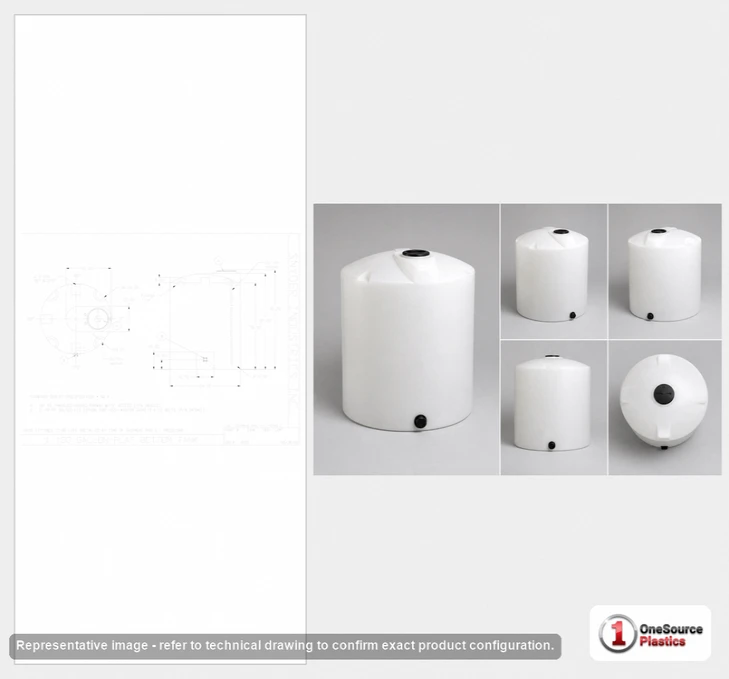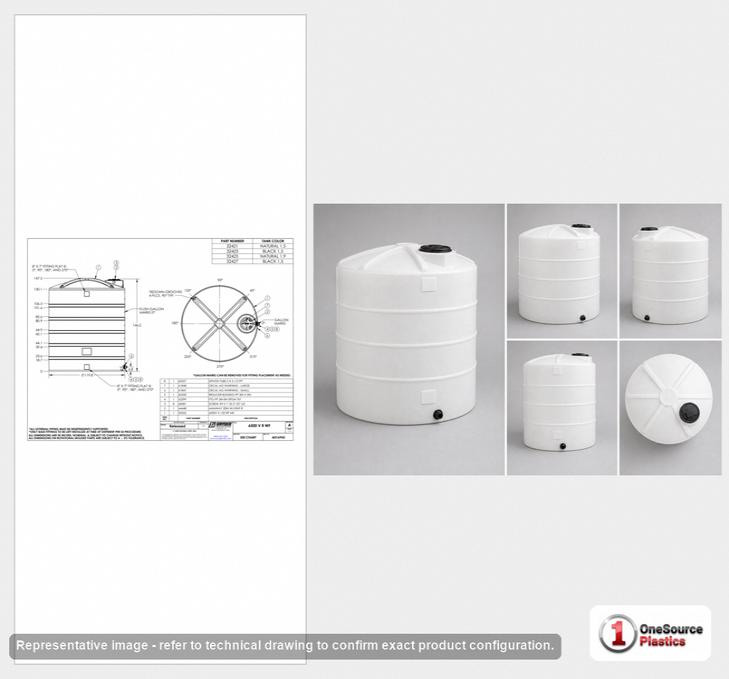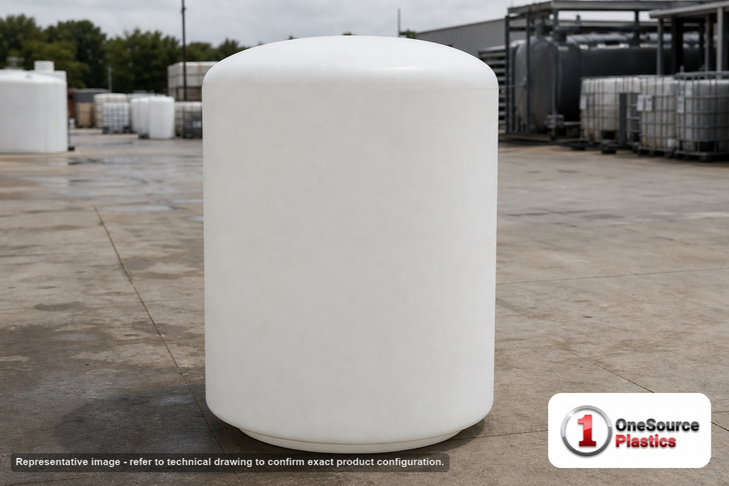
500 gallons, 48 inches across, 73 inches tall, 131 pounds empty
The Snyder SII-32344 holds 500 gallons in a white polyethylene shell 48 inches across and 73 inches tall, weighs 131 pounds empty, and is molded at Albertville, Alabama. The sheet rates the wall at a specific gravity of 1.9: 500 gallons of water is 4,170 pounds at 8.34 pounds per gallon, and the contents figure published against that wall is 7,923 pounds. It comes with a 20 inch threaded vented manway, a lid size given as 16 inches, and a 2 inch polypropylene female NPT bulkhead outlet with a siphon tube. Freight is class 400 and it moves as ordinary LTL freight. No temperature limit and no warranty term appear on this sheet, so this page states neither; ask us and we will get Snyder's current terms in writing.
Want it on your site? Get LTL freight to your ZIP, add it to your cart above, or call 866-418-1777 and a tank specialist will confirm the fit.
Farms and small plants buy the 500 because one man can plumb it
The duty here is a feed system somebody owns personally. At 500 gallons the buyer is a small water system or lift station dosing a treatment chemical, a farm or spray contractor holding a concentrate for the season, a food, dairy or beverage plant with a cleaning chemical at a wash-down station, a plating or finishing shop feeding a bath, a car wash or laundry with a detergent or reclaim tank, a greenhouse injecting nutrient into an irrigation line, a well house or booster station holding water for a slow source. What these have in common is that one person specifies it, one person plumbs it, and one person walks past it every day, which is why the shape matters more than the specification sheet. The 48 inch base is the number that decides most of these installations: it stands inside a containment curb, in a chemical shed, on a trailer deck, beside a pump skid, in the corner of a pump house, and it goes through a wide opening on a pallet. At 73 inches, six feet one inch, the manway is above head height for many people, so the fill point and the vent line get designed at working level rather than reached from a wobbling step. And 131 pounds empty means a forklift or three or four hands set it, not a crane, which is the whole reason a small site can install this tank in an afternoon. What the shape costs is footprint per gallon: 500 gallons on a four foot circle is a tall, narrow load, so the pad has to be flat and the tank has to be strapped, because a slim empty shell moves in wind and a slim full shell is unforgiving of a pad with a low corner. A rotationally molded floor bears on the whole surface it touches and nothing else, and 4,170 pounds of water will find the one place it does not touch. Pour or compact the base to the concrete pad sizing framework for above-ground polyethylene tanks, level and continuous. Then check the volume against the real dosing rate and the real delivery interval in the tank sizing calculator, and take the working reserve and the thermal freeboard from the tank sizing guide.
The 500s at 48 inches against the 500s at 53
| Part | Gallons | Diameter x height | Empty weight |
|---|---|---|---|
| SII-32344 (this tank, white, narrowest base) | 500 | 48 x 73 in | 131 lb |
| 5780100N42 (cross-linked, wider, taller) | 500 | 53 x 77 in | 141 lb |
| 5780100N48 (black, cross-linked, wider, taller) | 500 | 53 x 77 in | 141 lb |
| 5780100N51 (black, cross-linked, wider, taller) | 500 | 53 x 77 in | 141 lb |
| 5770100N42 (smaller, cross-linked) | 440 | 53 x 69 in | 130 lb |
| 1800000C34 (larger, black, same base) | 550 | 48 x 75 in | 110 lb |
Four tanks on this sheet hold 500 gallons and this is the only one on a 48 inch base. The three 5780100 shells are five inches wider and four inches taller at 141 pounds, in cross-linked walls, two of them black; take one of those when the liquid wants a cross-linked wall or a wall daylight cannot get through, and take this one when the five inches of diameter is the difference between fitting the curb and not. That is not a small distinction on the kind of site that buys a 500: containment curbs, shed doors and skid frames are built to the tank that was there before. The 5770100N42 steps down to 440 gallons at 130 pounds, almost this tank's weight for sixty fewer gallons, and the 1800000C34 is the interesting one: 550 gallons on this tank's own 48 inch base, two inches taller, listed at 110 pounds in a black wall, which the sheet gives and we print without explaining the weight difference. If daylight is the enemy and the extra gallons are welcome, look at that tank; if the wall rating on this sheet is what the liquid needs, this is the tank, and each of the others carries the rating its own sheet publishes.
Picked the 500 gallon tank? Add it to your cart above; freight is quoted to your ZIP before you pay anything.
Start at the pump: a metering suction off a 2 inch bulkhead
- The pump: 73 inches of shell gives six feet of liquid over the base, which is enough head to keep a metering, diaphragm or small transfer pump flooded if the pump sits below the outlet. On a feed system that is the difference between dosing and pretending to dose: a metering pump that loses suction keeps stroking, keeps its light on, and delivers nothing. Mount it low, on its own bracket off the floor rather than hung on the tank, with a short suction run that falls all the way to the pump and no high spot to hold an air pocket.
- Prime and protection: a cleanable strainer at the pump, a foot valve or check where prime has to be held between calls, and a low level float, probe or run-dry cut-out that stops the pump with liquid still over the fitting. Add a calibration column or a pot on the suction side if the dose is being proved to anybody, because that is the one instrument that tells you what actually left the tank.
- Outlet: a 2 inch polypropylene female NPT bulkhead fitting with a siphon tube, as the sheet lists it. The siphon tube takes the draw from inside the tank rather than through the base of the wall. Make the thread up once with the sealant the liquid calls for, and put a union a short way downstream so the pump or the valve can be changed without touching the tank fitting.
- At 73 inches up, design a fill coupling at working level rather than planning to pour into the manway from a step, keep the lid closed, and keep the vent clear so no pump ever draws against a blocked vent.
The first joint off the outlet is flexible, the first valve is carried on its own support, and nothing rigid is clamped between the wall and a building. On a tank this size the whole assembly is small enough that people bolt hard pipe straight to the bulkhead, and it is the commonest way a 500 gallon tank gets hurt. Read the level with an instrument rather than by eye or by lid: the level gauge selection guide for chemical service sets out which sensing technology suits which liquid and which ones foam, coat or crystallise their way into a false reading. And label the tank properly the day it lands, not the week after: the tank label and signage compliance guide reconciles the hazard diamond, the pictograms, the pipe marking and the placard hierarchy into one scheme that survives both a fire inspector and a workplace inspector.
Chemical feed, wash water and the labeling that goes with it
The jobs are small-system jobs: chemical feed and day storage at a small water system, lift station or booster house; cleaning and sanitising chemical at a dairy, food or beverage plant; bath and process chemistry at a plating or finishing shop; detergent, wax or reclaim water at a car wash or laundry; nutrient and injection storage at a greenhouse or nursery; concentrate storage for a spray contractor or a farm; and wash-down or equipment rinse water on a yard. The liquid decides suitability rather than the volume, so check the compatibility data against polyethylene and against the fitting materials before ordering, and read the rating on this sheet for what it is, which is the weight the wall is built to carry. Two buyers guides for tanks at this capacity are carried from the live page and are worth reading side by side, because they are two different shells at the same 500 gallons: the buyers guide to the white vertical tank on this base at this height and the buyers guide to the lower white vertical tank on the same base. Where the dimensions in those titles differ from this sheet's own figures, this sheet's figures are the ones that apply to this tank.
Chemical service ratings
The resin is rated for the liquids below at the concentrations shown; the fitting and gasket called out are the ones to order with the tank. Verify the exact service on the linked page or in the chemical compatibility database before ordering.
- Aluminum Sulfate (50%)
- Calcium Chloride (40%)
- Ethylene Glycol (100%)
- Ferric Chloride (50%)
- Ferric Sulfate (60%)
- Ferrous Sulfate (20%)
- Magnesium Chloride (30%)
- Potassium Carbonate (50%)
- Potassium Hydroxide (saturated)
- Sodium Carbonate (30%)
- Sodium Thiosulfate (40%) and
- Polyaluminum Chloride. Acetic Acid (60%) and Urea Solution (50%) use PP or PVC fittings with EPDM. A common high-intent use is
- DEF (diesel exhaust fluid, 32.5%) which calls for 316 stainless fittings with EPDM gaskets. Oxidizers and strong acids step up to Viton:
- Hydrochloric Acid (37%)
- Hydrogen Peroxide (50%)
- Phosphoric Acid (85%)
- Sodium Hypochlorite (under 16.5%) and with CPVC fittings
- Sulfuric Acid (98%).
- Hydrofluoric Acid (48%) and
- Hydrofluosilicic Acid (26%) run PP/PVC fittings with Viton, and
- Peracetic Acid (30%) needs 316SS fittings with Aflas gaskets.
- Sodium Bisulfate and
- Sodium Bisulfite use PVC or PP with EPDM
- Propylene Glycol and
- Zinc Orthophosphate use PP or 316SS with EPDM. Ozonated Water (up to 10 PPM) runs PVC fittings with EPDM gaskets.
Albertville to the yard, LTL, one pallet
The SII-32344 ships from Albertville, Alabama at class 400 as the sheet lists it, and it moves as ordinary LTL freight rather than as an oversize load, which is what keeps a tank this useful affordable to get to a small site. The freight cost estimator prices the lane to your ZIP, and the listed price is before freight. At 131 pounds it comes off the truck with a forklift or with hands, but a 48 inch base and 73 inches of height is an awkward thing to carry and an easy thing to tip, so plan the last fifty feet before the truck arrives: the door width, the curb height, the step into the shed. Set it on the finished base rather than parking it on gravel beside the base. Then fill it with clean water to the manway, hold it, and read the outlet thread, the base and the floor around it before the working liquid arrives; drain and dry it afterwards. Write the date of that first fill on the tank with a paint marker, because in five years it is the only record anybody will be able to find. Keep the delivery paperwork with the tank; the serial number on the shell is what a warranty claim starts from.
Freight and documents
Ships from: Albertville, AL. LTL freight is quoted to your ZIP with the freight cost estimator or by phone at 866-418-1777. The listed price is before freight.
See this tank
Interactive 3D model with live fill. This tank has an interactive 3D model built to its manufacturer dimensions. Rotate it, and set a fill level to see how much liquid it holds at any height. Open the 3D view on the product photo above. Download the 3D model (GLB).
Product video. Watch the 500 Gallon Plastic Vertical Chemical Storage Tank in White video (64 seconds) with dimensions, fittings and shipping notes.
Ready to order?
Add it to your cart at the top of this page, get LTL freight to your ZIP, request a written quote, or call 866-418-1777. The listed price is before freight.