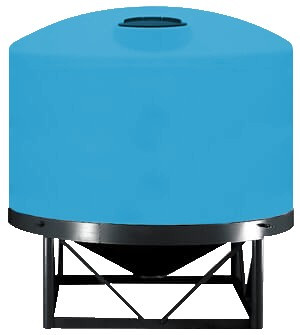
Thirty-five gallons under a ten inch lid
Part number SII-1580000N45 is a 35 gallon cone bottom tank listed at 30 inches long, 30.25 inches wide and 29.5 inches tall, at 14 pounds empty and 14 pounds shipping. The material field reads High Density Linear Polyethylene and the colour field reads White; HDPE is a word in the listing name and the material field is what this page cites. The wall carries a specific gravity rating of 1.9, and the sheet gives 555 pounds of max contents against 292 pounds of water at 8.34 pounds per gallon. The opening on top is a lid field reading 10 inches; this record publishes no manway at all. The service limit is 100 F / 37 C. Freight class reads 500 beside an LTL ship mode, out of Lincoln, Nebraska. The listing name calls this a 30 Degree tank and the sheet publishes no cone angle field, which is exactly how this page puts it. The outlet and inlet fields are empty, and there is no warranty term, no NMFC number, no structural detail and no stand on this record. None of that is asserted here.
Replacing a tank that failed? Call 866-418-1777 with what it held and how long it lasted; or check freight to your ZIP and put the 35 gallon tank in your cart above.
Small volume, complete drain: the duty behind a thirty-five gallon cone
Thirty-five gallons is a working batch, not a store, and the cone is there because the batch has to come back out whole. The duties that buy this size are the ones where the last of the liquid is the part that matters. A mix station making up a solution that is used the same day and made up again tomorrow. A dosing vessel feeding a small metering pump on a skid. A settling or sampling duty where solids drop to a point and get drawn off before the clear liquid above them. A plating, anodising or parts wash bath that is changed on a cycle and has to be emptied without tipping anything by hand. A laboratory, pilot or quality rig where a process is proved at a scale somebody can lift. A nursery, greenhouse or grow operation batching feed for an injector. In all of them the alternative is a drum, and a drum leaves its last inch on a flat floor for somebody to tip, pump or wipe. At 292 pounds of water this vessel is already past the weight where tipping is a sensible answer, which is the honest argument for a sloped bottom at a small size. The proportions are the second half of the case and they are unusual in a useful way. The sheet gives 30 inches of length against 30.25 inches of width, a fraction of an inch apart on a round vessel, and 29.5 inches of height. What they add up to is a tank that is almost exactly as wide as it is tall: two and a half feet across, two and a half feet high. That is a low, broad shape, and it is the reason this one turns up under a bench, on a cart, beside a machine or in a bay with something fixed overhead. A tall vessel of the same volume would not go in any of those places. Plan what carries it before it arrives, because a cone bottom tank has no flat floor and cannot stand on its own bottom. This sheet publishes no stand, no legs, no ring, no frame and no bolt pattern, so this page describes none, and whatever you put under it is a separate purchase. It has to take 14 pounds of empty tank, 292 pounds of water and 555 pounds at the rating, and it has to hold the discharge high enough that whatever the tank empties into will actually fit underneath. That clearance is the measurement people forget, and it is the one that decides whether the installation works. Settle the working volume with the tank sizing calculator and take the freeboard discipline from the tank sizing guide before you decide how much of the 35 gallons you can really use.
Four small cones, and the heights that tell them apart
| Part | Gallons | Length x width x height | Empty weight |
|---|---|---|---|
| SII-1580000N45 (this tank, white, rated 1.9) | 35 | 30 x 30.25 x 29.5 in | 14 lb |
| 1580000N51 (same volume, same circle, shorter) | 35 | 30 x 30 x 24 in | 14 lb |
| 32223 (less volume, a smaller circle) | 30 | 27 x 27 x 20 in | 20 lb |
| 32419 (more volume, this circle, listed heavier) | 60 | 30 x 30 x 29 in | 30 lb |
Read the last two columns together and the sheet tells a clear story. This listing and 1580000N51 both hold 35 gallons at the same 14 pounds, and the difference between them is height: 29.5 inches here against 24 inches there, with the width field on this one reading 30.25 inches against a flat 30. Five and a half inches is the whole of the published difference, and on a vessel that has to fit under a shelf or inside a cabinet, five and a half inches is frequently the entire decision. 32223 steps down to 30 gallons in a 27 by 27 by 20 inch shape, which is the shortest and narrowest item here and the right answer where the space is genuinely tight. 32419 steps up to 60 gallons in a 30 by 30 by 29 inch shape, almost exactly this tank's envelope for nearly twice the volume, which makes it the one to look at before you settle on 35 gallons. The weights do not track the sizes on this record: it gives 14 pounds for this listing and for 1580000N51, 20 pounds for the smaller 32223 and 30 pounds for 32419. The sheet gives those figures and explains none of them, so this page prints them and explains none of them either. The sibling names describe mixing vessels, which is a different arrangement at the top of the tank from the 10 inch lid on this one; if the opening is what your job turns on, tell us and we will confirm what each part number carries in writing before an order is placed. What this page stands behind is its own sheet: 35 gallons, a 30 by 30.25 by 29.5 inch envelope, 14 pounds, a specific gravity rating of 1.9, 555 pounds of max contents and a service limit of 100 F / 37 C. Where the angle rather than the volume is what you are choosing, the cone angle selection guide works through what a steeper or shallower cone actually does to a product.
Want the certified one or the plain one? Call 866-418-1777 and say what the inspector asks for; or request a quote on the row you need.
The drain nobody sized, and a ten inch lid instead of a manway
- The drain path first, because it is the reason the shape exists: the vessel runs to a single low point rather than across a floor, so what settles keeps moving toward the discharge and the last of the batch comes out instead of staying in.
- The outlet: the field on this record is empty. No outlet dimension, no thread, no bulkhead and no valve is published, so none is claimed here. Tell us the line or tube size you need to land, the valve type and the product, and we will confirm what this part number carries before anything is ordered.
- The inlet: also blank on this sheet. The fill arrangement is not published and is not described here.
- The cone angle: the listing name reads 30 Degree. The sheet itself carries no cone angle field, and this page says so rather than restating the name as a specification.
- The opening on top: a lid field reading 10 inches, and no manway entry at all on this record. Ten inches is a hand-and-hose opening rather than a body opening, so plan the charging, the cleaning and the inspection around that: a brush, a wash lance and a light go through it comfortably, a person does not.
- The vent: no separate vent field is published on this sheet, so none is described. On any vessel being drawn down by pump the air path is what protects the wall, and it is worth settling how that is arranged for your installation before the tank is in service.
- Ratings and blanks: a specific gravity rating of 1.9, 292 pounds of water at 35 gallons, 555 pounds of max contents and a service limit of 100 F / 37 C. No warranty term, no NMFC number and no structural detail appears on this record.
At this size the level is usually read through the opening or by weight rather than by instrument, but the discharge arrangement still deserves a drawing. Where it lands, what it lands in and how it is isolated are all decisions that are easier before the tank is on its support.
Benches, mix stations and sampling rigs that turn over a drum a day
Thirty-five gallons is a shift's worth of solution in a lot of operations, and that is the way to think about the buying case. A parts wash or plating line with a bath that is made up, used and changed on a cycle. A treatment skid on a package plant, holding a dosing chemical for a metering pump that runs steadily and needs to be topped up rather than watched. A laboratory or quality department making up working solution in a usable quantity instead of a drum-sized one. A nursery or greenhouse batching feed for an injector, where the mix changes between crops and nothing can carry over. A sampling or settling station where solids are collected at a point and drawn off first. A small manufacturing rig proving a process before it is trusted at scale. In every one, a person works at this tank by hand several times a day, and the two features that decide whether that is pleasant are the 10 inch lid and the low, broad shape. Together they put the whole of the vessel within easy reach of somebody standing beside it rather than climbing anything. Two honest limits belong here. The specific gravity rating on this record is 1.9, which describes how dense a liquid the wall is rated to hold and describes nothing else at all. It is not a statement about how your product behaves against polyethylene and we will not present it as one. Name the liquid, the concentration and the temperature it genuinely sits at when you enquire, look it up in our chemical compatibility reference before a gasket, a seal or a valve is chosen, and let the chemistry decide those rather than the tank. The service limit here is 100 F / 37 C, which is a real constraint on a heated bath or a solution made up warm, so read your duty against it rather than around it. On the routine: label the vessel with what is in it and when it was made up, because a small tank changes hands more often than a large one and the person who empties it is rarely the person who filled it. Check the lid seats properly every time rather than once. Keep the area under the discharge clear so a weep is seen rather than stepped in. And prove the tank with clean water before it holds anything that matters, because 292 pounds is the honest test of an installation somebody put together in an afternoon.
Rated liquids and the fittings to order with them
The resin carries a rating for each liquid below at the concentration shown, and each line names the wetted fitting and gasket to specify. Confirm the service you actually run on the chemical page or in the chemical compatibility database before ordering.
- Acetic Acid at 60% with PP/PVC fittings and EPDM gaskets
- Aluminum Sulfate at 50% with PVC fittings and EPDM gaskets
- Calcium Chloride at 40% with PVC fittings and EPDM gaskets
- DEF at 32.5% with 316SS fittings and EPDM gaskets
- Ethylene Glycol at 100% with PVC fittings and EPDM gaskets
- Ferric Chloride at 50% with PVC fittings and EPDM gaskets
- Ferric Sulfate at 60% with PVC fittings and EPDM gaskets
- Ferrous Sulfate at 20% with PVC fittings and EPDM gaskets
- Hydrochloric Acid at 37% with PVC fittings and Viton gaskets
- Hydrofluoric Acid at 48% with PP/PVC fittings and Viton gaskets
- Hydrofluosilicic Acid at 26% with PP/PVC fittings and Viton gaskets
- Hydrogen Peroxide at 50% with PVC fittings and Viton gaskets
- Magnesium Chloride at 30% with PVC fittings and EPDM gaskets
- Peracetic Acid at 30% with 316SS fittings and Aflas gaskets
- Phosphoric Acid at 85% with PVC fittings and Viton gaskets
- Polyaluminum Chloride with PVC fittings and EPDM gaskets
- Potassium Carbonate at 50% with PVC fittings and EPDM gaskets
- Potassium Hydroxide at saturated concentration with PVC fittings and EPDM gaskets
- Propylene Glycol with PP/316SS fittings and EPDM gaskets
- Sodium Bisulfate with PVC/PP fittings and EPDM gaskets
- Sodium Bisulfite with PVC/PP fittings and EPDM gaskets
- Sodium Carbonate at 30% with PVC fittings and EPDM gaskets
- Sodium Hypochlorite at under 16.5% with PVC fittings and Viton gaskets
- Sodium Thiosulfate at 40% with PVC fittings and EPDM gaskets
- Sulfuric Acid at 98% with CPVC fittings and Viton gaskets
- Urea Solution at 50% with PP/PVC fittings and EPDM gaskets
- Zinc Orthophosphate with PP/316SS fittings and EPDM gaskets
Fourteen pounds shipped, and why class five hundred is on the ticket
This tank is moulded at Lincoln, Nebraska, and Nebraska is the shipping state on the record, which puts the central plains on a short lane and either coast on a planned one. The freight class field reads 500, a numeric class rather than a mode, the ship mode reads LTL, and the sheet publishes no NMFC number. The interesting figure is the pairing: 14 pounds in a package 30 inches by 30.25 inches by 29.5 inches. That is two and a half feet cubed of air around a very light moulded shell, and a package that takes trailer space without loading it is exactly what a high numeric class describes. It is worth knowing before the quote arrives rather than after, and it is why a small tank does not always ship like a small item. Price the lane to your own ZIP with the freight cost estimator; the listed price is before freight. Receiving it is genuinely easy at 14 pounds: one person, no machine, no dock needed. Do the boring checks anyway. Look at the cone and the area around the low point in daylight before signing rather than in a doorway, check the 10 inch lid seats and closes properly while the tank is still empty and easy to turn, and keep the packaging until it has held water. Then prove it: stand it on whatever will carry it, fill it with clean water to hold the 292 pound load, and leave it standing full for a few hours with clean paper under the low point, because water finds a weep that product hides and paper shows it faster than a floor. If the tank is going on a cart or a bench rather than a fixed frame, decide how it is restrained before it is in service; at 555 pounds at the rating, a vessel this shape should not be free to be knocked. Keep one spare gasket for the outlet fitting on the shelf; it is the part that fails on a holiday.
Freight and documents
Ships from: Lincoln, NE. LTL freight is quoted to your ZIP with the freight cost estimator or by phone at 866-418-1777. The listed price is before freight.
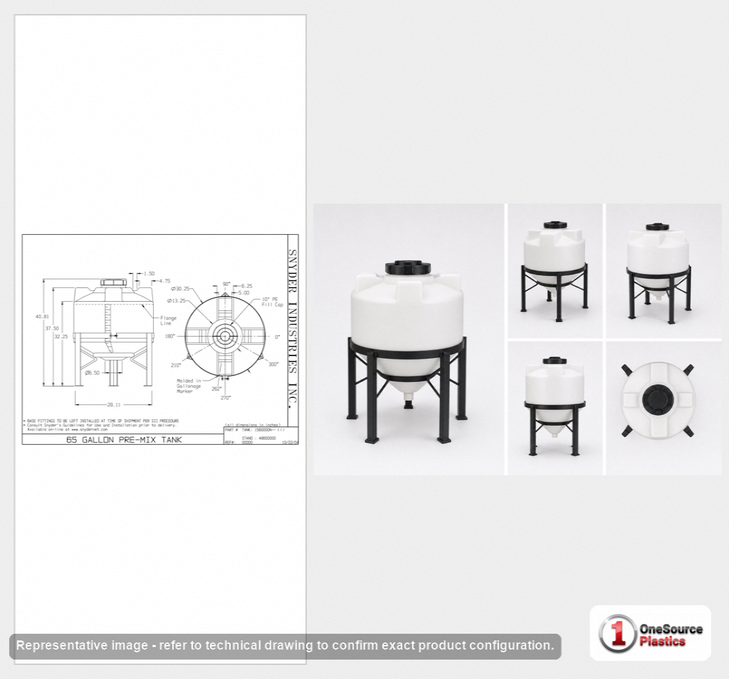
Technical drawing (PDF) for Snyder Industries 1580000N45.
See this tank
Interactive 3D model with live fill. This tank has an interactive 3D model built to its manufacturer dimensions. Rotate it, and set a fill level to see how much liquid it holds at any height. Open the 3D view on the product photo above. Download the 3D model (GLB).
Product video. Watch the 35 Gallon 30 Degree HDPE Cone Bottom Tank in White video (62 seconds) with dimensions, fittings and shipping notes.
Ready to order?
Add it to your cart at the top of this page, get LTL freight to your ZIP, request a written quote, or call 866-418-1777. The listed price is before freight.