Forty cubic feet of dry material over a 45 degree cone
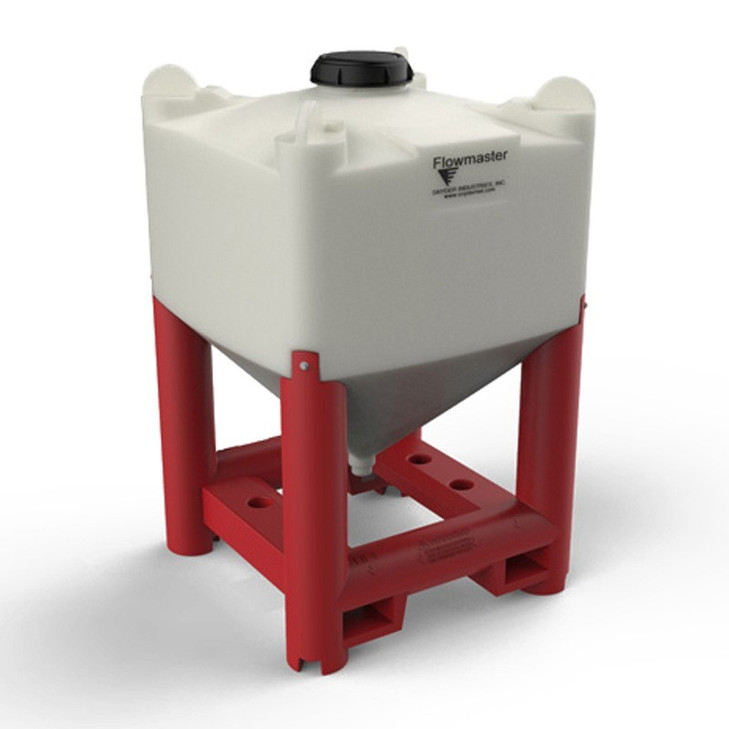
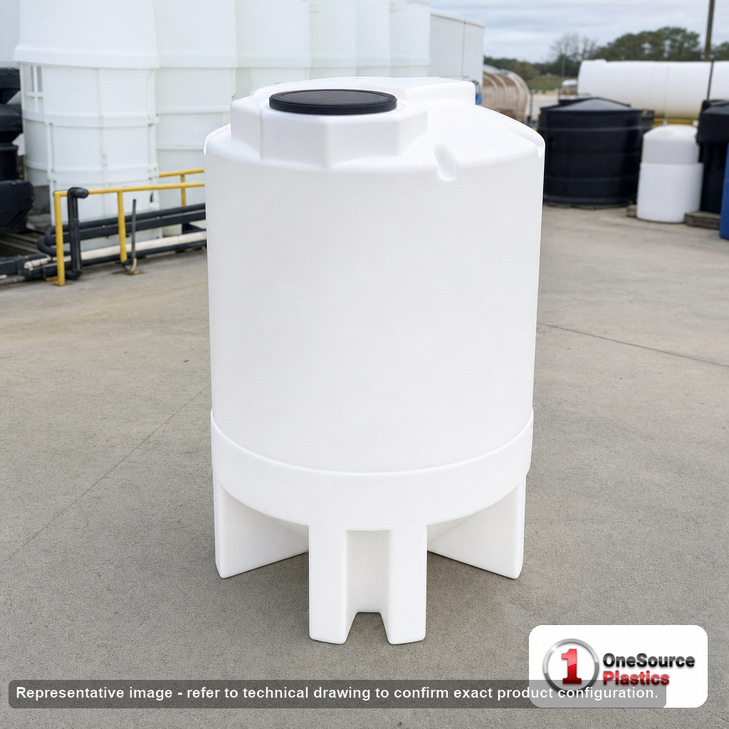
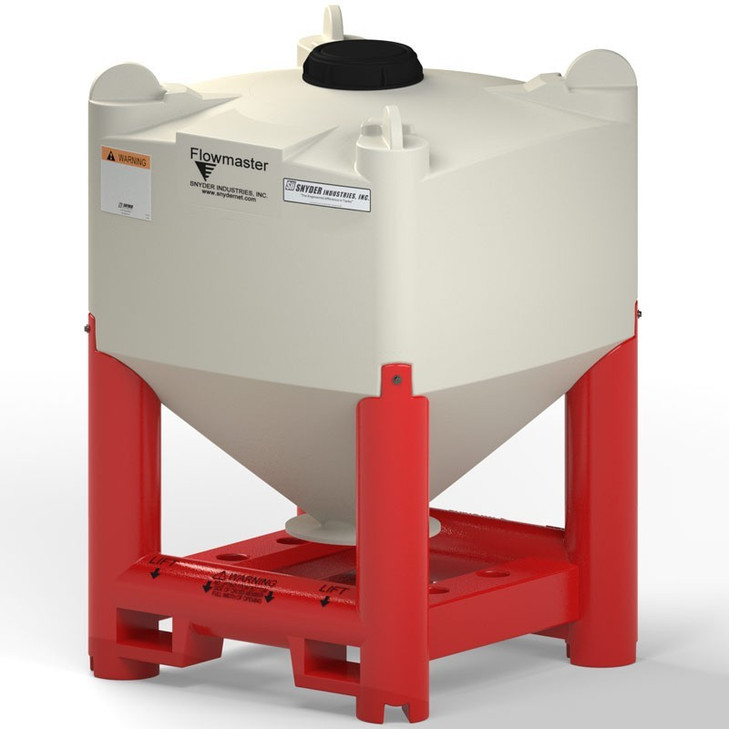
The Snyder SII-6370540N95402 is a 40 cubic foot capacity 45 degree plastic cone bottom dry hopper bin in white high density linear polyethylene, listed 53 inches long, 48 inches wide and 68 inches tall, at 341 pounds empty and 341 pounds shipping. Read the capacity again, because it is the thing most people get wrong about this product: it is rated in cubic feet, not in gallons, because it is a dry material bin. The sheet carries liquid fields as well, and a dry hopper bin is not sold on them, so no liquid capacity, no specific gravity and no liquid service is claimed anywhere on this page. The cone angle is published as 45 degrees and the name says the same. The opening on top is listed at 12 inches. The service limit is 120 F / 48 C. There is no outlet field, no inlet field, no stand and no warranty term on this sheet, and none of them is asserted here.
Replacing a tank that failed? Call 866-418-1777 with what it held and how long it lasted; or check freight to your ZIP and put the 300 gallon tank in your cart above.
A dry bin, not a liquid tank, and why that decides everything
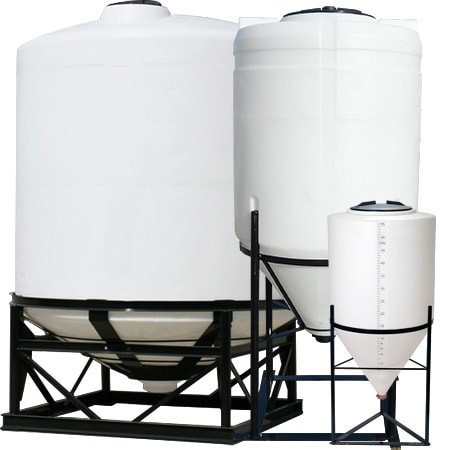
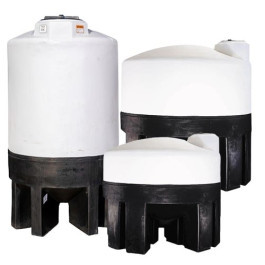
The family on this sheet is mixed, and that is exactly why the first decision is what state your material is in. This part is the dry hopper bin. Its nearest neighbour, SII-6370541N95402, is named on the sheet as a viscous liquid hopper tank with stand, at 50 inches by 45 inches by 68 inches and 385 pounds; the other two, SII-5740101N45 and SII-1560500N45, are named as cone bottom tanks. They look alike in a photograph and they are not the same product, so start from the material and let it pick the row. Dry material behaves nothing like liquid in a vessel. It does not find its own level, it does not flow until something makes it flow, and it can bridge over an opening and sit there while the outlet below it runs empty. That is what a 45 degree cone is for. Of the common cone angles it is the steepest, and the steeper the wall the better the chance that the material keeps moving under its own weight instead of arching across the throat and needing a hammer. So the reason to buy this bin rather than a shallower one is not capacity at all; it is the angle, and the angle is bought for the material's own behaviour. The cone angle buyer's guide compares 15, 30 and 45 degrees properly and it is the right place to settle that question before a part number is chosen. The second decision is what holds it up. A cone bottom bin cannot stand on its own bottom and this sheet publishes no stand, no legs and no frame, so the support is a separate item specified before the bin arrives; we will not print a part number the sheet does not carry. What the sheet does give you is the envelope that structure has to live inside: 53 inches by 48 inches in plan and 68 inches tall, with 341 pounds of empty bin plus the weight of whatever you put in it landing on the frame's feet. Set the frame on flat, continuous, level support and anchor it. Then work out how the material gets in: at 68 inches plus the height of the stand, the 12 inch opening is a long way up, and a fill route by hand, by hoist or by conveyor is part of the installation rather than an accessory. Size the volume against your real usage before any of it is built with the tank sizing calculator, and take the headroom discipline from the tank sizing guide.
The dry bin beside a viscous liquid hopper and two cone tanks
| Part | Listed as | Length x width x height | Empty weight |
|---|---|---|---|
| SII-6370540N95402 (this bin, dry, 45 degree) | 40 cubic foot dry hopper bin | 53 x 48 x 68 in | 341 lb |
| SII-6370541N95402 (viscous liquid, with stand) | 300 gallon viscous liquid hopper tank | 50 x 45 x 68 in | 385 lb |
| SII-5740101N45 (shallow cone tank) | 275 gallon 15 degree cone bottom tank | 42 x 42 x 63 in | 140 lb |
| SII-1560500N45 (cone tank with stand) | 325 gallon 30 degree cone bottom tank | 48 x 48 x 55 in | 145 lb |
The table is a materials table more than a size table. Only the top row is a dry bin; every other row is named on the sheet as a liquid tank and we name them exactly as it does. The second row is the closest relative and the most instructive comparison: SII-6370541N95402 stands the same 68 inches tall, is listed at 385 pounds where this bin is 341, and is described as a viscous liquid hopper tank supplied with a stand. Viscous liquid and dry powder are two answers to the same problem, which is that ordinary vessels do not empty themselves when the contents do not flow, and a steep hopper is the answer to both. Which one you need is decided by what you are storing, not by the shape. The bottom two rows step down in cone angle and step up in floor efficiency: SII-5740101N45 is a 15 degree cone at 42 inches square and 63 inches tall, only 140 pounds, and SII-1560500N45 is a 30 degree cone with a stand at 48 inches square and 55 inches tall, 145 pounds. Both are much lighter than this bin, because a dry bin carries a different kind of load and is built accordingly, and both are shallower, which is fine for a liquid that flows and wrong for a solid that bridges. There is a whole buyer's guide written around that smaller 30 degree cone and stand combination, and it is worth reading even if you end up here: the 30 degree cone bottom tank with poly stand buyer's guide goes through the stand, the discharge and the clearance underneath in the detail a spec sheet never carries.
Want the certified one or the plain one? Call 866-418-1777 and say what the inspector asks for; or request a quote on the row you need.
Twelve inches of opening, and the air a bin moves through it
- The opening and the air: the sheet publishes a 12 inch opening on top and nothing else. On a dry bin that single opening is doing two jobs at once, because every cubic foot of material that drops out of the bottom has to be replaced by a cubic foot of air coming in at the top. Fill it fast through a sock or a chute and the same opening has to let the displaced air out again. Keep it clear, keep it unobstructed while material is being drawn, and do not cap it and then open the discharge.
- Dust: air moving in and out of an opening carries fines with it. Where the material is dusty, the extraction, the sock or the filter arrangement belongs in the design of the installation rather than in a list of tank features, and this sheet publishes none of it.
- Access: 12 inches at 68 inches plus the height of whatever frame the bin sits in. That is a fill route to design, not a lid to reach over, and it is worth deciding at the same time whether anyone will ever need to look inside.
- The discharge: the sheet publishes no outlet and no inlet, so no size, no thread and no slide gate is claimed here. A dry hopper is finished with a gate or a valve chosen for the material's particle size and flow behaviour; tell us what you are storing and we will confirm what this part carries before it ships.
- The stand: none on this sheet. No legs, no frame and no bolt pattern is published, and nothing is invented. Whatever holds the bin up also sets the clearance under the discharge, which is the dimension that decides whether a drum, a bag or a conveyor fits underneath.
- Limits: 120 F / 48 C is the only service limit published, and there is no warranty term on this sheet.
Where the top of the bin carries more than one connection, decide the layout once on paper instead of drilling twice: the top fitting placement guide sets out how fill, vent, level and drain are arranged so they do not fight each other. Where a hopper on this sheet is feeding a pump on a liquid duty rather than a gate on a dry one, the suction geometry under it is its own engineering problem, and the pump priming and dry run protection guide covers foot valve reliability and low level cutoff properly.
Powders, pellets and granules that have to discharge clean
A dry hopper bin at this capacity is bought by operations that handle bulk solids in batches: plastics processors holding resin pellets and regrind beside a press, feed and grain handling at a mill or a farm, minerals, sand and abrasive media at a blast or wash operation, dry chemical and powder handling at a water treatment plant, food ingredient and dry mix storage, and any plant that buys a material in bulk bags and needs somewhere sensible to put it between the bag and the process. The common problem in every one of those is not storage; it is discharge. Solids bridge, rathole, segregate and pack under their own weight, and the fix is always geometry first and equipment second. Buy the steepest cone your space allows, keep the discharge full-bore, and look at how the material behaves in a small bin before scaling up. If your material is known to be difficult, say so when you enquire, because the honest answer may be a different shape rather than a bigger one.
Listed chemical service for this shell
The maker's list for this resin: each liquid, the concentration it is rated to, and the fitting and gasket that go on the order. Verify your own service on the linked page or in the chemical compatibility database before ordering.
- Acetic Acid at 60% (PP/PVC fittings)
- Aluminum Sulfate at 50%
- Calcium Chloride at 40%
- Ferrous Sulfate at 20%
- Magnesium Chloride at 30%, and
- Sodium Carbonate at 30%, all with PVC fittings and EPDM gaskets, plus Ozonated Water up to 10 PPM on the same PVC/EPDM pairing.Two fluids sit comfortably in
- DEF at 32.5% and
- Urea Solution at 50% both call for only a 1.35 SG tank, so this 1.5 SG bin is a strong fit for a DEF or urea program - note both want 316SS or PP/PVC f
- Sulfuric Acid at 98% (CPVC fittings, Viton gaskets)
- Hydrochloric Acid at 37% (PVC/Viton)
- Sodium Hypochlorite under 16.5% (PVC/Viton)
- Hydrogen Peroxide at 50% (PVC/Viton)
- Phosphoric Acid at 85% (PVC/Viton)
- Peracetic Acid at 30% (316SS/Aflas)
- Ferric Chloride at 50% (PVC/EPDM)
- Ethylene Glycol (PVC/EPDM), and
- Potassium Hydroxide (PVC/EPDM).This 1.5 SG unit is not rated for those - step up to a 1.9 SG tank rather than compromise wall strength.When you do commit fit
Nebraska, LTL, and 341 pounds on the deck
This bin is moulded at Lincoln, Nebraska, and the sheet lists Nebraska as the state it ships from, a central lane into the plains and the Midwest. The freight class is given as LTL, a mode rather than a numeric class, under NMFC 156600-03, and it shipments at 53 inches by 48 inches by 68 inches. Price the lane to your ZIP with the freight cost estimator; the listed price is before freight. At 341 pounds it needs a forklift or a pallet jack at the receiving end, taken under the body and never by the 12 inch opening, and the shipment is tall enough on a pallet that the door and the aisle on the route to its final position are worth measuring before the truck is booked rather than after. Set the frame first, level it, anchor it, and only then put the bin into it. Prove it with a partial fill before a full one: load a modest quantity, open the discharge, and watch whether the material moves all the way out under its own weight without help. That single test tells you more about whether this bin suits your material than any specification will. A bin that bridges on the first small fill will bridge worse on every one after it, so find out on day one while it is still easy to empty by hand. Keep one spare gasket for the outlet fitting on the shelf; it is the part that fails on a holiday.
Freight and documents
Ships from: Lincoln, NE. LTL freight is quoted to your ZIP with the freight cost estimator or by phone at 866-418-1777. The listed price is before freight.
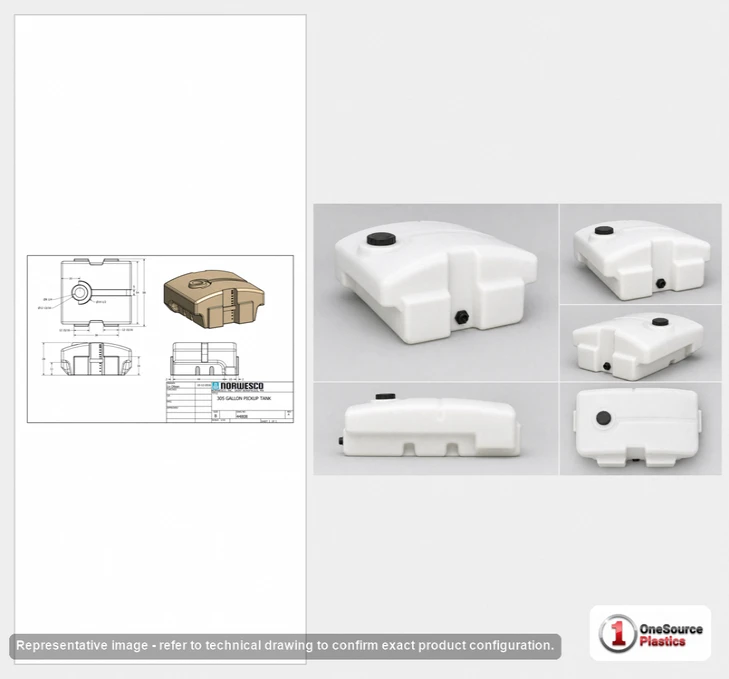
Technical drawing (PDF) for Snyder Industries 6370540N95402.
See this tank
Product video. Watch the Snyder Industries 40 Cubic Foot Capacity 45 Degree Plastic Cone Bottom Dry Hopper Bin video (69 seconds) with dimensions, fittings and shipping notes.
Ready to order?
Add it to your cart at the top of this page, get LTL freight to your ZIP, request a written quote, or call 866-418-1777. The listed price is before freight.