Eighty cubic feet of dry hopper bin at 45 degrees
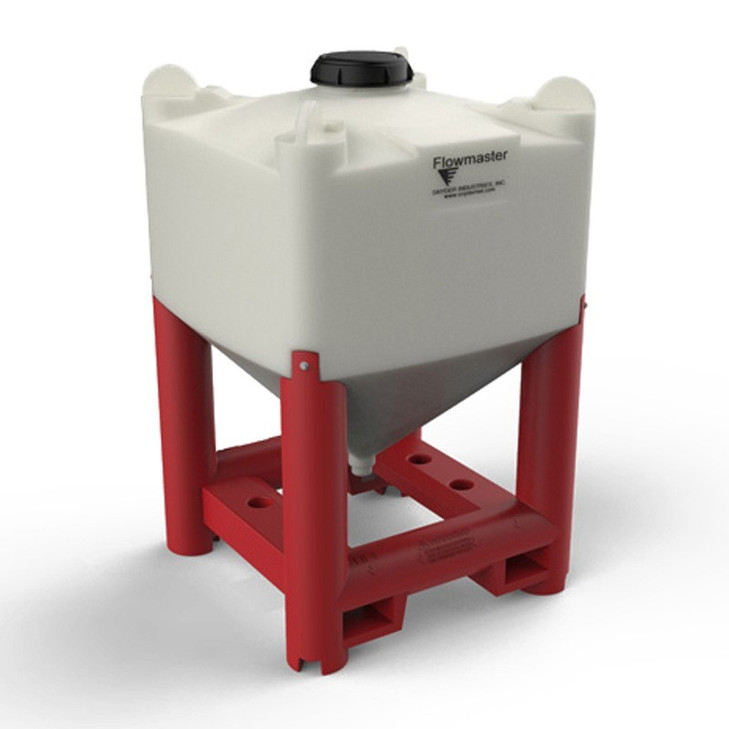
The Snyder SII-6370719N95402 is an 80 cubic foot capacity 45 degree cone bottom dry hopper bin, moulded in white high density linear polyethylene and listed at 53 inches long, 48 inches wide and 102 inches tall, at 385 pounds empty. Read the capacity unit first, because it is the whole point: this bin is rated in cubic feet, not in gallons, and it is a dry material bin. Its sheet does also carry a 600 gallon figure, a specific gravity of 1.5, 5,004 pounds of water and 7,506 pounds of max contents; those are liquid figures on a dry bin's sheet, and this page asserts no liquid capacity, no liquid duty and no specific gravity service from them. The cone angle is a real published field here at 45 degrees, which is the steepest of the common angles. The only opening on the sheet is 12 inches on top. The service limit is 120 F / 48 C. The product application field reads "Cone Bottom NO Stand", and the sheet publishes no outlet, no slide gate, no stand and no warranty term, so this page claims none of them. Freight is given as OVS under NMFC 156600, out of Lincoln, Nebraska.
Ready for the pad? Quote freight to your ZIP, add the 600 gallon tank to your cart above, and 866-418-1777 will confirm the truck and the unload.
The dry material duty this bin is built for
The buyer here is somebody moving a solid, not a liquid, and that changes every question. A dry hopper bin is bought to hold a powder, a pellet, a granule or a flake between delivery and use, and to release it downward under its own weight into a feeder, a mixer, a bagger, a truck or a hand scoop. The measure of success is that the material keeps moving when the gate opens. Dry solids do not behave like liquids: they arch across an opening, they rathole down the middle and leave a ring of stale material around the wall, they pack under their own weight if they sit long enough, and they take on moisture from the air and change behaviour overnight. Everything about this bin's geometry is aimed at that. A 45 degree cone is the steepest of the common angles and it is the one specified when the material is sluggish, cohesive or prone to bridging, because a steeper wall means the solid slides rather than sits. The 53 by 48 inch footprint under 102 inches of height gives a tall, narrow column that keeps the material over the outlet rather than spread across a wide floor. Eighty cubic feet is a meaningful working quantity for a small plant and a modest one for a large one, so the figure worth checking is how many hours or shifts it covers between refills; put your own consumption rate through the tank sizing calculator for the arithmetic, and take the headroom and freeboard discipline from the tank sizing guide, remembering that a bin filled to the top lid is a bin nobody can see into. The bin has to be held up. The application field says no stand, and the sheet publishes no legs, no skirt and no support ring, so the structure is a separate specification settled before the order. Whatever holds it must carry the bin plus the material, be level across the whole base, and leave working room underneath for the discharge arrangement and for a person to reach it. At 102 inches tall before any structure is added, the height to the fill point is the number that usually decides where in a building this can go: measure to the lowest obstruction first, then add the stand.
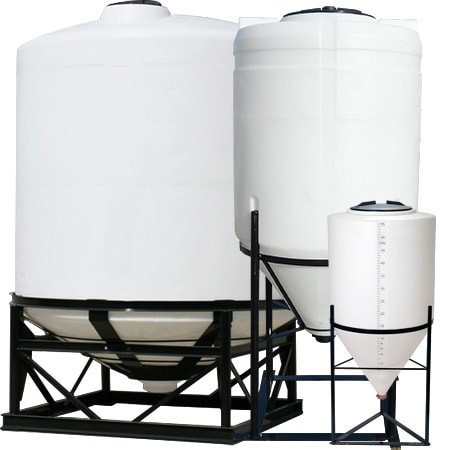
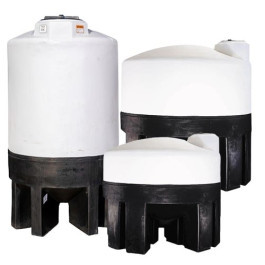
The bin, a 325 gallon cone and an 850 gallon cone
| Part | Capacity as the sheet gives it | Length x width x height | Empty weight |
|---|---|---|---|
| SII-6370719N95402 (this bin, dry, 45 degree) | 80 cubic feet | 53 x 48 x 102 in | 385 lb |
| SII-1560500N45 (liquid cone bottom tank with stand, 30 degree) | 325 gallons | 48 x 48 x 55 in | 145 lb |
| SII-1810100N45 (liquid cone bottom tank, 15 degree) | 850 gallons | 48 x 48 x 48 in | 126 lb |
Read the capacity column before anything else, because these three are not variants of one product. This bin is the only dry one in the group and the only one whose capacity is published in cubic feet; the other two are liquid cone bottom tanks measured in gallons, and we will not merge the two units or pretend they are comparable. What the table is genuinely useful for is the angle and the structure. SII-1560500N45 is a 325 gallon 30 degree cone bottom tank supplied with a stand, on a 48 inch square plan 55 inches tall at 145 pounds; it is the shortest thing on the sheet and the only one whose own name includes the stand, which is why it turns up in rooms with a low ceiling. SII-1810100N45 is an 850 gallon 15 degree cone at 48 by 48 by 48 inches and 126 pounds, and 15 degrees is the shallowest angle in the group: a gentle slope that keeps the vessel short and works for material that runs freely on its own. Against both of those, this bin is the tall one at 102 inches and much the heaviest at 385 pounds, and it is the steep one at 45 degrees. Those two facts go together. Steep cones cost height, and height is the price you pay for a bottom that keeps emptying when the contents do not want to move. If your material flows like water there is no merit in buying the steepest cone in the catalogue; if it bridges, cakes or arches, there is no substitute for it.
Still deciding between these? Freight to your ZIP often settles it; the wider tanks ship differently. Or call 866-418-1777 and we will walk the table with you.
A twelve inch opening on top and a discharge the sheet leaves open
- The discharge: this sheet publishes no outlet, no slide gate, no butterfly valve, no flange and no bulkhead, so no size and no hardware is claimed here. On a dry bin the discharge is the whole mechanism, because the gate, the transition and the first few inches of the flow path are where bridging either happens or does not. Tell us the material, the bulk density, the particle size and what it discharges into, and we will confirm what this part number carries before anything is ordered.
- Under the cone: whatever hangs below - a gate, a transition, a flexible connector, a feeder or a bagging spout - is carried on its own frame, never on the bin. A vibrating feeder bolted to a plastic cone is a crack waiting for the second shift.
- Filling: 12 inches on top is the only opening on the sheet. Twelve inches takes a fill spout, a flexible loading sock or a sack tip; it does not take a person, so decide how this bin gets cleaned and inspected before you decide what goes in it.
- Air displacement: a bin being filled with a solid is a bin displacing its own volume of air, and that air has to leave somewhere, filtered or not depending on the material. The sheet publishes no vent, no filter and no fitting other than the twelve inch opening, so that arrangement belongs to the installation.
- Level: no sight window, no level device and no graduation is published. On a bin that nobody can see into, a level device is usually what stops a plant running out mid-shift rather than a nicety.
- Limits: 120 F / 48 C is the service limit and there is no warranty term on this sheet.
Where the same site also runs liquid tanks feeding pumps, the two duties are worth keeping straight in the design, and the pump priming and dry run protection guide covers the suction geometry and low level cutoff engineering that belongs to those vessels, not to this bin.
Powders, pellets and granules that have to leave the bottom
Eighty cubic feet in a steep cone is bought by plants that feed a process from a buffer quantity of dry material: resin pellets beside an injection moulding or extrusion machine, granular treatment chemicals at a water or wastewater works, mineral and aggregate fines at a processing plant, feed and grain at a mill or a livestock operation, pigment, filler and additive holding beside a mixer, and seed, fertiliser or soil amendment at an ag or horticultural facility. Every one of those operations shares the same two failure modes, and neither is the bin's fault. The first is moisture: a material that was free flowing at delivery cakes after a humid weekend, and the cure is a sealed fill path and turnover, not a steeper cone. The second is stale material around the wall, which is what happens when the contents rathole down the middle and the outside ring never moves; a steep cone reduces that and a disciplined refill routine finishes the job. Tell us the material and its bulk density when you enquire and we will talk about the discharge arrangement before the bin, because on a dry duty that is where the money is won or lost.
Compatibility list
Liquids the maker rates this resin for, with concentration limits and the wetted fitting and gasket to specify. Confirm your own concentration and temperature on the chemical page or in the chemical compatibility database before ordering.
- acetic acid (60%)
- aluminum sulfate (50%)
- calcium chloride (40%)
- DEF (32.5%)
- ferrous sulfate (20%)
- magnesium chloride (30%)
- sodium carbonate (30%)
- urea solution (50%) and ozonated water (up to 10 PPM).Most run PVC fittings with EPDM gaskets, but a few will not accept that default package: DEF (32.5%) req
- ferric chloride (50%)
- hydrochloric acid (37%)
- sodium hypochlorite (<16.5%)
- sulfuric acid (98%)
- hydrogen peroxide (50%)
- phosphoric acid (85%)
- peracetic acid (30%) and
- ethylene glycol among them - need a higher 1.9 SG tank rather than this 1.5 SG model, and several call for Viton or Aflas gaskets rather than EPDM (sulfu
Lincoln to your site, 385 pounds, oversize
This bin is moulded at Lincoln, Nebraska, and the sheet lists Nebraska as the state it ships from. The freight class reads OVS, which is an oversize mode rather than a numeric class, under NMFC 156600, and it measures 53 inches long by 48 inches wide by 102 inches tall. Price the lane to your ZIP with the freight cost estimator; the listed price is before freight. At 385 pounds and eight and a half feet tall it comes off with a forklift or a telehandler, taken under the body and never by the twelve inch opening, and it travels better standing than lying if the trailer and the route allow it. Measure the door height and the aisle before the truck is booked, because 102 inches on a pallet is taller again than 102 inches on the floor. Set it on the finished, levelled structure and anchor it before anything is connected underneath. Then do the boring commissioning job properly: with the bin empty and the gate arrangement fitted, check that the discharge opens and closes freely, then load a small first charge of material and watch how it moves before the bin is filled. Before you lay out the fill spout, the air path and the level device on the top of this bin, read the top fitting placement guide; where the angle is still an open question, the cone angle selection buyer's guide compares the choices. Photograph the bin on its stand the day it is set, because the first thing anyone argues about later is how level it started out. Write the outlet fitting size and material on the site plan; the replacement is ordered by those two words.
Freight and documents
Ships from: Lincoln, NE. LTL freight is quoted to your ZIP with the freight cost estimator or by phone at 866-418-1777. The listed price is before freight.
Technical drawing (PDF) for Snyder Industries 6370719N95402.
See this tank
Product video. Watch the Snyder Industries 80 Cubic Foot Capacity 45 Degree Plastic Cone Bottom Dry Hopper Bin video (69 seconds) with dimensions, fittings and shipping notes.
Ready to order?
Add it to your cart at the top of this page, get LTL freight to your ZIP, request a written quote, or call 866-418-1777. The listed price is before freight.