


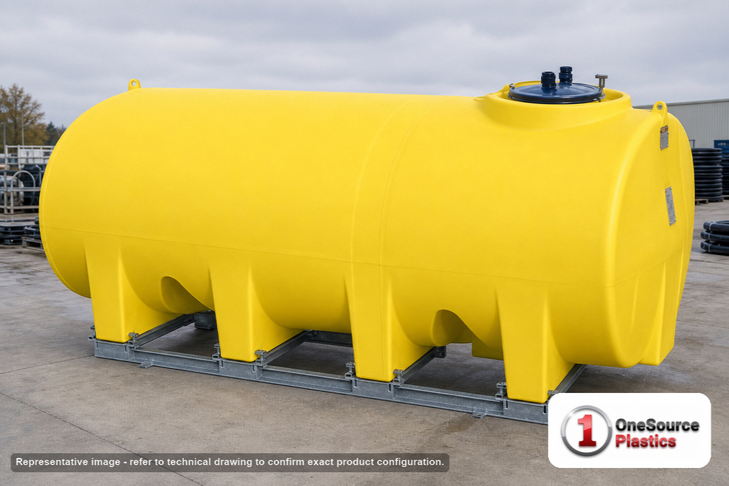
The Enduraplas 1900 Gallon Yellow Horizontal Sump Bottom Leg Tank ships as a complete unit with its integrated steel frame, built for hauling heavier-than-water liquids in the field. It holds 1,900 gallons, measures 130 inches long by 71 inches wide by 70 inches tall, and is rotationally molded from yellow polyethylene rated to a 1.9 specific gravity. The sump bottom drains low, and the frame lets you transport and set the tank as one piece. This is the horizontal leg tank operators reach for when they need a high-SG haul tank that travels.
Will it work for your load?
The 1.9 specific gravity rating is the spec that matters here. It means the tank is engineered to carry contents up to 1.9 times the weight of water: the maximum rated contents weight is 30,107 lb, versus 15,846 lb for a full load of plain water. That headroom is why this tank suits dense agricultural and industrial liquids rather than just water. Confirm your liquid's actual specific gravity stays at or below 1.9, then run the numbers through our Tank Sizing Calculator and Tank Sizing Guide. One caution for a haul tank: 30,107 lb is the tank's structural ceiling at SG 1.9, not a road-legal limit. Your gross combination weight (tank, frame, trailer, and truck) is what you have to verify against your DOT axle and GVWR limits before you load. See the technical drawing on this page for the sump and frame layout; the 71.0 x 130.0 inch footprint tells you the deck space you need.
Chemical compatibility
This tank is molded from polyethylene rated to a 1.9 specific gravity. The 1.9 SG rating is the chemical-relevant spec; before aggressive service, confirm the specific resin type with Enduraplas (HDLPE vs XLPE) as a final QC step, since high-density and cross-linked polyethylene behave differently against some chemistry. The compatibility below is drawn from the OEM chemical-resistance chart, which is concentration- and temperature-specific, so match your conditions to the chart before committing.
At the listed concentrations, the following are workable in this tank: Acetic Acid (60%), Aluminum Sulfate (50%), Calcium Chloride (40%), DEF (32.5%), Ethylene Glycol (100%), Ferric Chloride (50%), Ferric Sulfate (60%), Ferrous Sulfate (20%), Hydrochloric Acid (37%), Hydrofluoric Acid (48%), Hydrofluosilicic Acid (26%), Hydrogen Peroxide (50%), Magnesium Chloride (30%), Peracetic Acid (30%), Phosphoric Acid (85%), Polyaluminum Chloride, Potassium Carbonate (50%), Potassium Hydroxide (saturated), Propylene Glycol, Sodium Bisulfate, Sodium Bisulfite, Sodium Carbonate (30%), Sodium Hypochlorite (<16.5%), Sodium Thiosulfate (40%), Sulfuric Acid (98%), Urea Solution (50%), Zinc Orthophosphate, and ozonated water up to 10 PPM.
The fitting and gasket call is where field installs go wrong, so match it to your chemical: EPDM is the default gasket for most of these services, but Viton is required for Hydrochloric Acid, Hydrofluoric Acid, Hydrofluosilicic Acid, Hydrogen Peroxide, Phosphoric Acid, Sodium Hypochlorite, and Sulfuric Acid. Peracetic Acid is the outlier - it needs an Aflas gasket (not EPDM, not Viton) with 316 stainless fittings, and that gasket is the part people get wrong. DEF, Propylene Glycol, and Zinc Orthophosphate also want 316 stainless fittings; Sulfuric Acid wants CPVC. Confirm each chemical's fitting and gasket on its page and on our chemical compatibility resource, and never reuse a fitting or gasket from one chemical for another.
Freight and ordering
This tank ships LTL freight from the Enduraplas plant in Neche, ND, quoted live to your ZIP. Get your freight cost in seconds with our Freight Cost Estimator, or call 866-418-1777 and we will quote it by phone. For sizing and fleet-use questions on horizontal leg tanks, our guides on applicator and leg tanks for fertilizer and portable utility tank DOT classification are worth a read, and if you are hauling a blended fertilizer, our writeup on fertilizer-blend tank stratification covers mixing and field verification.
Freight and documents
Ships from: Neche, ND. LTL freight is quoted to your ZIP with the freight cost estimator or by phone at 866-418-1777. The listed price is before freight.
See this tank
Interactive 3D model with live fill. This tank has an interactive 3D model built to its manufacturer dimensions. Rotate it, and set a fill level to see how much liquid it holds at any height. Open the 3D view on the product photo above. Download the 3D model (GLB).
Product video. Watch the Enduraplas 1900 Gallon Yellow Horizontal Sump Bottom Leg Tank w/ Frame video (65 seconds) with dimensions, fittings and shipping notes.
Ready to order?
Add it to your cart at the top of this page, get LTL freight to your ZIP, request a written quote, or call 866-418-1777. The listed price is before freight.


