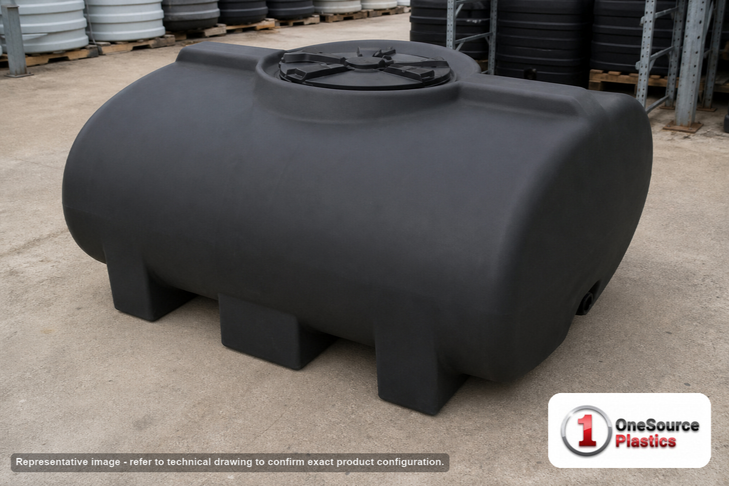
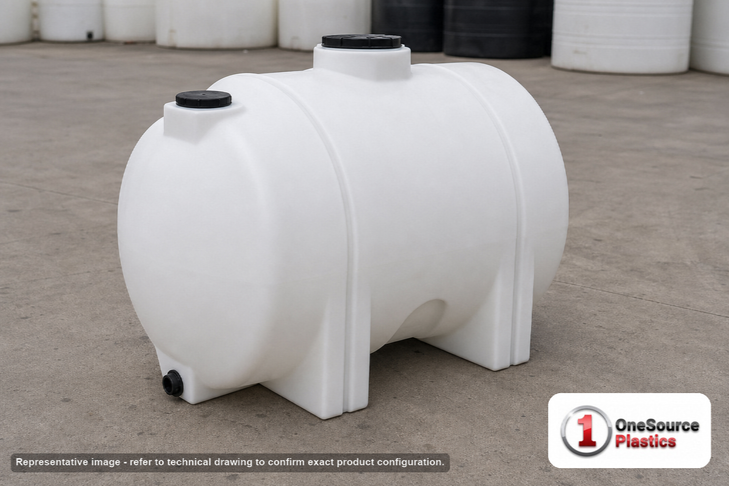
The Enduraplas 200 Gallon Yellow Horizontal Leg Tank (SKU THF00200Y) is a 200-gallon haul tank built for getting liquid down a field road, between yards, or onto a trailer. It runs 27 inches tall, 47 inches wide, and 55 inches long, with a 47.0 x 55.0-inch footprint that drops the center of gravity low and keeps the load stable in motion. The molded polyethylene body carries a 1.9 specific gravity rating, so it is engineered for heavy liquids - not just water - which is what separates a real horizontal leg tank from a water-only barrel.
Before you buy: confirm the resin
The single most decision-relevant unknown on this tank is its resin. Our data flags the tank_resin as HDLPE with a question mark, meaning we have not confirmed whether the shell is high-density linear polyethylene (HDLPE) or crosslinked polyethylene (XLPE). Those two resins behave very differently against aggressive media, and the resin determines whether half the acids in the compatibility list below are actually safe in this tank. If you are buying for any chemical service, call 866-418-1777 and confirm HDLPE vs XLPE with us before you order.
Will it handle your load?
Filled with water this tank weighs about 1,668 lb, and its 1.9 SG rating lets it carry liquid contents up to roughly 3,169 lb. That 1.9 rating is the number to plan around: it tells you the shell is built to support dense fluids like fertilizer blends and concentrated solutions, where lighter-rated tanks would be over-stressed. Match your liquid's density against that 3,169 lb ceiling before you fill - and if you are sizing a transport setup from scratch, the Tank Sizing Calculator and Tank Sizing Guide walk you through capacity versus weight so you do not overload your trailer or applicator. The integrated horizontal leg design is the reason this 200 gallon horizontal leg tank is a fixture on ag and utility fleets: the legs are part of the mold, so it sits flat and secures without a separate cradle.
Chemical compatibility
This tank is rated at 1.9 specific gravity, and with the right wetted-part materials it handles a wide range of solutions per the OEM chemical-resistance chart, which is always concentration- and temperature-specific. Verify your exact concentration and operating temperature against that chart before service - and confirm the resin first (see above). Note three special cases that break the common PVC/EPDM pattern and are the most likely to cause a failed install: DEF and Peracetic Acid both require 316 stainless wetted parts, Peracetic Acid uniquely needs an Aflas gasket (not Viton or EPDM), and Sulfuric Acid requires CPVC, not plain PVC. The full matrix from our data:
| Chemical | Conc. | Fitting | Gasket |
|---|---|---|---|
| Acetic Acid | 60% | PP/PVC | EPDM |
| Aluminum Sulfate | 50% | PVC | EPDM |
| Calcium Chloride | 40% | PVC | EPDM |
| DEF (diesel exhaust fluid) | 32.5% | 316SS | EPDM |
| Ethylene Glycol | 100% | PVC | EPDM |
| Ferric Chloride | 50% | PVC | EPDM |
| Ferric Sulfate | 60% | PVC | EPDM |
| Ferrous Sulfate | 20% | PVC | EPDM |
| Hydrochloric Acid | 37% | PVC | Viton |
| Hydrofluoric Acid | 48% | PP/PVC | Viton |
| Hydrofluosilicic Acid | 26% | PP/PVC | Viton |
| Hydrogen Peroxide | 50% | PVC | Viton |
| Magnesium Chloride | 30% | PVC | EPDM |
| Peracetic Acid | 30% | 316SS | Aflas |
| Phosphoric Acid | 85% | PVC | Viton |
| Polyaluminum Chloride | - | PVC | EPDM |
| Potassium Carbonate | 50% | PVC | EPDM |
| Potassium Hydroxide | Saturated | PVC | EPDM |
| Propylene Glycol | - | PP/316SS | EPDM |
| Sodium Bisulfate | - | PVC/PP | EPDM |
| Sodium Bisulfite | - | PVC/PP | EPDM |
| Sodium Carbonate | 30% | PVC | EPDM |
| Sodium Hypochlorite | <16.5% | PVC | Viton |
| Sodium Thiosulfate | 40% | PVC | EPDM |
| Sulfuric Acid | 98% | CPVC | Viton |
| Urea Solution | 50% | PP/PVC | EPDM |
| Zinc Orthophosphate | - | PP/316SS | EPDM |
| Ozonated Water | up to 10 PPM | PVC | EPDM |
Ozonated Water carries a hard ceiling of 10 PPM - treat that as a cap, not a starting point. Full background lives on our chemical compatibility resource; always verify your wetted parts against the OEM chart at your real concentration and temperature.
The mistake to avoid
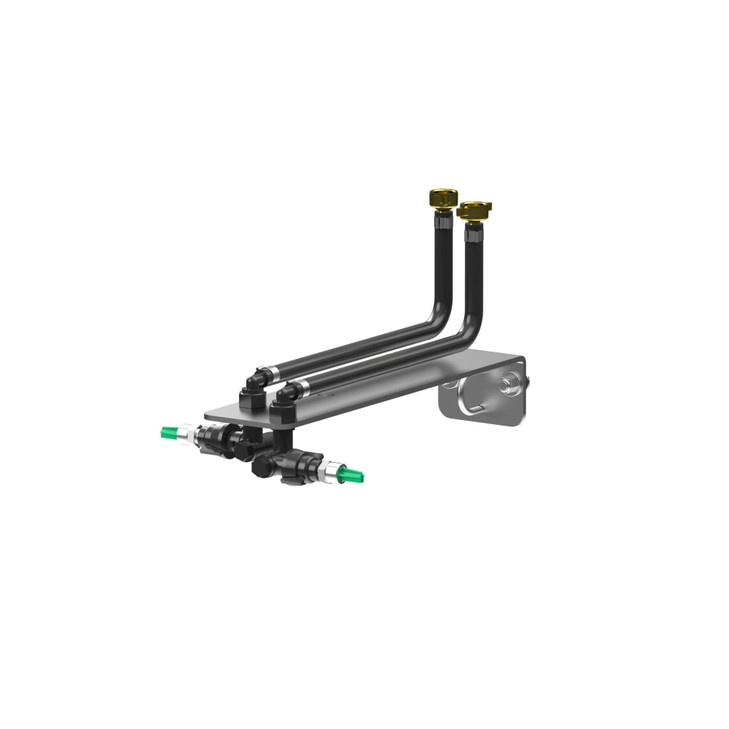
The expensive error on a high-SG transport tank is two-fold. First, do not assume the resin: that HDLPE flag is unconfirmed, and an aggressive chemical in a crosslinked-vs-linear mismatch shortens tank life dramatically. Second, do not reuse the wrong fittings and gaskets - matching EPDM where the chart calls for Viton, skipping Aflas on peracetic acid, running plain PVC instead of CPVC on sulfuric acid, or skipping 316 stainless on DEF is how a chemical install fails at the fitting before the tank ever does. One more planning note: this 1.9 SG rating is the ceiling for this line - there is no heavier-rated step-up to move into, so if your fluid runs denser than 1.9 SG against the 3,169 lb contents ceiling, call us rather than assume a bigger tank fixes it. See the technical drawing on this page for the fitting layout, and verify every wetted part against the OEM chart at your real concentration.
This tank ships LTL freight from the Enduraplas plant in Neche, ND, quoted live to your ZIP. Get your exact number with the Freight Cost Estimator, or call 866-418-1777 and we will quote it for you. For fleet and applicator context, our guides on applicator and leg tanks for fertilizer, loaf-style portable utility tanks and DOT classification, and fertilizer-blend tank stratification are worth a read before you spec your setup.
Freight and documents
Ships from: Neche, ND. LTL freight is quoted to your ZIP with the freight cost estimator or by phone at 866-418-1777. The listed price is before freight.
Ready to order?
Add it to your cart at the top of this page, get LTL freight to your ZIP, request a written quote, or call 866-418-1777. The listed price is before freight.