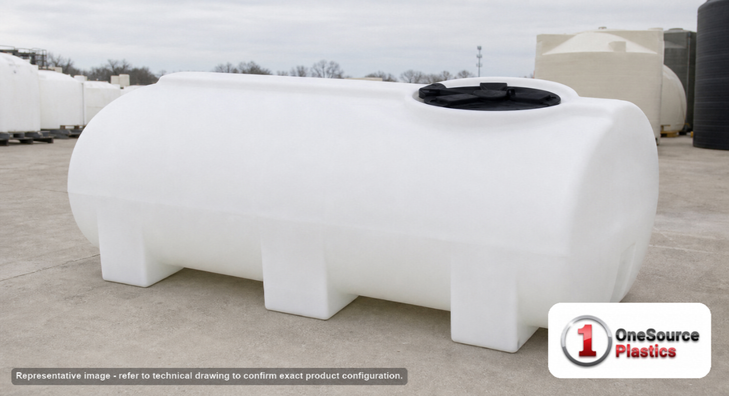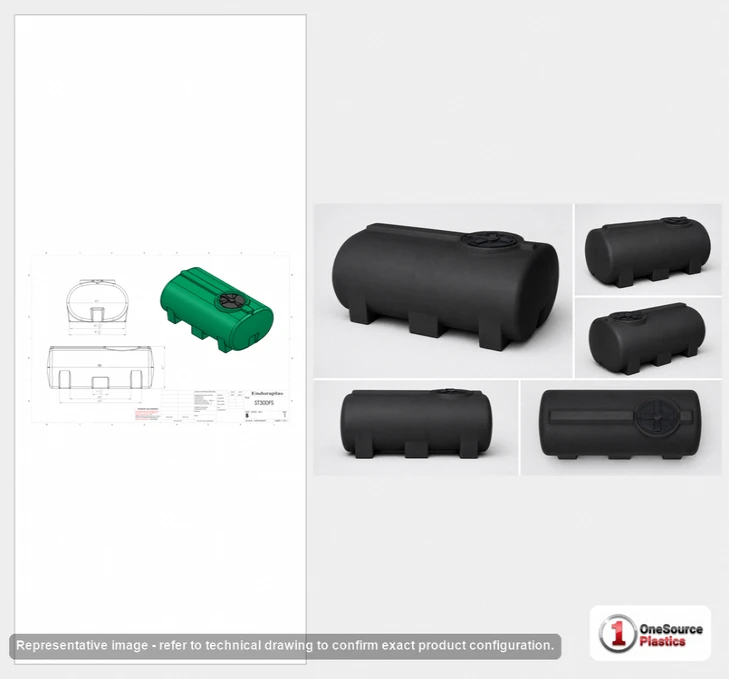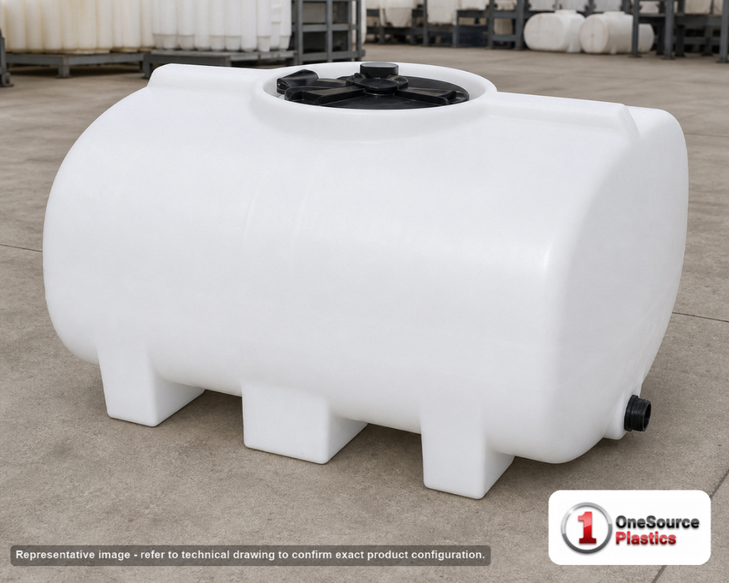
The Enduraplas 250 Gallon White Horizontal Leg Tank (SKU THF00250W) is built for fertilizer, ag chemical, and water hauling where a low, stable profile matters more than vertical height. At 34 inches tall on a 47 x 55 inch footprint, this 250-gallon horizontal leg tank sits low in a truck bed, on a trailer, or on a skid, and its integrated legs keep it cradled and resistant to roll during transport. Molded from natural white polyethylene, the translucent wall lets you read your fluid level at a glance, and the tank carries a 1.9 specific gravity rating, meaning it is engineered to safely hold contents up to 1.9 times the density of water.
Quick specs: 34 in H x 47 in W x 55 in L, footprint 47 x 55 in, water fill about 2,085 lb, rated weight ceiling 3,962 lb at 1.9 SG.
Will this tank work for your job?
The single most useful number on a horizontal leg tank is its weight allowance. Filled with water, this tank carries about 2,085 lb of contents; at its full 1.9 SG rating it is built to handle up to 3,962 lb of dense liquid. Use that 3,962 lb ceiling to size your trailer axles, truck springs, and tie-downs before you load, because undersizing the platform, not the tank, is where most leg-tank setups go wrong. If you are matching capacity to a spreader pass or a route, run your numbers through the Tank Sizing Calculator and the Tank Sizing Guide. Because leg tanks live on the road, it is worth reviewing how DOT treats portable ag tanks: our guides on applicator and leg tanks for fertilizer and portable utility tanks under the agricultural exemption walk through roadable classification for farm fleet use.
Chemical compatibility
This tank is molded from high-density linear polyethylene (HDLPE) and rated at 1.9 specific gravity. Because the resin designation in our data carries a question mark, confirm HDLPE versus crosslinked (XLPE) with us at 866-418-1777 before you commit it to chemical service. The strongest oxidizers in the list below, namely sodium hypochlorite, hydrogen peroxide, peracetic acid, and 98% sulfuric acid, are exactly where HDLPE and XLPE diverge, so confirm the resin specifically before running any of those four. Always match your fittings and gaskets to the chemical, and verify every selection against the manufacturer's chemical-resistance chart at your actual concentration and temperature.
Drawn from that chart, this tank is suited for fertilizer-blend and water-treatment chemistries including Acetic Acid (60%, PP/PVC fittings, EPDM gasket), Aluminum Sulfate (50%, PVC, EPDM), Calcium Chloride (40%, PVC, EPDM), DEF / diesel exhaust fluid (32.5%, 316SS, EPDM), Ethylene Glycol (100%, PVC, EPDM), Ferric Chloride (50%, PVC, EPDM), Ferric Sulfate (60%, PVC, EPDM), Ferrous Sulfate (20%, PVC, EPDM), Hydrochloric Acid (37%, PVC, Viton), Hydrofluoric Acid (48%, PP/PVC, Viton), Hydrofluosilicic Acid (26%, PP/PVC, Viton), Hydrogen Peroxide (50%, PVC, Viton), Magnesium Chloride (30%, PVC, EPDM), Peracetic Acid (30%, 316SS, Aflas), Phosphoric Acid (85%, PVC, Viton), Polyaluminum Chloride (PVC, EPDM), Potassium Carbonate (50%, PVC, EPDM), Potassium Hydroxide (saturated, PVC, EPDM), Propylene Glycol (PP/316SS, EPDM), Sodium Bisulfate (PVC/PP, EPDM), Sodium Bisulfite (PVC/PP, EPDM), Sodium Carbonate (30%, PVC, EPDM), Sodium Hypochlorite (under 16.5%, PVC, Viton), Sodium Thiosulfate (40%, PVC, EPDM), Sulfuric Acid (98%, CPVC, Viton), Urea Solution (50%, PP/PVC, EPDM), Zinc Orthophosphate (PP/316SS, EPDM), and Ozonated Water (up to 10 PPM, PVC, EPDM). The DEF and urea-solution ratings make this a practical mixing or storage tank for diesel exhaust fluid programs. Click any chemical above for its dedicated page, or browse the full chemical compatibility reference before ordering.
What buyers get wrong on this tank
The recurring mistake is treating the SG rating as a free pass. The 1.9 figure tells you the wall is built for dense liquid up to 3,962 lb, but it says nothing about your fittings and gaskets. Putting a Viton-required chemical on an EPDM gasket will fail at the connection long before the tank does, and that is not just the strong acids: sodium hypochlorite (bleach) and hydrogen peroxide both call for Viton here, and peracetic acid needs Aflas, yet these are exactly the water-treatment chemicals a buyer reaches for assuming EPDM is fine. If you are running DEF, note that it requires 316SS fittings, not PVC or brass, because diesel exhaust fluid corrodes copper, brass, and carbon steel at the connection. Read the fitting and gasket column for your specific chemical above, and confirm concentration against the OEM chart. The second common mistake is stratification: dense fertilizer blends salt out and layer if they sit, so review our guide on fertilizer-blend tank stratification and build a mixing protocol before the spreader runs off-spec. See the technical drawing on this page for fitting locations and overall geometry.
This horizontal leg tank ships LTL freight from the Enduraplas plant in Neche, ND, quoted live to your ZIP. Get an exact rate with the Freight Cost Estimator, or call 866-418-1777 to confirm resin, fittings, and lead time before you order.
Freight and documents
Ships from: Neche, ND. LTL freight is quoted to your ZIP with the freight cost estimator or by phone at 866-418-1777. The listed price is before freight.
See this tank
Product video. Watch the Enduraplas 250 Gallon White Horizontal Leg Tank video (60 seconds) with dimensions, fittings and shipping notes.
Ready to order?
Add it to your cart at the top of this page, get LTL freight to your ZIP, request a written quote, or call 866-418-1777. The listed price is before freight.