300 gallons stretched to 72 inches on a 38 inch width
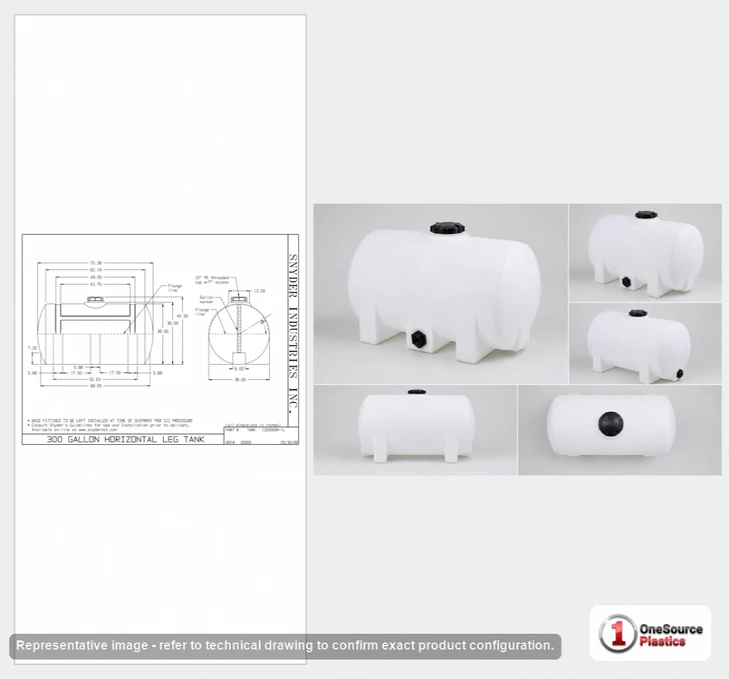
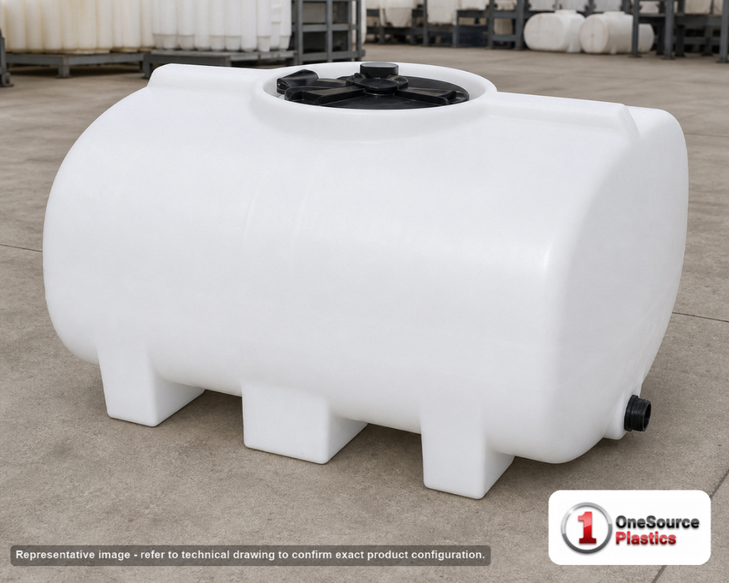
The Snyder SII-1320000C26 is a 300 gallon horizontal leg tank in white polyethylene, 72 inches long, 38 inches wide and 43 inches tall, 92 pounds empty and 92 pounds to ship, molded at Lincoln, Nebraska or Philippi, West Virginia. Its legs are moulded into the underside of the body as flat bearing feet, so it stands on a deck or a floor without a cradle, a saddle or a stand. The sheet rates the wall at a specific gravity of 1.9, which is where the 4,754 pound maximum contents figure comes from against 2,502 pounds for 300 gallons of water at 8.34 pounds per gallon. It carries a 1.25 inch outlet and a 10 inch threaded vented lid, a service limit of 120 F / 48 C, and a 3 year warranty. Freight is class LTL.
Buying on a purchase order? Request a written quote and we will return it with freight to your ZIP; card buyers add the 300 gallon tank to the cart above.
Six feet of tank on a narrow track: the deck it was drawn for
Six feet long and a little over three feet wide is a shape drawn for a deck rather than a floor, and it is the reason to buy this part number. Thirty-eight inches of width is the same width as the 230 gallon tank below it in this family, which means a mount built for one takes the other: the same rails, the same anchor spacing, the same clearance past a wheel well or a trailer fender. What changes is length, and 72 inches of it goes down the deck of a flat-bed trailer, along one side of a gooseneck, down the middle of a long pickup bed, or onto a skid frame that gets picked up and set down by forklift. That is where a 300 on legs belongs: a flat deck, bolted through the feet, with the pump, the reel and the plumbing mounted beside the tank rather than on it. On a shop or barn floor it works too, standing as a gravity supply against a wall where its 38 inch width keeps a walkway clear. What the shape asks for is a genuinely flat bearing surface over all six feet, because the feet carry through their whole flat area onto whatever they rest on: a rib in a truck bed, a raised toolbox lip, one cupped or broken deck board, or a hollow in a slab becomes the bearing point for the entire load, and with 2,502 pounds of water in the body that point will win. Plywood or a mat under it on a ribbed bed, a flat deck or a flat pour anywhere else, in full contact. Then design for the surge, because length is what makes a horizontal tank move: 300 gallons running six feet fore and aft under a hard stop puts a load into the tie-downs that a part-full tank multiplies, so restrain it forward and back as well as across, through the legs and into structure. How a leg or applicator tank is classified once it travels, and what an agricultural exemption does and does not cover, is set out in the applicator and leg tank classification guide, with the portable utility case in the loaf-style portable utility tank guide. Run 300 gallons against the real draw and refill interval in the tank sizing calculator, and take the working reserve and the freeboard a warming liquid needs from the tank sizing guide.
From 230 to 335: where the 300 sits
| Part | Gallons | Length x width x height | Empty weight |
|---|---|---|---|
| SII-1320000C26 (this tank, longest, narrowest) | 300 | 72 x 38 x 43 in | 92 lb |
| SII-1280000C26 (smaller, same width and height) | 230 | 52 x 38 x 43 in | 68 lb |
| SII-1004100C26 (larger, shorter, wider, taller) | 335 | 56 x 44 x 49 in | 116 lb |
The reason to buy this tank rather than either neighbour is that it adds volume without adding width or height. Against the SII-1280000C26 it is the same 38 inches across and the same 43 inches tall and holds seventy more gallons, bought entirely in length, so a deck that already carries the smaller tank will carry this one with the same clearance and the same fender gap; if the mount is width-limited or height-limited, this is the upgrade and the 335 is not. Against the SII-1004100C26 the trade runs the other way. That tank holds thirty-five more gallons in a body sixteen inches shorter, but it is 44 inches wide and 49 inches tall and listed at 116 pounds against this tank's 92, so it buys its volume in width and height and costs you both clearance and a heavier lift. Take it when the deck is short and open; take this one when the deck is long and tight. There is a third consideration that has nothing to do with capacity: this tank carries the 10 inch threaded vented lid, which is a real opening for cleaning, while the 335 carries the smaller lid. If the liquid is one that settles or leaves residue, that alone can decide it. Six feet of tank on a 38 inch track, a 10 inch lid, and 300 gallons is the combination this part number exists for.
Ready to choose a row? Add the 300 gallon tank to your cart above with freight quoted to your ZIP, or 866-418-1777 will confirm it against the site first.
The outlet stays 1.25 inch while the body gets longer
- Outlet: a 1.25 inch outlet, as the sheet lists it, at the low end of the body above the legs. This is the specification to be honest about, because it does not grow with the tank: the same port size serves the smaller leg tanks in this family, so on 300 gallons it is a feed fitting rather than a dump fitting. It suits a transfer pump, a spray pump or a hose line at working rates; it will not empty the tank in a hurry by gravity. If fast discharge is the duty, say so at order and we will point you at the tanks in this family that carry a larger outlet.
- The last gallons: six feet of body means a broad, shallow floor, so a level deck leaves a residue and a deck tilted toward the outlet does not. On a trailer, park with the outlet end downhill; on a skid, shim the far end.
- Valve and first joint: a shut-off valve at the outlet carried on its own support off the deck, and a flexible connector before any rigid pipe. With 2,502 pounds of water surging along a 72 inch body, hard pipe bolted from the fitting to a pump bracket is the failure that actually happens on mobile tanks.
- No inlet on this sheet, so none is claimed: filling is through the lid, with the hose run down inside the body rather than splashing across the surface.
- Access: a 10 inch threaded vented lid. That is a hand, a brush and a light, which is the maintenance that keeps a tank in service through a product change. Keep it closed in transit and keep the vent clear; a long tank drawn on hard through a blocked vent will deform before a short one does.
- Service limit: 120 F / 48 C, with a 3 year warranty as the sheet gives it.
Name the liquid at order and we will match the outlet fitting, the gasket and the valve material to it against Snyder's current documentation instead of guessing at the counter. Where the product is a blended fertilizer solution, the risk is the blend rather than the tank: a body this long and shallow has a great deal of surface and very little height to drive mixing, which is exactly the geometry in which layers form, and a stratified tank runs a spreader off spec before anyone sees it. The physics and the field checks that catch it are in the fertilizer blend stratification guide, and on a 72 inch tank they matter more than on a compact one. Where it freezes, drain the valve, the outlet and the hose and leave the body to ice on the surface; a plastic valve full of ice is scrap.
Row-crop nurse duty and long-deck utility work
Three hundred gallons on a long, narrow footprint is fleet equipment. The work: a nurse tank on a flat-deck trailer or a long-bed truck that keeps a sprayer running through a field or a right-of-way without a trip to the yard; starter fertilizer and fluid feed carried alongside a planter or a side-dress bar; water hauled in quantity to stock, to a planting or fencing crew, or to a remote pump house; dust control and compaction water on a construction or utility deck; de-icing brine on a contractor rig where the tank runs the length of the bed and leaves room for a spreader; wash-down and equipment rinse water on a landscape or municipal trailer; a standing gravity supply in a shop or barn, drawn down over a week. What all of those share is that the tank is mounted on something with length, and that the mount rather than the tank is what determines how long the installation lasts. Two limits stated plainly. This is a single-wall tank with no secondary containment, so it is the wrong product wherever site rules require the liquid to be contained. And the 120 F / 48 C service limit on this sheet applies to the liquid and to the tank standing loaded in the sun, which on a dark deck in high summer is not an abstract figure: shade it, fill it cool, or work it down before the afternoon.
Rated liquids and the fittings to order with them
The resin carries a rating for each liquid below at the concentration shown, and each line names the wetted fitting and gasket to specify. Confirm the service you actually run on the chemical page or in the chemical compatibility database before ordering.
- DEF / diesel exhaust fluid at 32.5% - just run it on 316SS fittings with EPDM gaskets, not PVC hardware.
- acetic acid (60%, PP/PVC fittings, EPDM gaskets)
- aluminum sulfate (50%, PVC, EPDM)
- calcium chloride (40%, PVC, EPDM)
- ethylene glycol (100%, PVC, EPDM)
- ferric chloride (50%, PVC, EPDM)
- ferric sulfate (60%, PVC, EPDM)
- ferrous sulfate (20%, PVC, EPDM)
- hydrochloric acid (37%, PVC, Viton)
- hydrofluoric acid (48%, PP/PVC, Viton)
- hydrofluosilicic acid (26%, PP/PVC, Viton)
- hydrogen peroxide (50%, PVC, Viton)
- magnesium chloride (30%, PVC, EPDM)
- peracetic acid (30%, 316SS, Aflas)
- phosphoric acid (85%, PVC, Viton)
- polyaluminum chloride (PVC, EPDM)
- potassium carbonate (50%, PVC, EPDM)
- potassium hydroxide (saturated, PVC, EPDM)
- propylene glycol (PP/316SS, EPDM)
- sodium bisulfate (PVC/PP, EPDM)
- sodium bisulfite (PVC/PP, EPDM)
- sodium carbonate (30%, PVC, EPDM)
- sodium hypochlorite (under 16.5%, PVC, Viton)
- sodium thiosulfate (40%, PVC, EPDM)
- sulfuric acid (98%, CPVC, Viton)
- urea solution (50%, PP/PVC, EPDM)
- zinc orthophosphate (PP/316SS, EPDM), and ozonated water (up to 10 PPM, PVC, EPDM). Note that the fitting and gasket material changes by chemical - the oxidize
Nebraska or West Virginia at 92 pounds
This tank is molded at Lincoln, Nebraska and Philippi, West Virginia, which covers the middle and the east of the country on short lanes, and on freight this light the lane costs more than the class does. It moves at class LTL as the sheet lists it, at 72 by 38 by 43 inches and 92 pounds empty, 92 pounds to ship. The freight cost estimator prices the lane to your ZIP, and the listed price is before freight. Six feet of length makes this an awkward pallet rather than a heavy one: it overhangs, it needs two people at the ends rather than one in the middle, and it must not be dragged on its feet, because those feet are the bearing surfaces the whole installation depends on. Tell us at order whether the delivery address has a dock or a forklift. Have the mount finished before the tank lands: anchor points through the legs at both ends, a mat or plywood if the deck is ribbed, and the straps in hand. Then fill it with clean water on its own mount, let it stand, drive it slowly, and look afterwards at the feet, the deck, the outlet and the lid seal. The habit that pays on a tank this long is checking the rear anchor first every season, because the back end is where the surge lands. Leave room to walk all the way around it; the side of the tank nobody can see is the side that leaks.
Freight and documents
Ships from: Lincoln, NE; Philippi, WV. LTL freight is quoted to your ZIP with the freight cost estimator or by phone at 866-418-1777. The listed price is before freight.
Technical drawing (PDF) for Snyder Industries 1320000C26.
See this tank
Interactive 3D model with live fill. This tank has an interactive 3D model built to its manufacturer dimensions. Rotate it, and set a fill level to see how much liquid it holds at any height. Open the 3D view on the product photo above. Download the 3D model (GLB).
Product video. Watch the Snyder Industries 300 Gallon Plastic Horizontal Leg Tank video (67 seconds) with dimensions, fittings and shipping notes.
Ready to order?
Add it to your cart at the top of this page, get LTL freight to your ZIP, request a written quote, or call 866-418-1777. The listed price is before freight.