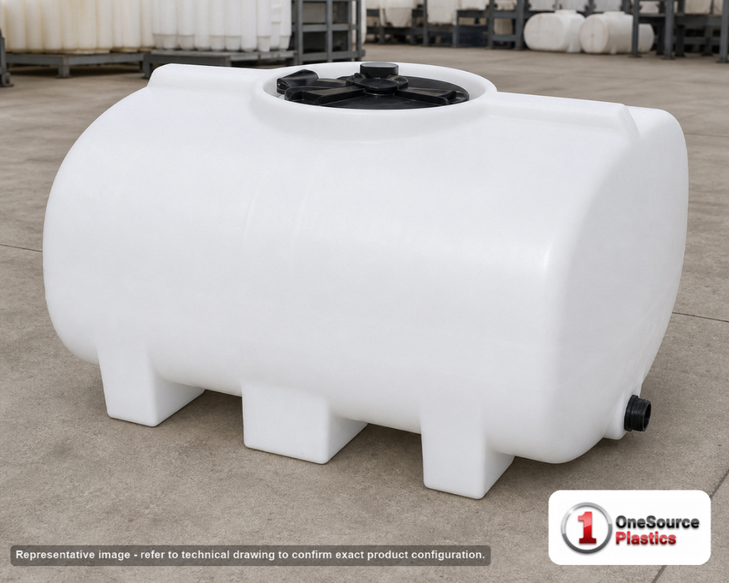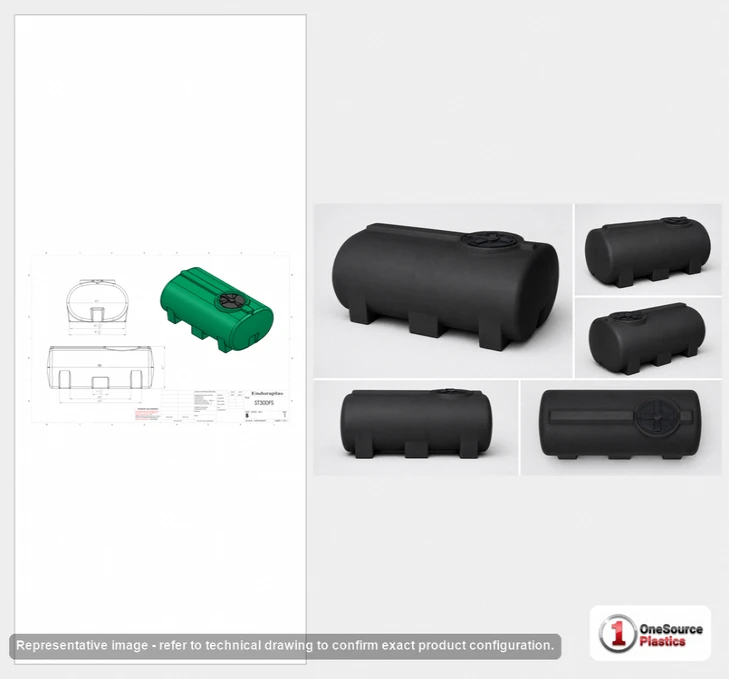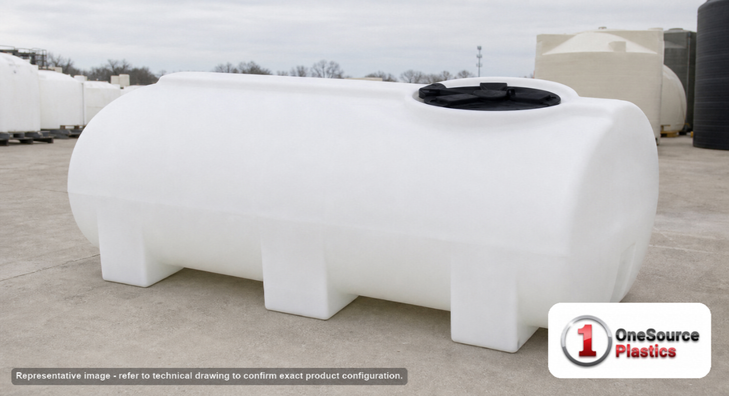
The Enduraplas 300 Gallon White Horizontal Leg Tank (SKU THF00300W) is a haul-class tank, so the number that should drive your decision is weight, not gallons. Rated to a 1.9 specific gravity, this 300-gallon natural white polyethylene tank can carry contents up to about 4,754 lb. Filled with plain water it runs roughly 2,502 lb, so moving up to a dense chemical or fertilizer load adds nearly 2,250 lb of swing. Before anything else, make sure your trailer, truck, or skid is rated for a payload approaching two and a half tons plus the tank itself. The tank sits low and wide at 31 in tall, 46 in wide, and 74 in long, riding on integral molded legs that keep it flat on a bed or trailer with a 46 x 74 in footprint. If you have been comparing Enduraplas horizontal tank options or searching for a 300 gallon horizontal leg tank, this is the size that fits most utility-bed and trailer setups.
Will it work for your load?
Plan around the heaviest fluid you will actually haul. At the full 1.9 SG rating the contents reach about 4,754 lb, and that single number sets your trailer rating, the deck or skid it rides on, and the tie-down plan. The wide 46 x 74 in footprint and molded legs keep the center of gravity low and spread the load, but confirm your frame can carry it loaded before you fill. The pack does not specify the molded outlet or fitting sizes and locations for this tank, so the outlet and fitting configuration is confirmed separately when you order. To match this tank against your jobs and fluids, run the numbers through the Tank Sizing Calculator and the Tank Sizing Guide.
Chemical compatibility: verify the resin first
This tank is molded from polyethylene at a 1.9 specific gravity rating, which is what lets it hold liquids well denser than water. The resin grade is listed as HDLPE but is not yet confirmed, so verify HDLPE versus XLPE (cross-linked) with us before you put this tank into any chemical service, because the two resins resist chemicals differently. Every rating below is concentration and temperature specific per the OEM chemical-resistance chart; match your fitting and gasket materials to the chemical and confirm your exact concentration and operating temperature with us first.
Most loads in this list use PVC fittings with EPDM gaskets, which cover the salts, glycols, and similar fluids: Aluminum Sulfate (50%), Calcium Chloride (40%), Ethylene Glycol (100%), Ferric Chloride (50%), Ferric Sulfate (60%), Ferrous Sulfate (20%), Magnesium Chloride (30%), Potassium Carbonate (50%), Potassium Hydroxide (saturated), Sodium Carbonate (30%), Sodium Thiosulfate (40%), and Ozonated Water (up to 10 PPM). Acetic Acid (60%), Hydrofluoric Acid (48%, Viton gasket), Hydrofluosilicic Acid (26%, Viton gasket), and Urea Solution (50%) call for PP or PVC fittings. Several are rated with the concentration to be confirmed: Polyaluminum Chloride (PVC, EPDM), Sodium Bisulfate (PVC/PP, EPDM), Sodium Bisulfite (PVC/PP, EPDM), Propylene Glycol (PP/316SS, EPDM), and Zinc Orthophosphate (PP/316SS, EPDM).
The mistake to avoid: don't mis-spec the fitting and gasket
The most expensive error on a 1.9 SG tank is dropping in fittings and gaskets that do not match the chemical, because the attack shows up first at the very fittings holding your load. Watch where the materials break from the PVC/EPDM default. The strong acids and oxidizers move to Viton gaskets: Hydrochloric Acid (37%, PVC), Hydrogen Peroxide (50%, PVC), Phosphoric Acid (85%, PVC), and Sodium Hypochlorite (<16.5%, PVC). Sulfuric Acid (98%) goes further to CPVC fittings with Viton. Two break the PVC habit entirely and need 316 stainless fittings: DEF (32.5%, EPDM) and Peracetic Acid (30%), with peracetic also requiring an Aflas gasket rather than EPDM or Viton. Spec the wrong gasket and you get a slow chemical attack at the connections. For full ratings and to confirm your exact concentration, see our chemical compatibility resource, and reference the technical drawing on this page for the tank profile.
This tank ships LTL freight from the plant in Neche, ND, with freight quoted live to your ZIP. Get your number with the Freight Cost Estimator or call 866-418-1777 to set up a quote. For application background, see our guides on applicator and leg tanks for fertilizer, portable utility tanks and DOT classification, and fertilizer-blend tank stratification.
Freight and documents
Ships from: Neche, ND. LTL freight is quoted to your ZIP with the freight cost estimator or by phone at 866-418-1777. The listed price is before freight.
See this tank
Product video. Watch the Enduraplas 300 Gallon White Horizontal Leg Tank video (67 seconds) with dimensions, fittings and shipping notes.
Ready to order?
Add it to your cart at the top of this page, get LTL freight to your ZIP, request a written quote, or call 866-418-1777. The listed price is before freight.