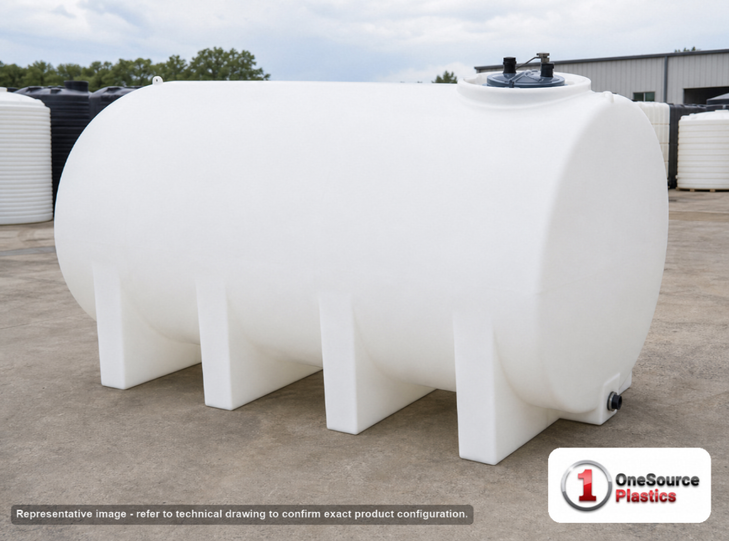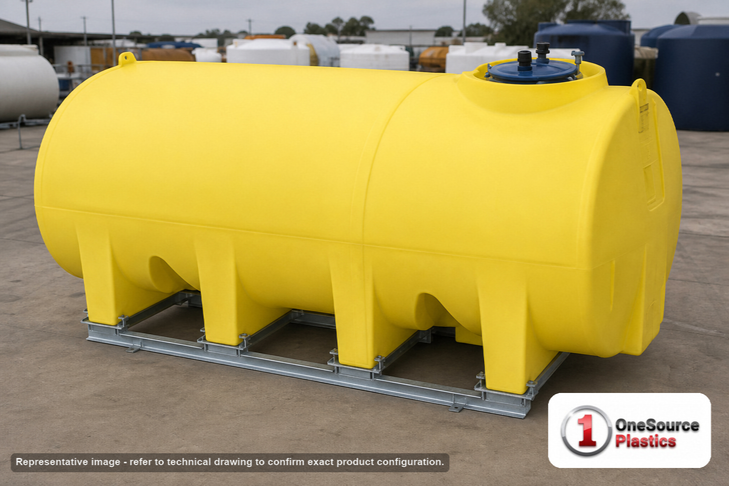
The Enduraplas 2800 Gallon Yellow Horizontal Sump Bottom Leg Tank carries a 1.9 specific gravity rating, putting it at the top of the polyethylene density ceiling for leg tanks built to haul and store dense liquids. At 145 inches long, 97 inches wide, and 76 inches tall, this yellow polyethylene horizontal leg tank rides on an integrated frame with a sump bottom that pulls liquid toward a low drain point for cleaner draw-down and easier rinse-out. Filled with water it carries 23,352 lb; at its full 1.9 SG rating it is built to hold up to 44,369 lb of contents, so whatever chassis or trailer sits under it has to be sized for that load, not just the tank.
Will it work for your application?
The 1.9 specific gravity rating is the number that matters here. It means the wall thickness is built for dense liquids, and you can run it well below that ceiling for lighter loads with margin to spare. At 1.9 SG this is effectively the heaviest-rated poly option, so you are already buying the toughest tank in the class rather than wondering whether something denser exists. Use the Tank Sizing Calculator to match your liquid's density against the 2,800-gallon capacity, and review the Tank Sizing Guide before you commit to a footprint. The 97 x 145 inch footprint and 76-inch height are dimensions you should confirm against your trailer deck and any building clearance. Outlet and fitting size, count, and placement are not specified in our listing data, so confirm those with us at 866-418-1777 and check the technical drawing on this page against your plumbing run before you finalize the install.
Chemical compatibility
This tank is molded from polyethylene and rated to 1.9 specific gravity. The resin code in our data is not confirmed, so confirm the exact resin (HDLPE vs XLPE cross-linked) with us before committing it to chemical service, since the two resins resist different families of chemicals. The fitting and gasket materials below come from the OEM chemical-resistance chart and are concentration- and temperature-specific; always verify your exact concentration and operating temperature against that chart, not just the chemical name. The sump bottom matters here too: settled, concentrated liquid sits at the low drain point, so match the sump-drain fitting and gasket to the most aggressive material listed for your chemical.
Chemicals compatible with this resin and SG rating include acetic acid (60%, PP/PVC fittings, EPDM gaskets), aluminum sulfate (50%, PVC, EPDM), calcium chloride (40%, PVC, EPDM), DEF (32.5%, 316SS, EPDM), ethylene glycol (100%, PVC, EPDM), ferric chloride (50%, PVC, EPDM), ferric sulfate (60%, PVC, EPDM), ferrous sulfate (20%, PVC, EPDM), hydrochloric acid (37%, PVC, Viton), hydrofluoric acid (48%, PP/PVC, Viton), hydrofluosilicic acid (26%, PP/PVC, Viton), hydrogen peroxide (50%, PVC, Viton), magnesium chloride (30%, PVC, EPDM), peracetic acid (30%, 316SS, Aflas), phosphoric acid (85%, PVC, Viton), polyaluminum chloride (PVC, EPDM), potassium carbonate (50%, PVC, EPDM), potassium hydroxide (saturated, PVC, EPDM), propylene glycol (PP/316SS, EPDM), sodium bisulfate (PVC/PP, EPDM), sodium bisulfite (PVC/PP, EPDM), sodium carbonate (30%, PVC, EPDM), sodium hypochlorite (under 16.5%, PVC, Viton), sodium thiosulfate (40%, PVC, EPDM), sulfuric acid (98%, CPVC, Viton), urea solution (50%, PP/PVC, EPDM), zinc orthophosphate (PP/316SS, EPDM), and ozonated water (up to 10 PPM, PVC, EPDM). Note the gasket call-outs: chlorinated and oxidizing chemicals like sodium hypochlorite, hydrogen peroxide, and sulfuric acid require Viton rather than EPDM, and peracetic acid needs Aflas. DEF is a special case: at 32.5% it runs on 316SS fittings and demands a dedicated, contamination-free tank with no shared service alongside the acids or chlorinates above. See the full chemical compatibility guide for the OEM chart.
Common mistake to avoid
The error that wrecks these tanks is under-supporting the load. A buyer who sizes a trailer or pad for water weight (23,352 lb) and then fills it with a 1.9 SG liquid can be carrying nearly double that, up to 44,369 lb at the rated maximum. Match your suspension, deck, and tie-downs to the actual contents weight, not the water number. On public roads, a 145-inch length combined with that loaded weight can also trigger oversize or over-axle-weight permitting, so plan the route before you load. The other quiet mistake is the resin question: a polyethylene tank pressed into a chemical it was never rated for fails at the wall, so confirm the resin and run your chemical against the OEM chart first.
This tank ships LTL freight from the Enduraplas plant in Neche, ND, quoted live to your ZIP. Get your freight rate with the Freight Cost Estimator, or call 866-418-1777 to talk through trailer mounting, fittings, permitting, and lead time. For application background, see our guides on applicator and leg tanks for fertilizer, portable utility tank DOT classification, and fertilizer-blend tank stratification.
Freight and documents
Ships from: Neche, ND. LTL freight is quoted to your ZIP with the freight cost estimator or by phone at 866-418-1777. The listed price is before freight.
Technical drawing (PDF) for Enduraplas THD02800KY.
See this tank
Interactive 3D model with live fill. This tank has an interactive 3D model built to its manufacturer dimensions. Rotate it, and set a fill level to see how much liquid it holds at any height. Open the 3D view on the product photo above. Download the 3D model (GLB).
Ready to order?
Add it to your cart at the top of this page, get LTL freight to your ZIP, request a written quote, or call 866-418-1777. The listed price is before freight.