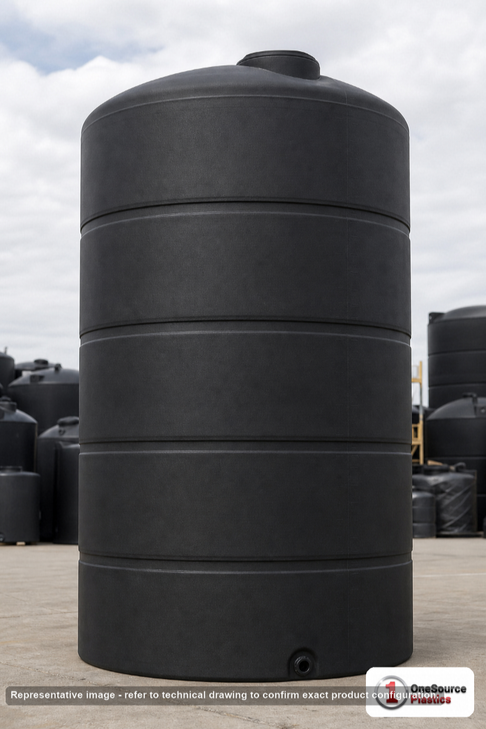
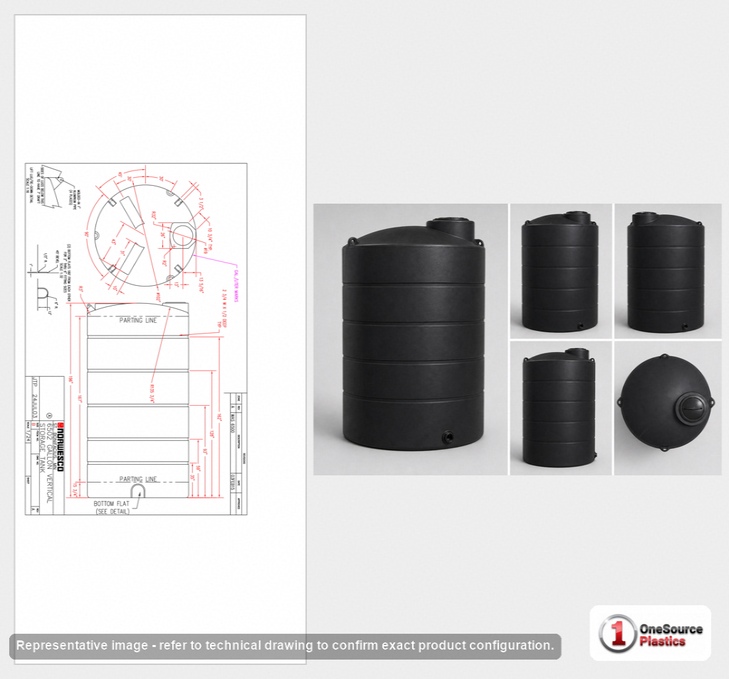
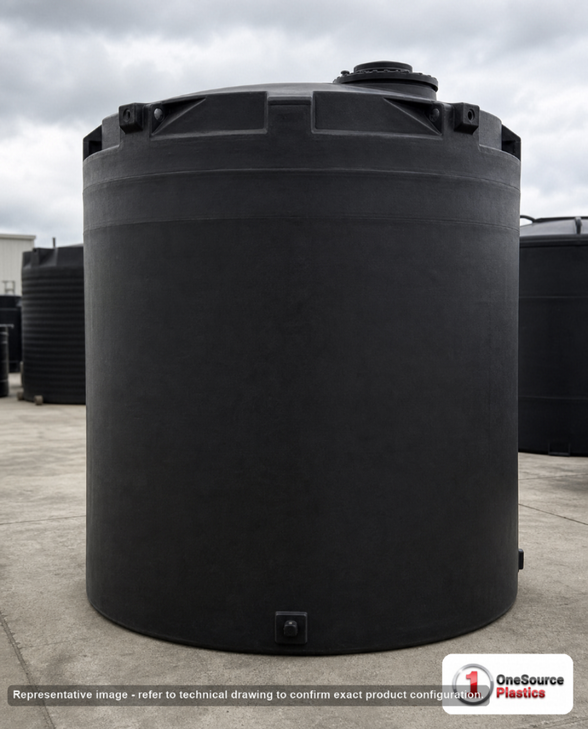
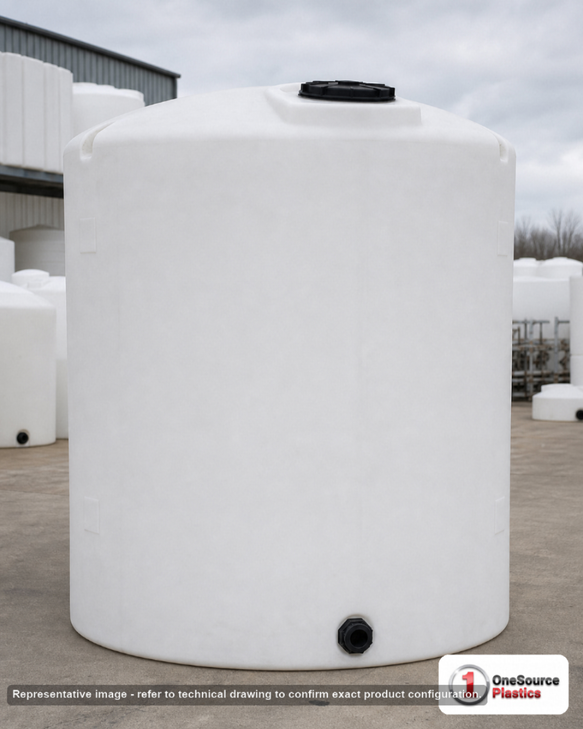
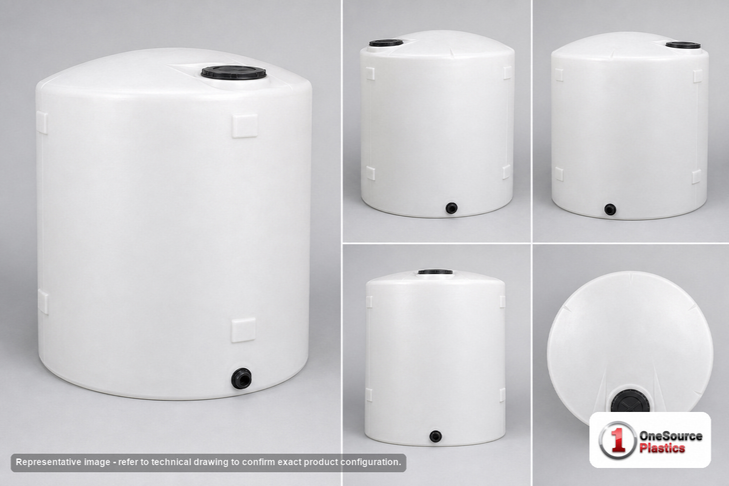
Norwesco 6500 Gallon Black Heavy Duty Vertical Storage Tank (40232B)
40232B holds 6500 gallons in a black polyethylene shell 119 inches across and 150 inches tall, which is a circle just under ten feet wide standing twelve and a half feet high. The empty weight cell and the shipping weight cell both read 1506 lb. The outlet is a 3 inch PP female NPT bulkhead fitting with a 2 inch reducer and the top opening is a 16 inch threaded vented manway. The specific gravity cell reads 1.9, a full shell of water is 54210 lb at 8.34 pounds per gallon, and the maximum contents cell reads 102999 lb. Service ceiling 120 F / 48 C, warranty cell five year, freight class 300, mode LTL. Two plants build it: St. Bonifacius in Minnesota and Hanford in California.
Know your ZIP and your ceiling height? Freight to your ZIP takes seconds, and 866-418-1777 will confirm the height; then add it to your cart above.
102999 lb in the contents cell
The buyer this record answers is storing something heavier than water and needs the vessel's published ceiling to prove it can. The specific gravity cell reads 1.9 and the maximum contents cell reads 102999 lb, while the same shell full of water comes to 54210 lb at 8.34 pounds per gallon. That is the whole argument for this part number over anything else with the same gallon figure on its face, and it is an argument made entirely in printed cells rather than in adjectives.
What the sheet still refuses to tell you is what the liquid is. The application cell is empty, no chemistry appears anywhere, and nothing on this record speaks to compatibility, mixing, heating or venting for a specific product. A supplier's data sheet for your liquid and a conversation with your engineer are what turn these cells into a specification; this page only prints the cells honestly.
The service ceiling of 120 F / 48 C sits alongside them and is the easiest limit to overlook, because a 6500 gallon body of liquid changes temperature slowly and gives no warning at the wall. If your stream is ever warmer than the ceiling on arrival, that is an upstream problem to fix upstream, not something a shell absorbs over a few seasons.
Five ways to buy sixty-five hundred gallons
| Sibling row | Gallon cell | Shell dimensions | Weight lb |
|---|---|---|---|
| 40232B (this record) | 6500 | 119 x 119 x 150 in | 1506 |
| 40224B | 6500 | 119 x 119 x 150 in | 1346 |
| 40263 | 6500 | 119 x 119 x 150 in | 1506 |
| 42411 | 6500 | 120 x 120 x 147 in | 1346 |
| 40764 | 6100 | 119 x 119 x 140 in | 1286 |
| 47620B | 6502 | 102 x 102 x 196 in | 1700 |
Three rows share this record's shell at 119 by 119 by 150 inches and a fourth, 42411, is a slightly different shape at 120 by 120 by 147 for the same gallon figure. Choosing between them by the gallon column is impossible and choosing by the shell column gets you most of the way; the rest is on each record's own sheet, in the cells this page prints at the top for 40232B. Open the one you are considering and read its grade line, its contents cell, its port and its warranty cell there.
The last two rows are genuinely different vessels. 40764 is a shorter shell at 140 inches on the same 119 inch circle for 6100 gallons, and 47620B is the outlier: 6502 gallons in a narrow 102 inch circle standing 196 inches tall. That is the row for a site where floor space is the scarce thing and headroom is not. This record takes the opposite position, a wider and lower shell, which is the one to want when a roof, a canopy or a crane reach is what constrains you.
Need two of them? Request a written quote for the pair with freight to your ZIP, or call 866-418-1777 and we will price the truck once.
Installing the draw-off in order
- Start at the port. The outlet is a 3 inch PP female NPT bulkhead fitting supplied with a 2 inch reducer, so decide before anything is threaded whether this is a 3 inch installation or a 2 inch one. Changing size once at the wall is clean; changing it twice on the way to the pump is how a suction line ends up starving a perfectly good pump.
- Set the pump where the head helps you. A full shell puts 150 inches of liquid above the fitting, so a pump beside the tank starts flooded. Keep the suction run short and rising, with no dip to hold air between transfers.
- Carry the pipe on its own support. The bulkhead seals a hole in a poly wall; it is not a bracket, and a full 3 inch line is heavy enough to matter.
- Confirm the fill route. The inlet row prints a dash, which means this record specifies one port and the 16 inch threaded vented manway is where liquid goes in unless you build something else.
- Protect the vent. On a shell this size an obstructed vent and a hard-pulling pump are all it takes to draw the wall inward, so nothing is taped, capped or stacked over that manway, ever.
- Commission with water. Fill to the top once on the finished slab, watch the foundation for a day, then re-check the bulkhead by hand after the shell has settled into its loaded shape.
The honest limitation, said once: this sheet publishes no structural provision of any kind, so anchoring and restraint for a twelve and a half foot tank are designed by whoever engineers the pad and are not specified anywhere on this record.
A 119 inch circle under a 150 inch stack
The proportions here are the friendliest in the family: wide enough to be stable, low enough that the manway is a reasonable climb, and heavy enough at 54210 lb of water to demand a proper slab. Our concrete pad sizing guide covers the framework and the point at which it hands off to a designer.
For water caught off a roof, the work happens before the tank: our first-flush diverter sizing guide covers what to send to waste before the rest reaches the manway. For a standing reserve on a property with no hydrant, our reservoir design guide for remote sites covers sizing discipline and freeze protection. For a plant putting streams back to work, our reuse topology piece explains staged trains and why separating qualities beats enlarging one vessel.
Get the volume right before the shape: the sizing calculator and the sizing guide turn a draw rate and a refill interval into a defensible gallon figure.
Minnesota or California, and what to check at the tailgate
The crate line reads 119 by 119 by 150 inches at 1506 lb, the same figure as the empty weight cell, so no packing allowance is published on this record. Class 300, LTL, and just two plants, St. Bonifacius in Minnesota and Hanford in California. Two origins on opposite sides of the country make the lane the dominant cost, so run your ZIP through the freight cost estimator before you commit; the listed price is before freight.
Stand a tape on the height at the tailgate before you sign anything. Three rows in this family print the same 119 inch circle and the 150 inch height, so the paperwork and the part number tag are what prove which record actually arrived; the tape confirms you are holding a 150 inch shell and the tag confirms which of them it is. Read both together and note them on the bill.
Once that is done, unload onto the prepared surface directly. A 6500 gallon shell parked on rough ground "just for now" is how the bottom picks up the damage nobody looks for. Photograph the outlet fitting from below before the pipe goes on; a slow weep is easier to compare against than to describe.
Freight and documents
Ships from: St. Bonifacius, MN; Hanford, CA. LTL freight is quoted to your ZIP with the freight cost estimator or by phone at 866-418-1777. The listed price is before freight.
Technical drawing (PDF) for Norwesco 40232B.
See this tank
Interactive 3D model with live fill. This tank has an interactive 3D model built to its manufacturer dimensions. Rotate it, and set a fill level to see how much liquid it holds at any height. Open the 3D view on the product photo above. Download the 3D model (GLB).
Ready to order?
Add it to your cart at the top of this page, get LTL freight to your ZIP, request a written quote, or call 866-418-1777. The listed price is before freight.