A hundred gallons of applicator tank, 31 inches tall
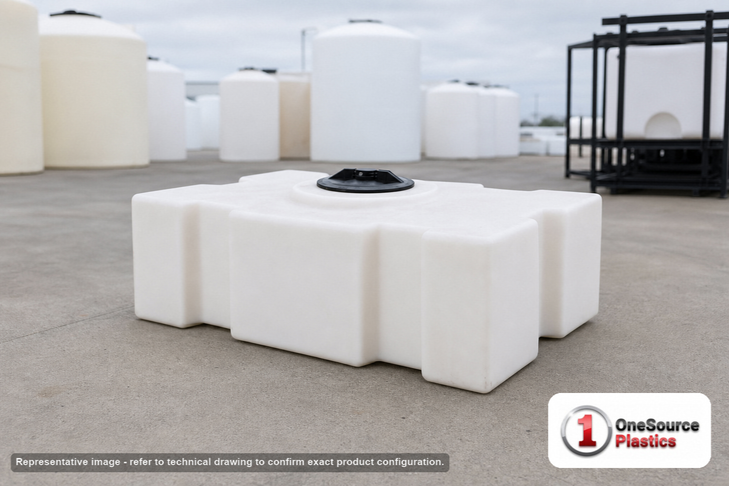
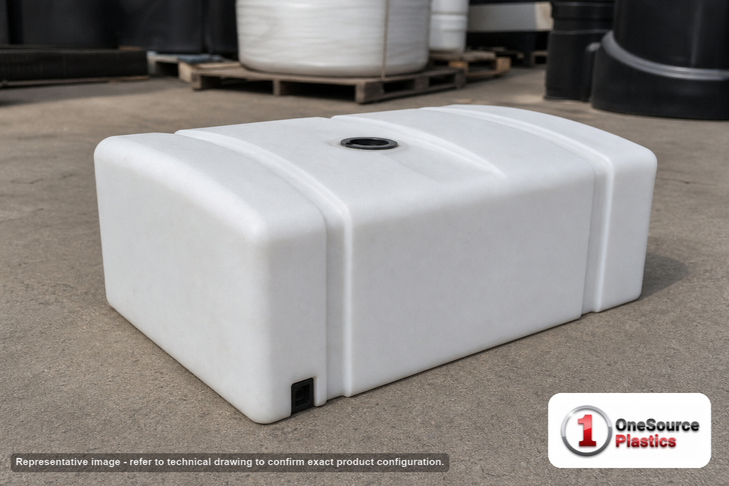
The Snyder SII-PCO100 is a 100 gallon portable pest control operator tank in white polyethylene, listed at 38 inches long, 30 inches wide and 31 inches tall, and 50 pounds empty. PCO is short for pest control operator, and a tank with that name is a sprayer and applicator tank: it holds the mix while the pump, the hose reel and the gun are mounted separately. No product is named on the sheet and none is named here. The wall is rated at a specific gravity of 1.5, which gives 834 pounds for 100 gallons of water at 8.34 pounds per gallon and 1,251 pounds of max contents. The only opening the sheet publishes is a 10 inch lid; there is no outlet, no inlet, no maximum service temperature and no warranty term on it, so this page asserts none of them. The freight class field reads UPS, which is a shipping mode rather than a numeric class, and this tank is listed at four plants, more than anything else in its batch.
Want it on the pad this month? Check freight to your ZIP, add it to your cart above, and 866-418-1777 will confirm the ship date.
Route work is the duty and the bed is the limit
The duty comes first and it is a simple one. A route operator loads a hundred gallons of finished mix at a base in the morning, drives to a sequence of jobs, draws the tank down through a pump and a reel, and comes back empty. Everything about this tank is sized around that day: enough volume that the route is not interrupted by a refill, light enough empty that one person can handle it, and short enough that it does not turn the vehicle into something the driver cannot see past. Thirty-one inches tall is the number that does the most work on this sheet. That is low enough to keep the load below the eye line in a mirror on most pickups and low enough to sit under a cap or a tonneau, and a low centre of gravity on a tank that spends its life cornering is worth more than any other feature it has. Thirty inches wide and 38 long gives a rectangle that uses the bed instead of wasting the corners the way a drum does, and it will not roll if a strap goes slack. Mount it on flat, continuous, level support under the whole 38 by 30 inch base, not across two rails with the middle unsupported, and strap it over the body rather than over the lid so the straps pull the tank down onto its base. Empty it is 50 pounds and one person carries it. The sheet gives 834 pounds full of water and 1,251 pounds at the rating, and that is the load a strap, a deck and a bed side are holding when the vehicle stops hard. The sheet publishes no baffle, so assume the liquid moves: brake earlier with it full, and run it either full or nearly empty rather than half, because a half tank shoves the hardest. Check that a hundred gallons is genuinely your route in the tank sizing calculator before buying the footprint, and take the freeboard a warming or foaming mix wants from the tank sizing guide. Where this tank ends up as a fixed shop fixture beside a fill station rather than a travelling one, the surface under it is still worth getting right; the concrete pad sizing guide for above-ground polyethylene tanks sets out the framework and its boundary.
The fifty, the two hundreds and the one fifty
| Part | Gallons | Length x width x height | Empty weight |
|---|---|---|---|
| SII-PCO100 (this tank, portable) | 100 | 38 x 30 x 31 in | 50 lb |
| SII-1200000N43 (industrial rectangular, same footprint) | 100 | 38 x 30 x 31 in | 65 lb |
| SII-1170000C137 (half the volume, narrower) | 50 | 38 x 20 x 22 in | 40 lb |
| SII-1570000N43 (largest, lowest profile) | 150 | 48 x 36 x 29 in | 65 lb |
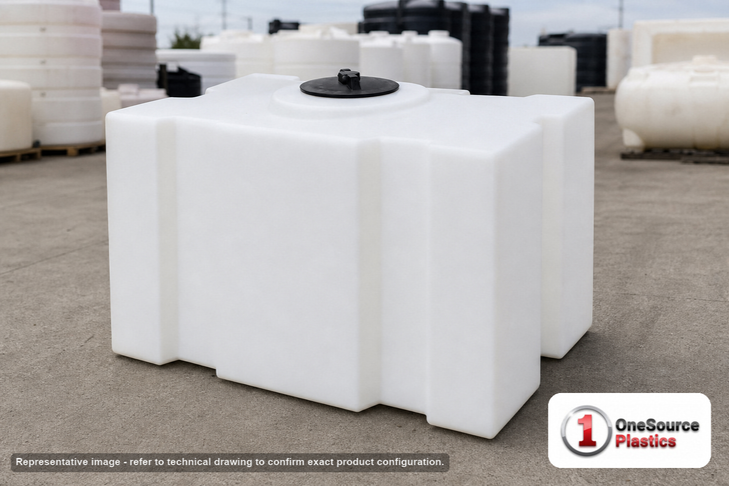
The most useful row in this table is the second one. SII-1200000N43 holds the same 100 gallons in exactly the same 38 by 30 by 31 inch envelope and is listed at 65 pounds where this tank is 50. Fifteen pounds on an identical footprint is the whole published difference, and where a tank comes out of a bed by hand at the end of a season, fifteen pounds is a real number. The sheet explains nothing further about it, so neither will we; order by part number where a fleet is already standardised and ask us where the mounting is fabricated. Below, SII-1170000C137 holds 50 gallons in 38 by 20 by 22 inches at 40 pounds. Note what that buys: the same 38 inch length but only 20 inches across, which leaves room beside it in a bed for a second tank, a reel or a toolbox, and 22 inches tall, nine inches lower than this one. It is the tank for an operator who would rather carry two products than twice the volume of one. Above, SII-1570000N43 holds 150 gallons at 48 by 36 by 29 inches and 65 pounds, and it is the interesting one: half again the volume, ten inches longer and six wider, and yet two inches shorter than this tank. If the deck is long and open, that is more product on a lower profile for the same empty weight as the industrial hundred. If the bed is short or crowded, this 38 inch body is the one that fits. Measure the bed, not the brochure.
Which wall for your chemical? Call 866-418-1777 with the name and the concentration, or send a quote request and we will pick the row.
Drawing off through a ten inch lid
- The pump and the draw: there is no outlet and no inlet on this sheet, so no size, thread or position is claimed. With the top opening as the only published route in or out, the working arrangement on a tank this size is a suction line and a foot strainer dropped through the lid to a frame-mounted pump. Keep the pump below the liquid line where the layout allows, because a pump that lifts on every start is a pump that wears through a season, and clamp the suction hose to the frame so the lid rim never carries it.
- Off the bottom: set the strainer clear of the floor of the tank so the last inch of settled material is not the first thing it picks up at the start of the next job.
- Filling: the 10 inch lid at 31 inches off the base is knee height in a truck bed and bench height on a shop floor. Ten inches takes a fill hose, a wand, a jug and a strainer basket, and it is big enough to get a lance in for rinsing, which is worth knowing before you decide what the tank will carry.
- Air path: the sheet does not describe the lid as vented. A closed top on a tank that a pump is pulling from is a wall under load, so confirm the venting arrangement for your pump and your draw rate at order time rather than on a hot afternoon at the end of a route.
- Level: no sight tube, no gauge and no graduation appears on this sheet. If the operator needs to read the level from the ground or the cab, specify it when you order.
- Limits: no maximum service temperature and no warranty term on this sheet. The specific gravity rating of 1.5 is the only rating it carries.
Tell us the liquid when you order and the lid seal, the strainer and any fitting we add are matched to it instead of being left generic. What goes in an applicator tank is the operator's decision, made against that product's own label and the licence it is applied under; the label is the document that governs, not a web page.
Spray trucks, grounds crews and the tank that fills at the yard
A hundred gallons on a low rectangle is the workhorse size for operations that finish a tank in a shift: pest control and lawn care route trucks, turf and ornamental crews, golf course and sports field maintenance, municipal parks and cemetery vehicles, right-of-way and fence line rigs, nursery and greenhouse trailers, and building service contractors who dose, wash and rinse. The same body does second duty as a clean water supply for equipment washdown and for mixing at the job, which is often what decides between fifty, a hundred and a hundred and fifty gallons. The question is arithmetic rather than preference: how many stops before a refill, and how far the refill is. A tank sized so that it is emptied is a tank that never has to be drained, disposed of and explained, and that is the strongest argument there is for buying the volume the route actually uses.
Four plants and a fifty pound shipment
This part is listed at four plants: Marked Tree, Arkansas, Merced, California, Lincoln, Nebraska, and Philippi, West Virginia. Four moulding points is unusual and it is a genuine advantage on a small tank, because the lane that matters is the short one, and a mid-South, a West Coast, a plains and an Appalachian option between them put most of the country within a day or two. The sheet gives the freight class as UPS, which is a shipping mode rather than a numeric class, and it carries no NMFC number at all. Price the lane to your ZIP with the freight cost estimator; the listed price is before freight. At 50 pounds one person takes it off the truck and carries it, so no forklift needs booking and no dock appointment needs making. Set it in the bed or on the skid, strap it down empty, then fill it with clean water on level ground and watch the lid seal through a full 834 pound load before any product goes near it. Drive a short loop with that water in and look at the straps again, because a strap that has bedded in after a mile wanted another turn. Write the contents and the date on the shell in paint marker the day it goes into service; a tank nobody can identify from the tailgate is the one that gets topped up with the wrong thing. Walk the base after the first hard rain; a pad that shifts shows it at the edge first.
Freight and documents
Ships from: Marked Tree, AR; Merced, CA; Lincoln, NE; Philippi, WV. LTL freight is quoted to your ZIP with the freight cost estimator or by phone at 866-418-1777. The listed price is before freight.
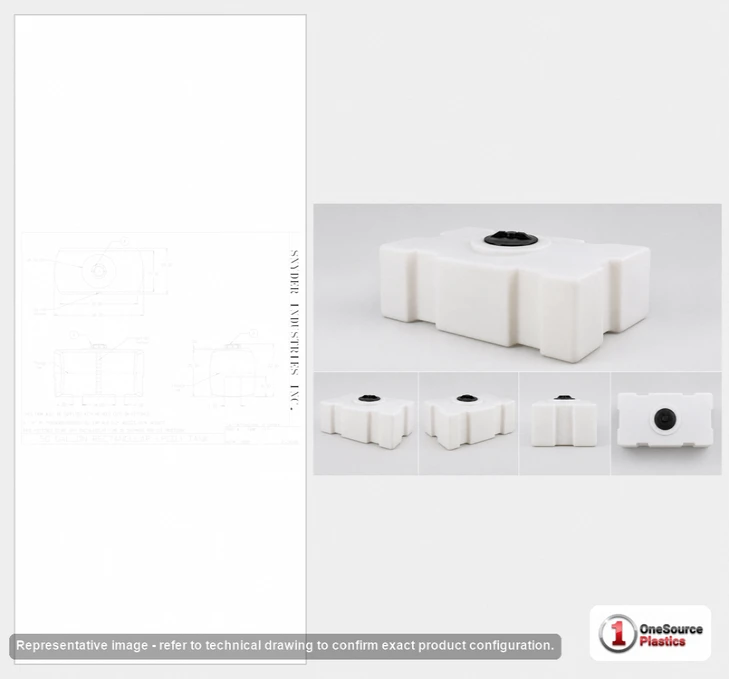
Technical drawing (PDF) for Snyder Industries PCO100.
See this tank
Product video. Watch the Snyder Industries 100 Gallon Plastic Portable Pest Control Operator Tank video (52 seconds) with dimensions, fittings and shipping notes.
Ready to order?
Add it to your cart at the top of this page, get LTL freight to your ZIP, request a written quote, or call 866-418-1777. The listed price is before freight.