Ten thousand gallons on the same 142 inch plan
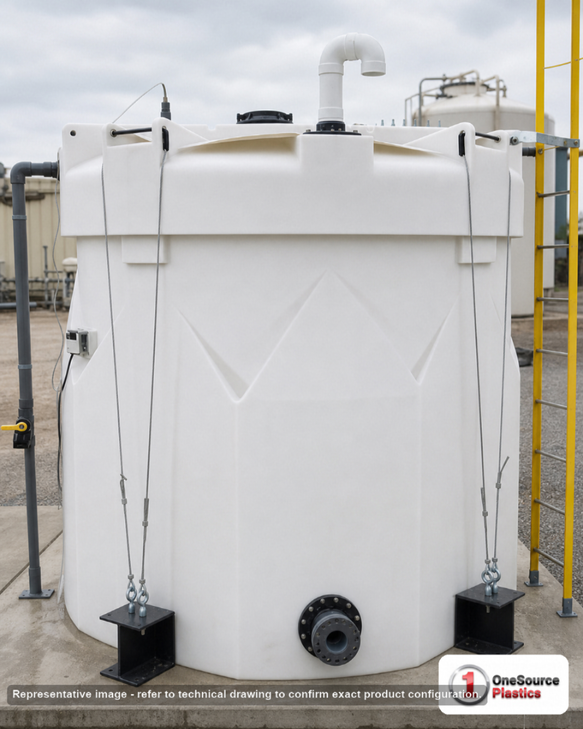
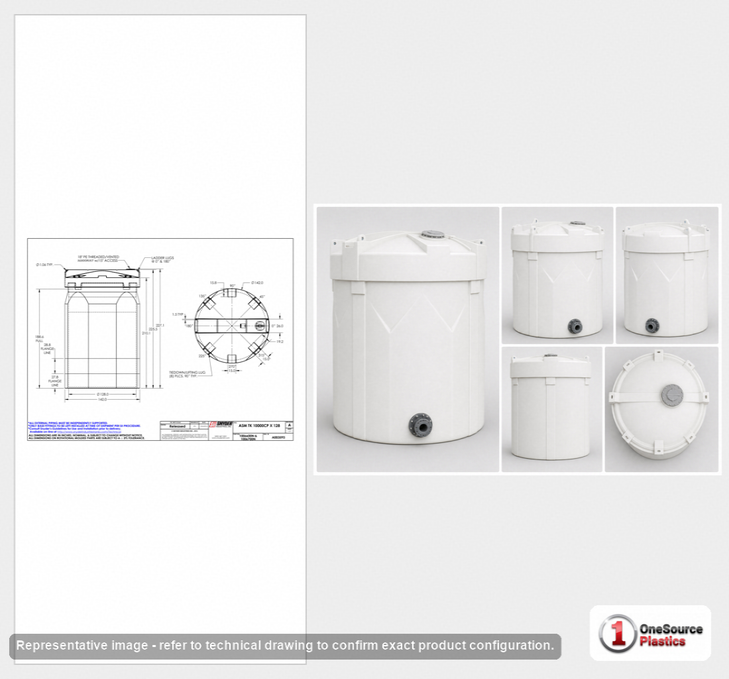
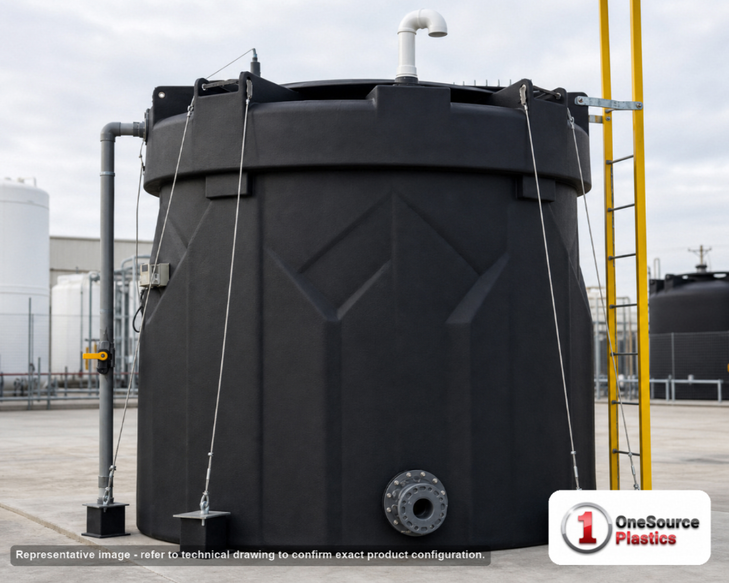
The Snyder 1006600N30 is a 10,000 gallon double wall tank that Snyder names Sulfuric Acid, and we describe it exactly as the maker names it: this sheet publishes no concentration, no acid strength and no compatibility statement, so none appears on this page. The shell is opaque white high density linear polyethylene, 142 inches long by 142 inches wide by 226 inches tall, 7,400 pounds empty. One capacity, one set of overall dimensions, one empty weight and one rating are published for the whole assembly. There is no separate inner tank figure, no separate outer containment figure, no annulus dimension and no containment percentage anywhere on the sheet, so this page states none. The wall is rated at a specific gravity of 1.9, and the sheet gives 83,400 pounds for 10,000 gallons of water at 8.34 pounds per gallon with 158,460 pounds of max contents. The published opening is an 18 inch threaded vented manway; the outlet field reads "1 Manway / Lid", which names an opening rather than a pipe size, and the inlet field is blank. The service limit is 120 F / 48 C and the warranty is a 3 Year Warranty, with no maintenance interval published. The ship mode is LTL at class 250 with no NMFC number, moulded at Lincoln, Nebraska.
Replacing a tank that failed? Call 866-418-1777 with what it held and how long it lasted; or check freight to your ZIP and put the 10000 gallon tank in your cart above.
Same footprint as the 12,500, four feet shorter
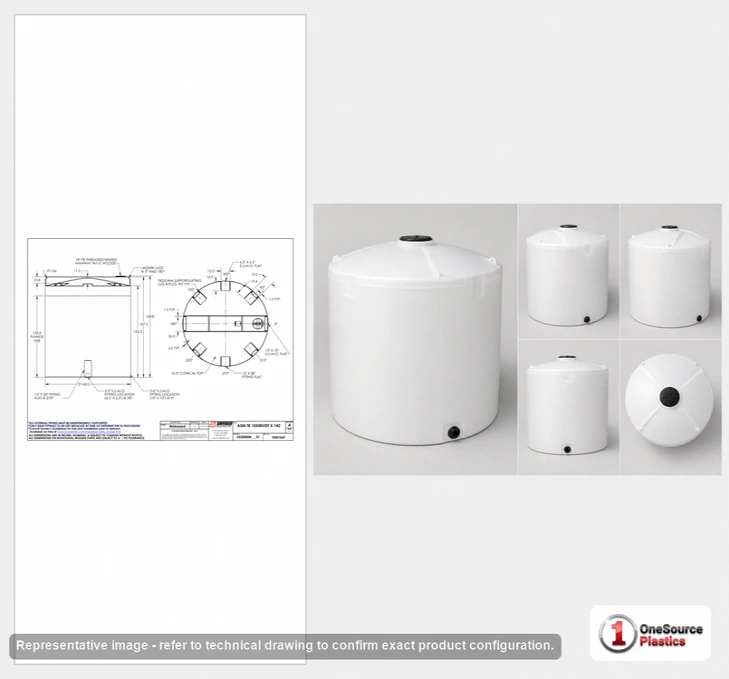
This tank and the 12,500 gallon listed on the same sheet stand on an identical 142 inch square. The only things that separate them are height and weight: 226 inches and 7,400 pounds here, 274 inches and 9,500 pounds there. So the choice between the two is not a pad decision at all, which is unusual at this scale and worth understanding before anybody prices a slab. The ground work, the footprint, the approach and the bearing area are the same whichever you take; what changes is whether your roof line, canopy, overhead service run or planning constraint will carry another four feet of vessel. Where it will, the larger tank costs you nothing in site preparation. Where it will not, this is the same tank with the top taken off it, and it is the right answer rather than a compromise. Downward the sheet publishes an 8,700 gallon at 197 inches and 5,000 pounds on the identical plan, which is the same logic again one step further. That is the whole shape of this decision: on the 142 inch plan you are buying height, and the pad is a constant. The pad itself is the real engineering. Two hundred and twenty-six inches of vessel on a 142 inch square carries 83,400 pounds of water, or 158,460 pounds at the published 1.9 rating, and a load like that is a designed slab on designed subgrade, not an existing yard surface that looks flat. Work from the concrete pad sizing guide for above ground polyethylene tanks and get it specified and cured before the tank is scheduled. Then size the volume honestly, because on a contained tank the usable capacity is not the nameplate figure: the Captor double wall freeboard sizing guide works that through on thermal expansion, chemistry and density, and your own consumption belongs in the tank sizing calculator with the freeboard rules from the tank sizing guide.
Two identical names at two different weights
| Part | Name on the sheet | Gallons | Size and empty weight |
|---|---|---|---|
| 1006600N30 | this tank, Sulfuric Acid, opaque white | 10,000 | 142 x 142 x 226 in, 7,400 lb |
| 1006600N40 | ASTM XLPE | 10,000 | 142 x 142 x 226 in, 6,400 lb |
| 1006600N46 | ASTM XLPE Black | 10,000 | 142 x 142 x 226 in, 6,400 lb |
| 1006600N48 | ASTM XLPE Black (same name, heavier) | 10,000 | 142 x 142 x 226 in, 7,400 lb |
| 1006400N46 | ASTM XLPE Black, same plan, shorter | 8,700 | 142 x 142 x 197 in, 5,000 lb |
| 1031100N30 | Sulfuric Acid, same plan, taller | 12,500 | 142 x 142 x 274 in, 9,500 lb |
Four listings share this 142 by 142 by 226 inch shell, and the sheet gives two of them the same name at two different empty weights: 1006600N46 at 6,400 pounds and 1006600N48 at 7,400. What that column does tell you honestly is that these part numbers are not interchangeable on paper, so order against the number on your drawing, your existing installation or your spares list, and tell us the product and the strength so we can confirm the listing matches before anything is quoted. The three capacity rows are the useful comparison and they all sit on this one footprint. The 8,700 is shorter and 5,000 pounds empty; the 12,500 is taller and 9,500. Since the pad does not change across the three, the sensible way to pick is on the delivery programme rather than on the site: a larger vessel means fewer truck drops for the same annual usage, and the cost per truck drop on the chemical itself usually falls as the drop gets bigger. Put your real consumption against those three heights and the answer is normally obvious in one line of arithmetic.
Want the certified one or the plain one? Call 866-418-1777 and say what the inspector asks for; or request a quote on the row you need.
Eighteen inches of manway over a 226 inch shell
- The vent: the manway is listed as threaded and vented, and on a vessel holding 10,000 gallons that path is the wall's only protection during a bulk fill and during a hard pump-down. The air volumes are large and they move at the same rate as the liquid. Keep it clear, inspect it whenever the manway is open, and never blank or restrict it.
- The manway: 18 inches, and the only opening this sheet publishes. It does duty as the fill route, the inspection route and the cleaning route, and 18 inches is wide enough to work a lance and take a real look at the wall.
- Reaching it: the manway sits at 226 inches, which is nearly nineteen feet up. Access is engineered rather than improvised, with a fixed ladder or platform, a fall protection arrangement, and the fill connection brought down to ground level so nobody climbs to take a delivery.
- The outlet field: it reads "1 Manway / Lid" and nothing else, and the inlet field is blank. That names an opening, not a pipe size, so no outlet dimension, thread, bulkhead, flange or valve is published or claimed. Give us the line size, the valve and the pump arrangement and we will confirm what this part number carries before anything is ordered.
- The space between the walls: no monitoring port, gauge or alarm is published on this sheet. At this volume that arrangement deserves a written procedure rather than a habit.
- Structure: the sheet publishes no lifting lugs, no ladder lugs and no flange lines on this part number.
- Limits: 120 F / 48 C, a specific gravity rating of 1.9, and a 3 Year Warranty with no maintenance interval published.
Name the product and its strength at order time. Every wetted part on a vessel this size is selected against the chemistry, and the fitting is the one route a release can take out of a tank that otherwise has two walls around it.
Where the truck drop sets the tank size
Ten thousand contained gallons is bought by sites whose storage is sized against a delivery schedule rather than against a process volume: municipal water and wastewater treatment, power generation and cooling water chemistry, mining and mineral processing reagent storage, pulp and paper, plant-scale metal finishing, fertilizer and agricultural chemical distribution, and industrial plants that take a bulk drop instead of handling totes. The second wall is not a convenience at this size. It is the difference between a vessel that stands on a pad and a vessel that stands inside a built containment structure somebody has to design, drain, coat and maintain for the life of the tank. Where a site is assembling its own spill prevention paperwork around bulk storage, our Captor double wall spill planning walkthrough is where to begin; nothing here is a claim that any particular rule is satisfied by this part number, and that plan is written against your site rather than against a catalogue. Agree the receiving procedure when you buy the tank: where the driver connects, who watches the fill, what the stop level is and who signs it off.
Seven thousand four hundred pounds out of Lincoln
Lincoln, Nebraska is the only plant on this sheet and Nebraska the only ship-from state, which puts the plains and the Midwest on a short lane and makes anything further a scheduled movement. The sheet gives the ship mode as LTL at class 250 with no NMFC number, and the shipping dimensions as 142 by 142 by 226 inches at 7,400 pounds. Price your own lane with the freight cost estimator; the listed price is before freight. Plan the receiving end in detail, because nothing about this is a pallet truck delivery: a vessel nearly twelve feet across and close to nineteen feet tall wants lifting equipment with the reach and the capacity, a clear approach for the truck, and a cured, level, prepared pad waiting rather than being poured around it. Lift under the base by the arrangement the rigger specifies and never by the manway. Set it plumb, check it in two directions and confirm the whole 142 inch footprint bears evenly before a single line is connected. Then fill it with clean water, hold that 83,400 pound load, and walk the base line, the manway seal and the pad in good light while the tank is under load. Drain it, let it dry, open the space between the walls, record what you saw and the date, and photograph the base from four sides. Book the water fill as a scheduled job with the crane still on site; finding a bearing problem after the rigger has left is the expensive version of this inspection. Keep one spare gasket for the outlet fitting on the shelf; it is the part that fails on a holiday.
Freight and documents
Ships from: Lincoln, NE. LTL freight is quoted to your ZIP with the freight cost estimator or by phone at 866-418-1777. The listed price is before freight.
Technical drawing (PDF) for Snyder Industries 1006600N30.
See this tank
Interactive 3D model with live fill. This tank has an interactive 3D model built to its manufacturer dimensions. Rotate it, and set a fill level to see how much liquid it holds at any height. Open the 3D view on the product photo above. Download the 3D model (GLB).
Ready to order?
Add it to your cart at the top of this page, get LTL freight to your ZIP, request a written quote, or call 866-418-1777. The listed price is before freight.