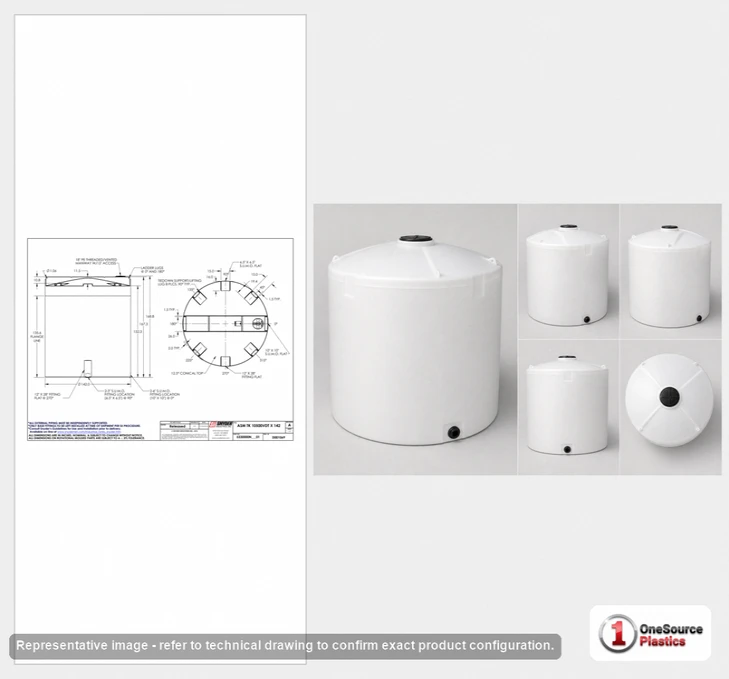
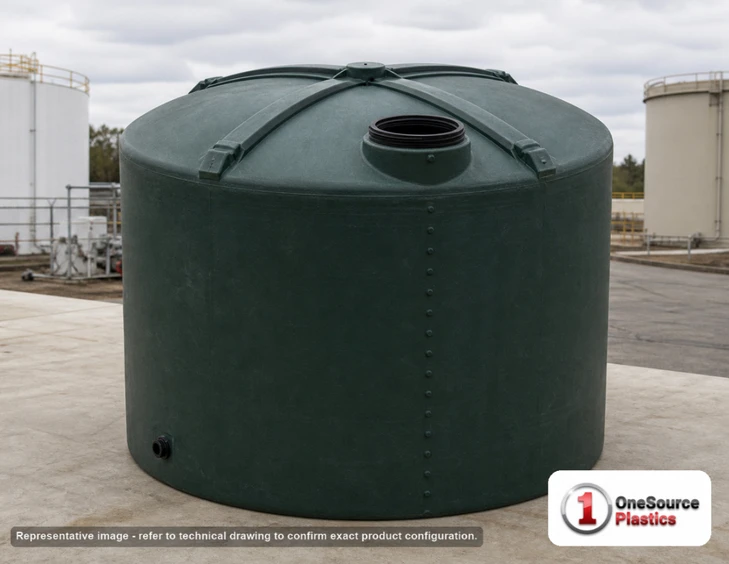
9,500 gallons of chemical storage on a ten foot base
The Snyder 7450000N43 is a white polyethylene vertical chemical storage tank, 120 inches across and 215 inches tall, holding 9,500 gallons at 3,800 pounds. The sheet rates its wall for a specific gravity of 1.9, or 150,537 pounds of contents against 79,230 for water, and at 3,800 pounds it carries the most resin of any tank on this base, the wall for a plant's bulk caustic, ferric or acid that will be filled from tankers for decades. An 18 inch threaded, vented manway on top, a 3 year warranty, and it ships as oversize freight.
Two ways to buy. Add it to your cart above with freight quoted to your ZIP, or request a written quote for a job that needs paperwork.
Nearly two tankers, on one slab
A tanker compartment is roughly half this tank, so 9,500 gallons is one delivery with a full reserve, or a plant that takes two loads a week and wants a margin against a missed one. The 120 inch base does it at 215 inches, which is a platform and a rail at the manway, and the base is shared with Snyder's 5,500 through 9,800 gallon tanks, so a slab poured for one takes the next. The list below is the resin's rated chemistry; check the liquid at its concentration in the chemical compatibility database; the weight rating and the chemical rating are two different questions. A single wall tank of regulated chemical needs a berm sized to its volume; the Snyder Captor 110 percent containment comparison covers when a double wall tank is the cleaner answer than a basin. The tank sizing calculator sizes the volume to feed rate and delivery interval, and the tank sizing guide covers the reserve.
Grades on the 120 x 215 inch tank, and the sizes beside it
| Part | Gallons | Diameter x height | Empty weight |
|---|---|---|---|
| 7450000N43 (this tank) | 9,500 | 120 x 215 in | 3,800 lb |
| 7450000N42 (XLPE) | 9,500 | 120 x 215 in | 3,600 lb |
| 7450000N40 (XLPE, lighter wall) | 9,500 | 120 x 215 in | 2,800 lb |
| 7450000N46 | 9,500 | 120 x 215 in | 2,800 lb |
| 7450000C26 (general grade) | 9,800 | 120 x 215 in | 2,800 lb |
| 7400000C26 | 8,900 | 120 x 194 in | 1,900 lb |
The N42 is cross-linked polyethylene for oxidizers, 200 pounds lighter, and the N40 is the lighter cross-linked wall at 2,800 pounds, the same weight as the N46 linear grade and the 7450000C26 general grade, which is rated for 9,800 gallons in this same shell. The 7400000C26 is the 8,900 gallon general-grade tank, 21 inches shorter on this base. The 5660000N43 is the 5,500 gallon double wall on this base for a site with neither a berm nor a basin.
Torn between two rows? Call 866-418-1777 with the liquid and the ceiling height, or ask for a quote on both and compare the freight.
Openings, sampling and labels
- Access: 18 inch threaded, vented manway, 215 inches up; vent outside on caustic and acid service, fill through a dip tube, and size the vent for a tanker's unload rate.
- Outlet: the bulkhead fitting is chosen for the chemical at order time; a flanged transition, an expansion joint, and a valve supported off the slab.
- Service limit: 120 F / 48 C.
Three practices make a bulk chemical tank a safe one. Choose the level sender for the chemical with the level gauge selection guide; on a tank this tall a radar or hydrostatic sender read at ground level saves the climb. Draw samples that represent the tank and not its stratified top, per the bulk tank chemical sampling protocol; eighteen feet of caustic stratifies, and a sample from the top tells you about the top. And label it so the fire inspector and the workplace inspector read the same thing, NFPA 704 diamond and GHS pictograms reconciled as the tank label and signage compliance guide describes, at a height a person on the ground can read.
The slab and the straps
Full, the tank loads a 120 inch circle to 150,537 pounds at the rating, and a rotationally molded floor bears on the whole pad, so the pad is what matters: an engineered slab in full contact under the entire floor, screeded flat, with no pipe trench or drain crossing under it. An empty tank gets strapped, because 215 inches of empty polyethylene is a sail, and the straps come off or go slack once the tank is full and its own weight anchors it. Leave a walkway around the tank wide enough for the inspector and the sampler, and put the platform at the manway on its own footings, not hung from the tank.
Unloading without a spill
The truck's pump outruns the manway vent, so size the vent for the unload rate or give the fill its own top bulkhead and vent line. A fill pipe to the floor keeps caustic or coagulant from free-falling and foaming. A dense liquid heats when water is added to it, so a batch tank is filled with water before the chemical, never after. The first delivery into a new tank is watched from start to finish, with the slab edge and the outlet fitting checked as the level climbs, and each delivery after it is logged with its date and strength; at this volume the log is also the inventory.
Inspecting a tall wall
Polyethylene gives out above the liquid, where vapor and sunlight reach it, so the yearly inspection is done from the platform with the manway open and a light on the top third, looking for crazing and chalk. The outlet fitting and the flanged transition are checked at every delivery, because that is where a tank this heavy moves as the level changes, and the expansion joint is what takes that movement instead of the fitting. Nothing is hung from the shell, nothing is bolted through it below the liquid line after the tank is in service, and the walkway stays clear.
In service
Caustic, coagulant and acid bulk storage at large water and wastewater plants with a berm, process chemical storage at industrial sites that take tanker deliveries, and any regulated liquid at plant scale at a site an inspector visits. One chemical per tank; label it once for both inspectors; keep the manway shut so nothing escapes as vapor.
Rated chemistries for this tank
The manufacturer lists these liquids for this resin at the concentrations noted, with the fitting and gasket material to specify. Check the concentration and temperature you actually run on the linked page or in the chemical compatibility database before ordering.
- Acetic Acid
- Aluminum Sulfate
- Calcium Chloride
- DEF
- Ethylene Glycol
- Ferric Chloride
- Ferric Sulfate
- Ferrous Sulfate
- Hydrochloric Acid
- Hydrofluoric Acid
- Hydrofluosilicic Acid
- Hydrogen Peroxide
- Magnesium Chloride
- Peracetic Acid
- Phosphoric Acid
- Polyaluminum Chloride
- Potassium Carbonate
- Potassium Hydroxide
- Propylene Glycol
- Sodium Bisulfate
- Sodium Bisulfite
- Sodium Carbonate
- Sodium Hypochlorite
- Sodium Thiosulfate
- Sulfuric Acid
- Urea Solution
- Zinc Orthophosphate
Freight and unloading
At 120 inches across and 215 inches long on the deck the 7450000N43 is oversize freight (NMFC 156600) on a flatbed at a lane rate; the freight cost estimator prices the move to your ZIP, and the price on this page is before freight. A crane sets 3,800 pounds upright on the slab; a forklift can take it off the deck, not raise it. Fill it with water to the manway once, hold the level, and look the outlet fitting over before chemical arrives. The first fill is the only cheap time to find a problem, so do it in daylight with someone watching the base.
Freight and documents
Ships from: Lincoln, NE. LTL freight is quoted to your ZIP with the freight cost estimator or by phone at 866-418-1777. The listed price is before freight.
Technical drawing (PDF) for Snyder Industries 7450000N43.
See this tank
Interactive 3D model with live fill. This tank has an interactive 3D model built to its manufacturer dimensions. Rotate it, and set a fill level to see how much liquid it holds at any height. Open the 3D view on the product photo above. Download the 3D model (GLB).
Product video. Watch the Snyder Industries 9500 Gallon HDPE Vertical Chemical Storage Tank in White video (76 seconds) with dimensions, fittings and shipping notes.
Ready to order?
Add it to your cart at the top of this page, get LTL freight to your ZIP, request a written quote, or call 866-418-1777. The listed price is before freight.