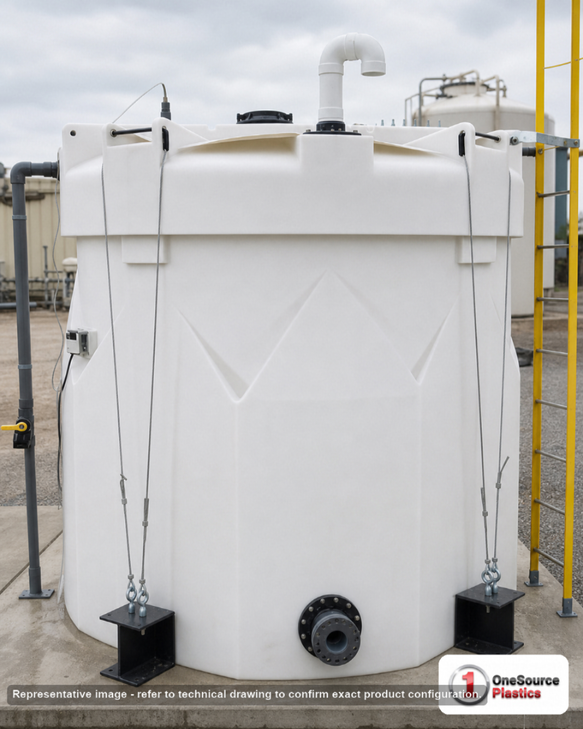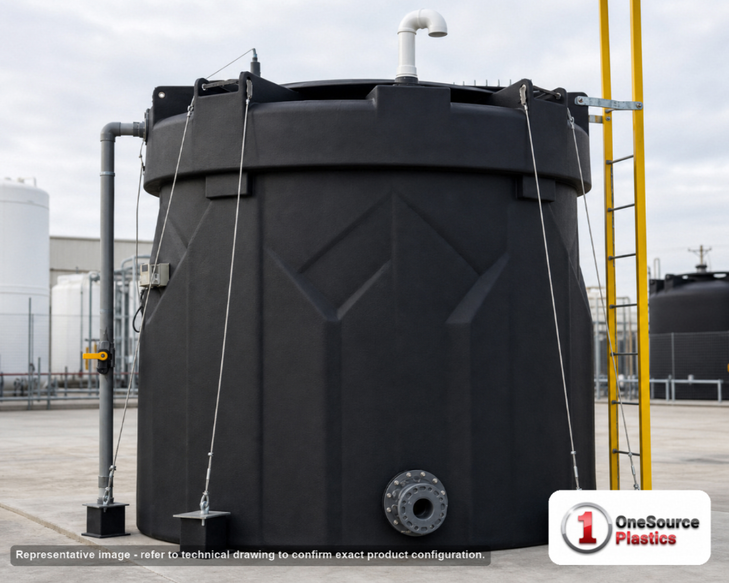
Ten thousand gallons, cross-linked, 140 F / 60 C
A warm product held at bulk volume and dense enough to matter is a narrow specification, and this sheet covers it. The Snyder 1006600N48 is a 10000 gallon double wall tank, named by the maker as an ASTM XLPE Black double wall tank, and those name words are repeated as a name only. The material field reads crosslinked linear polyethylene and the colour field reads black. The shell is listed at 142 inches long by 142 inches wide by 226 inches tall and 7,400 pounds empty. One capacity, one set of overall dimensions, one empty weight and one rating are published for the whole assembly: there is no separate inner tank figure, no separate outer containment figure, no annulus dimension and no containment percentage on this sheet, so none appears here. The wall is rated at a specific gravity of 1.9, and the sheet gives 83,400 pounds for 10,000 gallons of water at 8.34 pounds per gallon with 158,460 pounds of maximum contents. The only opening is an 18 inch threaded vented manway; the outlet field reads "1 Manway / Lid", an opening and not a pipe size, and the inlet field is empty. The service limit is 140 F / 60 C, the warranty is a 3 Year Warranty, and the ship mode is LTL at class 250 with no NMFC number out of Lincoln, Nebraska.
Ordering for a plant or a bid? Request a written quote with freight to your ZIP for the file; a single 10000 gallon tank goes straight to the cart above.
Warm dense service at ten thousand gallons
Look at who actually needs both figures on this sheet at once, because that is the buyer. A plant storing a product that is both warm and heavier than water, in a quantity that arrives by tanker: caustic and process chemical holding on hot manufacturing lines, clean-in-place supply across a food, beverage or dairy site, boiler house and cooling tower chemistry at station scale, plating and metal finishing at plant volume, pulp, paper and mineral processing, and treatment chemical storage where the product does not arrive cold. The service limit here is 140 F / 60 C, the higher of the two carried in this 226 inch shell, and the rating is a specific gravity of 1.9, carrying 158,460 pounds of maximum contents against 83,400 pounds of plain water at 8.34 pounds per gallon. Warm and dense together is what this listing is written for, and it is why a lower-limit or lighter-rated shellmate is not a substitution when both conditions are real. If only one of them is real, say so and we will point at the sheet that matches, because paying for wall you will never work is the most common mistake at this size. The containment does what it does at any volume, only the stakes are larger. Ten thousand gallons on an indoor slab, or on a yard surface that reaches a drain, is the quantity at which a release stops being a clean-up and becomes a notifiable event, and a vessel that is its own bund takes that off the table without a poured structure, its own drainage design and its own maintenance. The value is in being able to show the space between the walls is empty, so the inspection schedule is written before the tank lands. Warm service works the wall hardest where nobody looks, which is the subject of the wall thickness at the vapour saturated headspace guide, and a warm product also fails to give you the nameplate volume, which the Captor double wall freeboard sizing guide works through on thermal expansion, chemistry and density. Run your usage and drop size through the tank sizing calculator with the freeboard discipline from the tank sizing guide, and design the slab for 83,400 pounds of water standing on a just-under-twelve-foot square before the tank is scheduled.
The 226 inch shell and its neighbours
| Part | Gallons | Height | Plan | Empty weight |
|---|---|---|---|---|
| 1006600N48 (this tank, named ASTM XLPE Black, listed to 140 F / 60 C) | 10,000 | 226 in | 142 x 142 in | 7,400 lb |
| 1006600N30 (named Sulfuric Acid, same listed weight) | 10,000 | 226 in | 142 x 142 in | 7,400 lb |
| 1006600N46 (named ASTM XLPE Black, lighter listing) | 10,000 | 226 in | 142 x 142 in | 6,400 lb |
| 1006600N40 (named ASTM XLPE, lighter listing) | 10,000 | 226 in | 142 x 142 in | 6,400 lb |
| 1006400N46 (same plan, one step down) | 8,700 | 197 in | 142 x 142 in | 5,000 lb |
| 1031100N30 (same plan, one step up) | 12,500 | 274 in | 142 x 142 in | 9,500 lb |
Two listed weights cover the four rows on this shell: this tank and 1006600N30 at 7,400 pounds, 1006600N46 and 1006600N40 at 6,400. The sheet does not say why, and neither will we; what the weight column is good for is planning the lift, while the rating line and the service limit on each individual sheet are what decide the service. Between this tank and 1006600N46 in particular, both are black cross-linked listings on the identical shell, and the sheets separate them on the rating and the empty weight, each page citing only its own. The three capacities on this plan are where the real sizing decision lives, and the family makes it clean: 8,700 gallons at 197 inches, 10,000 at 226, 12,500 at 274, all on the same 142 inch square. The ground work never changes. So measure the clear height at the final position with a platform and a fill arrangement allowed for above an 18 inch manway, check any site line or planning cap, and then count deliveries. Where the height is available, the larger vessel normally wins on running cost, because the annual usage is fixed and fewer arrivals mean a better cost per truck drop. Where it is not, the shorter row is the same tank with the top taken off it and it needs no change to the slab you were pouring anyway.
Need the taller or the wider one? Every row links to its page with freight to your ZIP on each; 866-418-1777 will check the ceiling and the pad.
What a pump needs from a tank with one published opening
- The pump path: one opening is published and no outlet dimension appears, so the discharge arrangement is designed with us rather than inferred. The head at the base of a 226 inch column governs the pump and the valve, and at the 1.9 rating a dense product makes that figure larger than water would.
- Temperature at the seal: the sheet lists 140 F / 60 C. If the product runs near it, gasket material, valve seats, seals and any flexible connection are chosen against temperature as well as chemistry, and that is where a weep starts on an otherwise sound tank. Say so when you order.
- Prime and draw-down: specify the pump for the end of a draw rather than the start, because a tall vessel gives up its head as it empties. Keep the suction short and rigid where the layout allows.
- Low level: set the stop level and protect it with a cut-out. A black wall gives an operator nothing to see, so the instrument is the whole of the level system.
- The outlet field: it reads "1 Manway / Lid" with the inlet field empty, naming an opening rather than a pipe size, so no outlet dimension, thread, flange or valve is claimed on this page. Tell us the duty, the temperature and the line size and we will confirm what this part number carries.
- The manway: 18 inches, threaded and vented, at 226 inches, serving as fill, inspection and cleaning route at once. Access is engineered with the installation and the fill connection is brought down to ground level wherever the delivery allows.
- The vent: part of the manway, and a warm headspace moves more air for the same change in level. Keep it clear, inspect it whenever the manway is opened, and never blank it.
- Structure: the sheet lists 8 lifting lugs, ladder lugs and 2 flange lines on this shell.
- The space between the walls: no monitoring port, gauge or alarm is published, so that arrangement is specified separately.
- Limits: 140 F / 60 C, a specific gravity rating of 1.9, and a 3 Year Warranty.
Give us the product, the strength and the working temperature together, and every wetted part on the vessel is chosen once against the duty you actually run.
Chemical make-up and clean-in-place supply at plant scale
This listing belongs where a warm, dense product is held in bulk and drawn continuously: sanitation and clean-in-place chemical supply across a whole food, beverage or dairy plant, caustic and acid holding on hot process lines, boiler and cooling tower treatment at station scale, plating and metal finishing at plant volume, pulp, paper and mineral processing, and treatment chemical storage at municipal works where the stream does not arrive cold. Ten thousand gallons is a tanker programme rather than a tote programme, and the second wall is what makes receiving that delivery indoors or on a draining surface a planned decision rather than an exposure somebody carries. Two habits earn their keep from the first week: inspect the space between the walls on a fixed schedule with the date recorded, and put the vent and the top arrangement on the maintenance round, because on warm duty the headspace ages faster than anything you can see from the floor. Where the real reason for a vessel this size is private fire water storage rather than chemical holding, that duty is sized by different rules and the fire water reservoir design guide for rural and remote sites is where that enquiry starts; nothing on this page is a claim about that use.
A 226 inch load and the equipment that lands it
The plant named on this sheet is Lincoln, Nebraska, and no ship-from state field is published at all, so the plant is printed and nothing further about the lane is claimed. The ship mode is LTL at class 250 with no NMFC number, and the load is 142 by 142 by 226 inches at 7,400 pounds. Price your lane with the freight cost estimator; the listed price is before freight. The sheet publishes no crane rating, no rigging plan, no permit and no escort requirement, so none is stated here; it does publish 8 lifting lugs, and everything else about the lift is planned by your rigger against the machine that can reach the position. Send us the site constraints early. A load just under twelve feet across and close to nineteen feet tall needs a measured approach, standing room for the equipment, and a cured, level pad finished before the truck is booked. Lift under the base by the arrangement the rigger specifies and never by the manway. Set it plumb, check two directions, confirm the whole 142 inch footprint bears evenly, and only then connect anything. Fill with clean water, hold the 83,400 pound load, and read the manway seal, the base line and the pad in good light while it is loaded. Drain it, dry it, open the space between the walls, look in and record the date on the shell. Then walk the pad edge again after the first hard rain, because a subgrade that is going to move tells you at the edge first and long before it tells you at the tank. A strap that is checked once a season is a strap that holds; put it on the same calendar as the gutters.
Freight and documents
Ships from: Lincoln, NE. LTL freight is quoted to your ZIP with the freight cost estimator or by phone at 866-418-1777. The listed price is before freight.
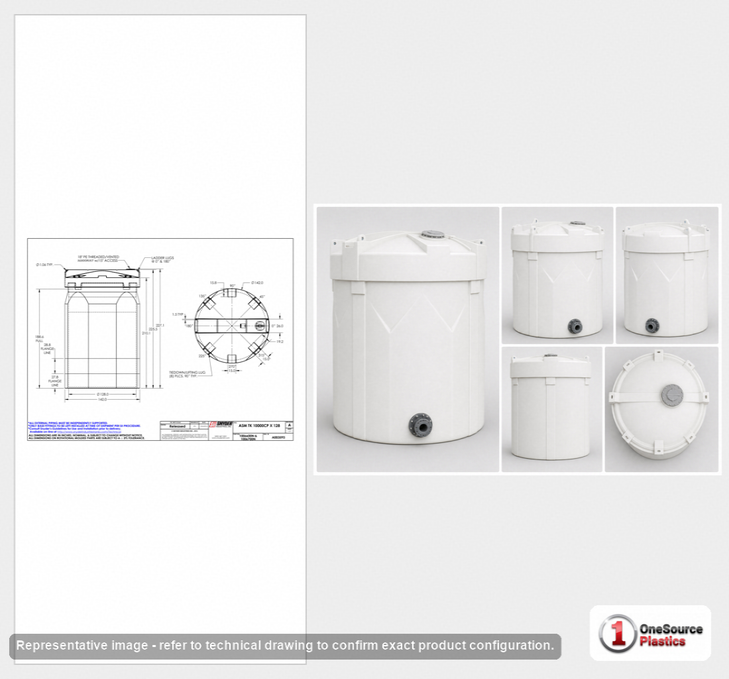
Technical drawing (PDF) for Snyder Industries 1006600N48.
See this tank
Interactive 3D model with live fill. This tank has an interactive 3D model built to its manufacturer dimensions. Rotate it, and set a fill level to see how much liquid it holds at any height. Open the 3D view on the product photo above. Download the 3D model (GLB).
Ready to order?
Add it to your cart at the top of this page, get LTL freight to your ZIP, request a written quote, or call 866-418-1777. The listed price is before freight.