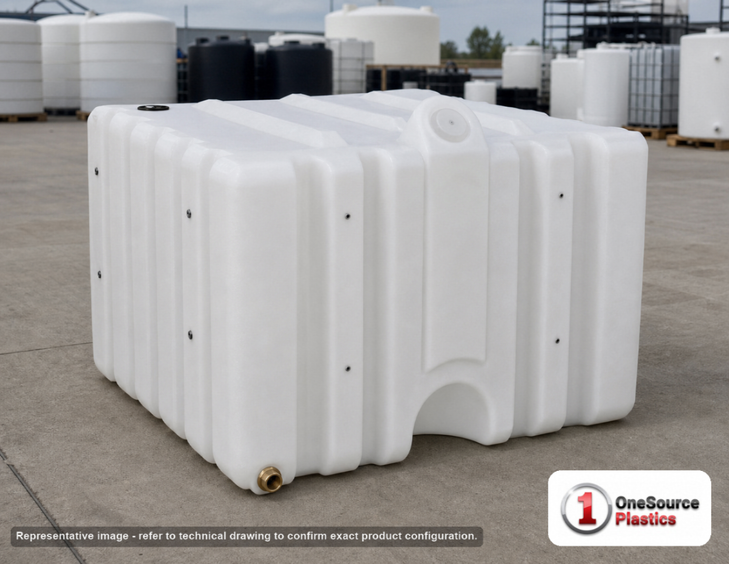
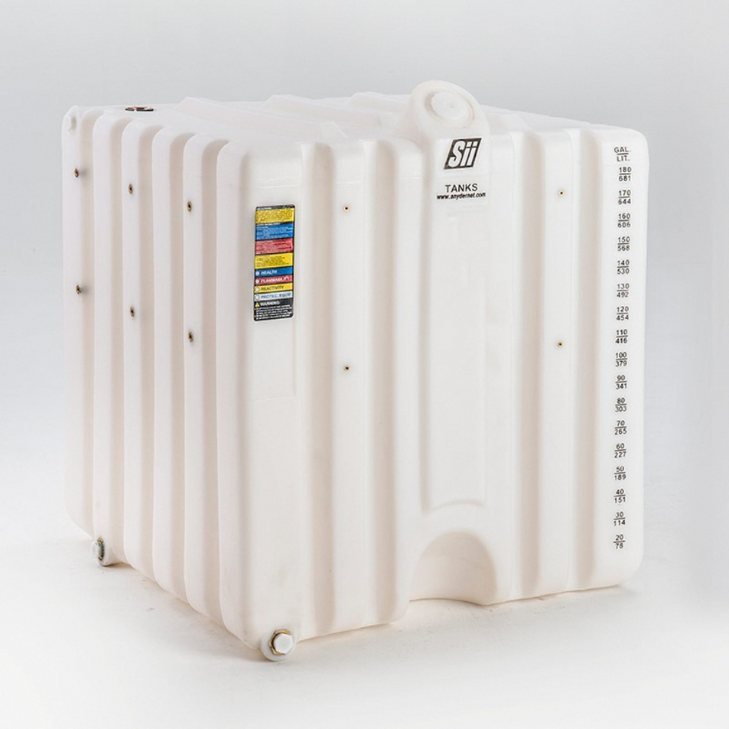
The slimtainer: 22 inches wide, 54 inches long, 120 gallons
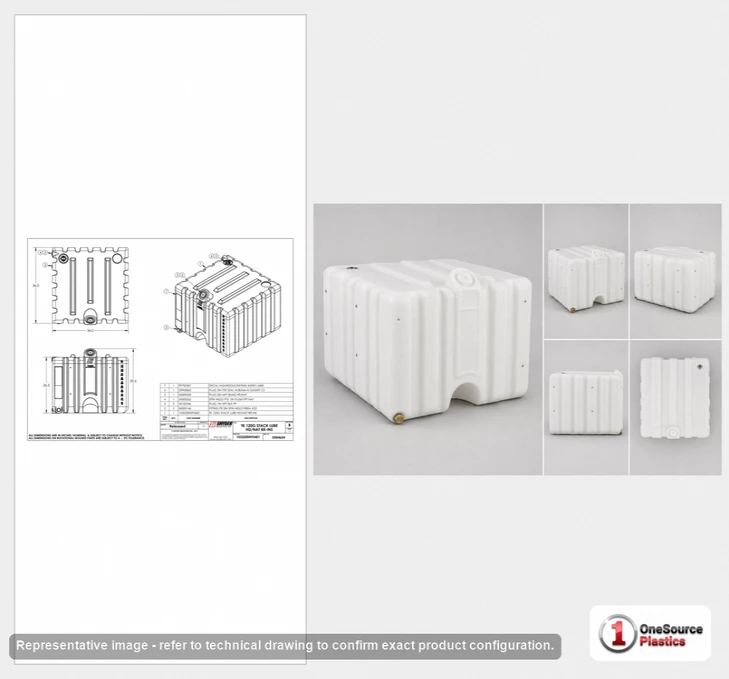
Twenty-two inches is the number that sells the Snyder SII-1035500N95401. It is a 120 gallon slimtainer with a brass dispense fitting, in white high density linear polyethylene, 54 inches long, 22 inches wide and 32 inches tall, listed at 60 pounds empty and 60 pounds to ship, molded at St. Bonifacius, Minnesota. The sheet rates the wall at a specific gravity of 1.9, which is where the 1,902 pound figure for maximum contents comes from against 1,001 pounds for 120 gallons of water at 8.34 pounds per gallon. Access is an 8 inch lid, and the freight listing is class LTL under NMFC 156600-02. This sheet publishes no maximum operating temperature and no warranty term, so neither is asserted here; ask us and we will get Snyder's current terms in writing.
Ready to price it? The listed price is before freight; quote freight to your ZIP in a few seconds, then add to cart above or call 866-418-1777.
The duty is a narrow space, and that is the only reason this part number exists
Start with who is short of width. A fleet shop with a working aisle between a bench and a lift. A wash bay where the chemical has to stand against a wall and the door has to keep opening. A greenhouse or nursery bench run that is long and shallow by design. A service truck or van where the load has to go down one side and leave the other free for tools. A plating, printing or laboratory line where the vessel stands between machines. A municipal store where concentrate lives along a wall in a corridor. All of them draw liquid by hand into smaller vessels, all of them need somewhere near 120 gallons of it, and none of them can give up the four feet of clearance a square container wants. This body answers that and nothing else: 22 inches across is narrower than most doorways are wide and narrower than the wheel wells of a pickup bed, so it passes through and sits down where a cube will not. It buys that by stretching to 54 inches, four and a half feet, which is the wrong trade in a short space. At 32 inches tall it is the taller of the two 120 gallon dispensing containers on this sheet, which puts the lid a little further up and puts a pail comfortably under the fitting. Under the base, flat and continuous carries the whole argument, because the body bears on every part of the surface it is resting on and nothing else: a long narrow container spanning two bench supports with a gap in the middle is carrying 1,001 pounds of water, or up to 1,902 pounds of contents at the sheet's rating, on those two lines instead of across its floor. Support it end to end. Where it stands on a slab instead of a bench or a pallet, the concrete pad sizing framework is the right reference and it scales down to a footprint this small. Then check the volume against the duty rather than the space: 120 gallons against your real daily draw and refill interval in the tank sizing calculator, with the reserve you never dip into and the headspace a warming liquid needs from the tank sizing guide.
Same 120 gallons, two footprints, two NMFC listings
| Part | Gallons | Length x width x height | Empty weight |
|---|---|---|---|
| SII-1035500N95401 (this slimtainer, narrow) | 120 | 54 x 22 x 32 in | 60 lb |
| SII-1032200N95401 (cubetainer, same volume, square) | 120 | 36 x 36 x 30.5 in | 63 lb |
| SII-1032100N95401 (smaller, square, lowest) | 80 | 36 x 36 x 21.75 in | 50 lb |
| SII-5700102N95704 (used oil containment tank, with level gauge) | 120 | 34 x 34 x 51 in | 100 lb |
| SII-5710102N95704 (larger used oil containment tank, with level gauge) | 150 | 34 x 34 x 62 in | 110 lb |
The decision that matters here is between this container and the SII-1032200N95401, and it is decided with a tape measure rather than an argument. Both hold 120 gallons. Both carry an 8 inch lid and the same brass dispense fitting in the name. Both are rated at a specific gravity of 1.9 and both list 1,001 pounds of water and 1,902 pounds of maximum contents. This one puts that volume in 54 inches by 22 inches and is listed at 60 pounds; the other puts it in a 36 inch square at 63 pounds. So the slim body is the lighter of the pair on the sheet and it is the one that fits a narrow run, while the square body is the one you can reach across from two sides and the one that wants a shorter space. The sheet also lists them under different NMFC codes, 156600-02 here against 156600-03 on the square one, with the same class and the same plant; both are printed as given and neither is explained. Below the pair, the SII-1032100N95401 is the low square 80 at 21.75 inches for a bench or an under-shelf spot with a small draw. The other two part numbers here are named for a different job entirely: the sheet calls the SII-5700102N95704 and the SII-5710102N95704 used oil containment tanks with a level gauge, 34 inches square, standing 51 and 62 inches at 100 and 110 pounds. It publishes no containment volume or percentage for either, so this page asserts none on their behalf. If the requirement is containment rather than dispensing, say so when you call and we will work from the manufacturer's own documentation.
Want us to check the fit? Send the site dimensions to 866-418-1777 or through a written quote request and we will confirm the tank, the pad and the freight.
Drawing it down: the dispense fitting and the low corner it sits in
- The drain path: this container is drawn by gravity through the brass dispense fitting the part number is named for, with nothing pumped and nothing plumbed. The consequence of a 54 inch body only 22 inches wide is that the liquid runs to the low end rather than settling in a broad pool, so a container sitting dead level empties further than a square one does, and a container with a shim under the far end empties further still.
- The fitting itself: brass rather than plastic is the reason to buy this part number instead of a plain container, because the fitting on a vessel people open by hand every day takes the wear, the knocks and the cross-threading that the shell never sees. Keep it on the side away from traffic, clear of the edge of the bench or pallet, and never lift or drag the container by it.
- The outlet as the sheet lists it: the sheet gives the outlet as 1 with no unit, so the figure is printed and nothing is inferred from it. It is not a pipe size. Tell us what you mean to connect and we will confirm the thread against Snyder's current documentation before you buy fittings.
- The inlet as the sheet lists it: the sheet gives the inlet as 2, again without a unit. In service a container this shape is filled through the lid with the hose down inside the body, in the place it is going to be drawn from.
- Access: an 8 inch lid at 32 inches, reachable without a step, wide enough for a fill hose, a light and a hand. Keep it closed between draws, because a long open vessel takes in dust and insects along its whole length.
- No temperature limit and no warranty term on this sheet, so neither appears on this page; ask us and we will put Snyder's current position in writing.
Handling is where a slim container gets damaged, so plan it. Fill it where it will stand: 60 pounds empty is a two-person carry, and 1,001 pounds of water or up to 1,902 pounds of contents at the rating is a machine job, not a lift. A long narrow body carried part-full on a deck rolls rather than sloshes, and it wants strapping at the pallet in two places along its length rather than one strap over the middle. Support the full 54 inches underneath; a container hanging over the end of a pallet is carrying its load on an edge. Keep it to one product and label it with that product, because a narrow vessel is the hardest of this family to see into and to prove clean. And take the level reading through the lid rather than by feel; along four and a half feet of floor, an inch of depth is a surprising number of gallons.
Fleet shops, wash bays and greenhouse benches where the width is fixed
This is the container for a place that is long and thin. A fleet or municipal shop with concentrate against a wall and an aisle that has to stay open. A truck wash bay holding detergent or pre-soak where the door swings over the floor. A greenhouse or nursery bench feeding a mixing station. A service van or utility bed where the load goes down one side. A plating, printing, food or laboratory line where the vessel stands between two machines. A yard cabinet or store where the container lives under a counter. The duty in all of those is the same small repeated draw into a jug, a pail or a sprayer, which is what the brass fitting is for, and the reason to choose this part number over the square one is purely that the space is fixed at less than two feet across. Two honest limits. There is no containment on this container and the sheet publishes no containment figure, so where site rules require a contained vessel, this is not it. And the sheet gives no maximum operating temperature at all, so we will not imply one: tell us how hot the liquid is when it arrives and how hot the room gets, and we will check it against Snyder's documentation instead of guessing on your behalf.
Minnesota freight at 60 pounds, and the shipment it lands on
The SII-1035500N95401 is molded at St. Bonifacius, Minnesota and the sheet lists it at class LTL under NMFC 156600-02, shipping at 54 inches by 22 inches by 32 inches and 60 pounds. The freight cost estimator prices the lane to your ZIP, and the listed price is before freight. At four and a half feet long this ships as a shipped item rather than a parcel, so tell us at order whether the address has a dock, a machine or neither; a long light shipment is easy to unload and easy to drop, and two people who know it is coming handle it better than one who does not. Inspect the base along its whole length, the lid seal and the dispense fitting before the driver leaves. Keep the pallet or skid it arrives on, because a narrow container is awkward to carry and simple to move on a pallet jack. Water-test it before the first working fill: put clean water in it where it will stand, leave it for a day, and look under both ends as well as the middle. Then set the height of whatever you fill from it, because the one thing people get wrong with a slim container is buying it for the width and then finding the pail does not clear the fitting. A photo of the tank on its pad, full, on day one is worth keeping; it is the baseline every later inspection is compared against.
Freight and documents
Ships from: St. Bonifacius, MN. LTL freight is quoted to your ZIP with the freight cost estimator or by phone at 866-418-1777. The listed price is before freight.
Technical drawing (PDF) for Snyder Industries 1035500N95401.
See this tank
Product video. Watch the Snyder Industries 120 Gallon Slimtainer Tank with Brass Dipense Fitting video (67 seconds) with dimensions, fittings and shipping notes.
Ready to order?
Add it to your cart at the top of this page, get LTL freight to your ZIP, request a written quote, or call 866-418-1777. The listed price is before freight.