Fifteen hundred and fifty gallons cross-linked and rated 140 F / 60 C
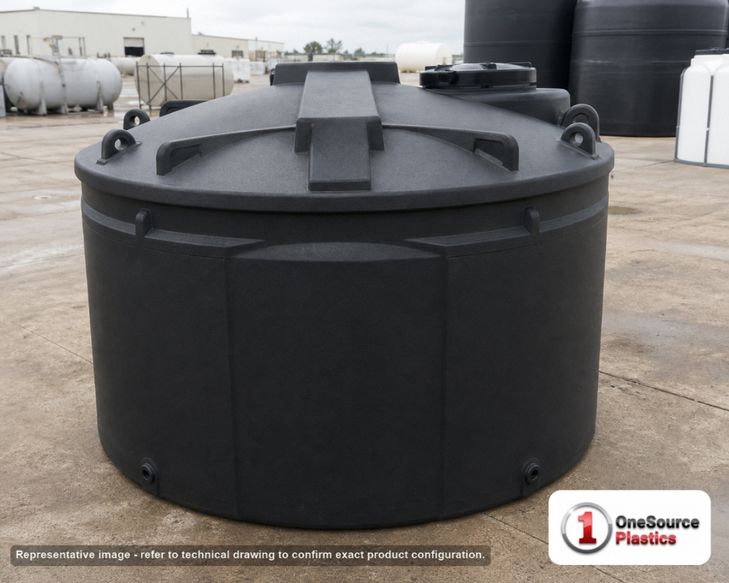
The Snyder 5490000N48 is a 1,550 gallon double wall tank, listed on its sheet as an ASTM XLPE Black Captor. Those name words are the maker's name for the product and nothing is claimed from them here; Captor is Snyder's own product name for this containment range. It is moulded in black cross-linked linear polyethylene at 76 inches long by 76 inches wide by 136 inches tall and 780 pounds empty. One capacity, one envelope, one weight and one rating are published for the whole assembly, with no separate inner tank figure, no separate outer containment figure, no annulus dimension and no containment percentage on the sheet, so none is stated here. The wall is rated at a specific gravity of 1.9, and the sheet gives 12,927 pounds for 1,550 gallons of water at 8.34 pounds per gallon with 24,561 pounds of max contents. The published opening is an 18 inch threaded vented manway; the outlet field reads "1 Manway / Lid", which names an opening and not a pipe size, and the inlet field is blank. The structural record is 8 lifting lugs, ladder lugs and two flange lines. The service limit on this sheet is 140 F / 60 C and the warranty is a 3 Year Warranty. Freight is LTL at class 300 with no NMFC number, moulded at Philippi, West Virginia.
Talk to a person first? 866-418-1777 reaches a tank specialist, not a call center; or see freight to your ZIP and add the 1550 gallon tank to your cart above.
The warmer duty on the tall shell
One field decides this part number against the two listings standing on the identical shell, and it is the service limit: 140 F / 60 C, the highest figure published anywhere in this group. That is the duty this tank is bought for. A plant with a warm chemical store, a process stream that arrives above ambient, a jacketed or traced line feeding the vessel, a wash or clean-in-place system that returns warm, or a southern yard where summer ambient is the design case, specifies this listing rather than a shellmate. We cite that figure exactly as this sheet gives it and we never borrow a number from a twin part number, because the limit that matters is the one printed against what you actually order; the other listings on this shell carry their own, lower figures on their own sheets. Ask and we will read you each of them before you commit. Two things follow from a warm duty and both belong in the design rather than in a footnote. The first is that a tank rating is not a system rating. The pump, the hose, the strainer, the seals and any gasket we fit are each rated separately, and on a warm service the weakest of them sets your working limit, not the wall. The second is that the top of the tank is the hard part. A polyethylene wall's most demanding service is at the vapour line rather than under the liquid, which is exactly where a warm duty concentrates, and the wall thickness at the vapour saturated headspace guide sets out why an inspection from the liquid side misses it. Read that before the first maintenance schedule is written, not after. The duties themselves are ordinary: chemical holding at a water or wastewater works, warm process and cleaning chemical storage in food, beverage and dairy, pulp and paper additive feed, plating, pickling and surface finishing, textile and industrial laundry, and cooling or boiler treatment in a warm plant room. Fifteen hundred and fifty gallons is a bulk holding that takes a tanker drop, which is usually where the bulk chemical cost per gallon argument for the step up comes from. The proportion asks the same of the ground as the rest of this shell group. Over eleven feet of tank on a 76 inch square base puts 12,927 pounds of water and 24,561 pounds at the published 1.9 rating onto roughly forty square feet, so flat, continuous, level and carrying the whole footprint is the specification, with a signed calculation for anything that is not a ground bearing slab. Size it before you order: the Captor double wall freeboard sizing guide covers why the nameplate figure is not the usable volume on a contained tank, and thermal expansion is a larger part of that on a warm duty than a cold one. Put your own turnover through the tank sizing calculator and take the freeboard rule from the tank sizing guide. Where the second wall is going into a written spill prevention plan, our Captor double wall spill prevention walkthrough is the place to start, and nothing on this page claims a rule, a listing or an approval. Where the duty is private fire water storage instead, the fire water reservoir design guide for rural and remote sites is the right starting point; this page makes no claim about that use.
Three 1550 listings beside this one
| Part | Gallons | Length x width x height | Empty weight |
|---|---|---|---|
| 5490000N48 (this tank, named ASTM XLPE Black Captor) | 1550 | 76 x 76 x 136 in | 780 lb |
| 5490000N51 (named ASTM Black Captor) | 1550 | 76 x 76 x 136 in | 780 lb |
| 5490000N52 (named Sodium Hypochlorite (UV) Captor) | 1550 | 76 x 76 x 136 in | 780 lb |
| SII-5490000N30 (opaque white, listed at a heavier weight) | 1550 | 76 x 76 x 136 in | 970 lb |
| 5990302N30 (smaller, wide and low, named Sulfuric Acid) | 1500 | 93 x 93 x 76 in | 950 lb |
| 5570000N48 (larger, wider, named ASTM XLPE Black Captor) | 2000 | 102 x 102 x 103 in | 900 lb |
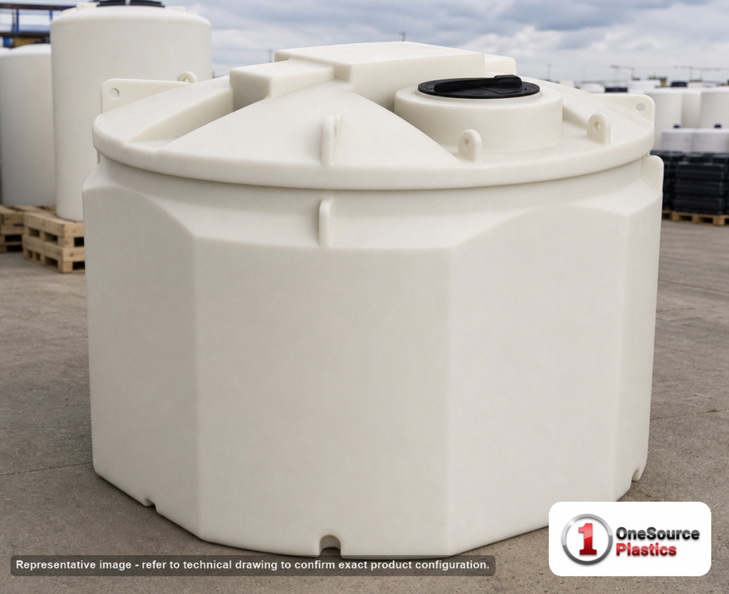
Four part numbers stand on this identical 76 by 76 by 136 inch shell. Three are listed at 780 pounds and SII-5490000N30 at 970, and that listing is also spelled with a prefix the others do not carry; both the weight and the spelling are printed as the sheet gives them and neither is explained here, because the sheet explains neither. What separates the four in practice is colour and service limit. This one is black and carries the highest published figure in the group on its own sheet; the others carry their own on theirs, and each of our pages prints only what its own sheet says. If the duty is warm, this is the row to price, and if you are unsure we will read you all four figures over the phone. The two remaining rows are a shape decision rather than a capacity one. 5990302N30 holds 1,500 gallons, fifty fewer than this tank, on a 93 inch plan at only 76 inches tall and 950 pounds: a vessel you can reach the top of from a short platform, and a far easier tank to live with if the yard has the room. 5570000N48 holds 2,000 gallons on a 102 inch plan at 103 inches and 900 pounds. This tank is the narrowest and the tallest of the three by a wide margin. Choose on whichever of floor and height your site is genuinely short of, and count the cost of getting an operator safely to the manway as part of that decision rather than as an afterthought.
Neighboring size a better fit? Every row links to its own page; freight to your ZIP is quoted on each, or call 866-418-1777.
Discharge design when the wall is rated higher than the pump
- The discharge path: no outlet connection is published. The outlet field reads "1 Manway / Lid", which is an opening and not a pipe size, and the inlet field is blank, so nothing about a thread, bulkhead, flange or valve is claimed on this page. The arrangement built here is a drop pipe through the manway to a pump alongside, which is a suction lift from the bottom of a 136 inch tank.
- Rating the system, not the tank: the wall on this sheet is rated to 140 F / 60 C. The pump, the hose, the strainer, the seals and any gasket we supply carry their own ratings, and on a warm duty the lowest of those is the working limit of the installation. Tell us the temperature and the product and we will specify against both rather than against the tank alone.
- Prime on a warm fluid: a warm liquid is harder to keep on the suction side of a pump than a cold one, and the lift from the bottom of a tall tank is where that shows first. Keep the suction short and rising, avoid a high point that traps vapour, and give the pump a foot valve or a self-priming head.
- Low level protection: the sheet publishes no level device, gauge or sight arrangement, and the shell is black, so the cut-out is the only warning the installation gets. Fit it at installation.
- The opening: an 18 inch threaded vented manway is the only opening published, serving as fill point, drop pipe route, inspection hatch and cleaning access.
- Reaching it: at 136 inches the access is a fixed platform with fall protection, designed with the tank rather than added later.
- The vent: listed as vented, and on a warm duty that path is working harder than it does on a cold one. Keep it clear, inspect it whenever the manway is open, and never restrict it.
- Structure: this sheet publishes 8 lifting lugs, ladder lugs and two flange lines; rig on the lugs to the maker's instructions and claim nothing beyond the published record.
- The space between the walls: no monitoring port, gauge or alarm is published, so that arrangement is specified separately.
- Limits: 140 F / 60 C, a specific gravity rating of 1.9, and a 3 Year Warranty.
Name the product, the strength and the working temperature when you order. The second wall does nothing for a fitting or a seal chosen generically, and on a warm duty those are the parts that go first.
Heated process feed and steam adjacent rooms
This capacity with the higher published service limit goes where the liquid, the room or the season runs warm: clean-in-place and sanitation chemical storage in food, beverage and dairy, additive and bleach feed in pulp and paper, plating, pickling and anodising lines, textile processing and industrial laundry, a chemical store next to a boiler house or a steam main, cooling water treatment on a process site, and yard storage in a hot climate where summer ambient is the design case rather than an exception. Fifteen hundred and fifty gallons is a bulk holding that takes a tanker drop instead of tote handling, which is usually where the money argument for the step up comes from. Two things are worth writing into the operating procedure on a warm duty. Read the wall at and just above the liquid line when the manway is open, because that is where the service is hardest and where a problem shows first. And check the vent on the same schedule, since a path that is adequate on a cool day is the one that finds you on a hot one.
Loading a hundred and thirty-six inches onto one pallet position
Philippi, West Virginia is the plant on this sheet and West Virginia the only ship-from state; the mid-Atlantic and the Ohio valley are short lanes and the far West is a planned move. Freight is LTL at class 300 with no NMFC number listed, and the shipment is the tank at 76 by 76 by 136 inches and 780 pounds. Price the lane to your own ZIP with the freight cost estimator before you settle the capacity; the listed price is before freight. One pallet position and a modest weight, but over eleven feet of height on a six foot four base, which is the combination that makes the handling plan about balance rather than capacity. Work on hard standing, approach square, and use a machine with the reach to keep the vessel upright. Take it under the base or on the published lugs, never by the manway. Measure the lowest overhead point on the route into the building before the truck is booked, not on the morning it arrives. Set it on the finished, cured, level pad in its final position, confirm it is plumb from two directions and secure it before a single line is connected. Fill it with clean water, hold that 12,927 pound load overnight, and read the manway seal, the base all the way round and the pad under it in good light. Drain it, let it dry, open the space between the walls and record the date on the shell. On a warm duty, add one line to that first record: the temperature the tank will actually see in service, so that whoever inspects it in three years knows what it has been doing. Once it is full and holding, leave it alone for a day before the plumbing goes on; a settled tank is a quiet one.
Freight and documents
Ships from: Philippi, WV. LTL freight is quoted to your ZIP with the freight cost estimator or by phone at 866-418-1777. The listed price is before freight.
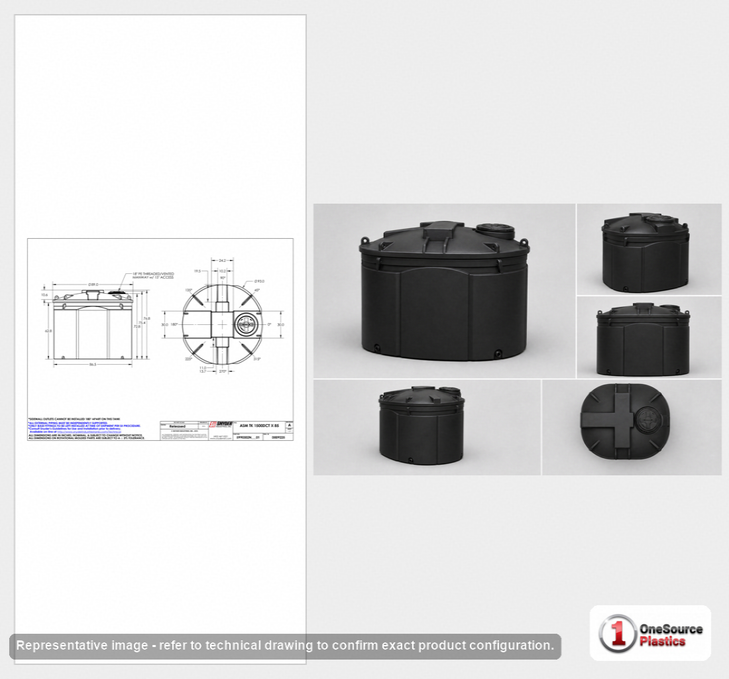
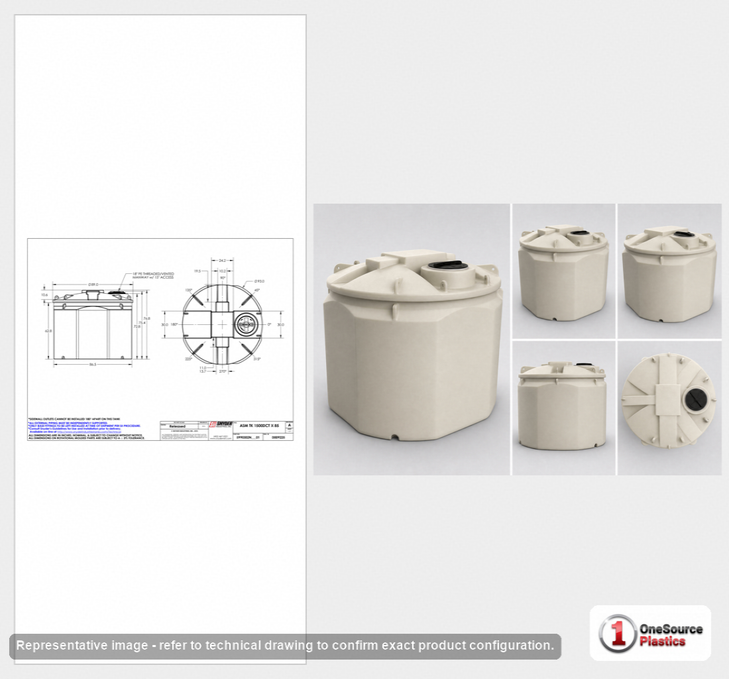
Technical drawing (PDF) for Snyder Industries 5490000N48.
See this tank
Interactive 3D model with live fill. This tank has an interactive 3D model built to its manufacturer dimensions. Rotate it, and set a fill level to see how much liquid it holds at any height. Open the 3D view on the product photo above. Download the 3D model (GLB).
Ready to order?
Add it to your cart at the top of this page, get LTL freight to your ZIP, request a written quote, or call 866-418-1777. The listed price is before freight.