Two hundred and forty five gallons on the same 42 by 48 inch plan
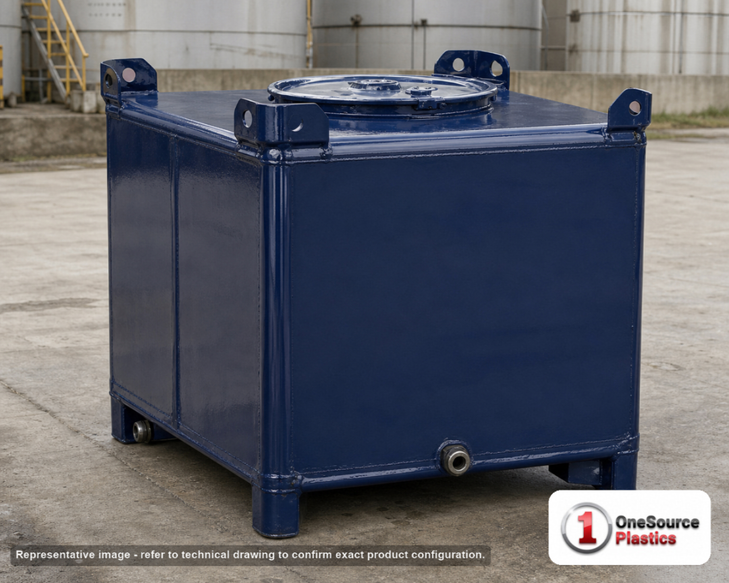
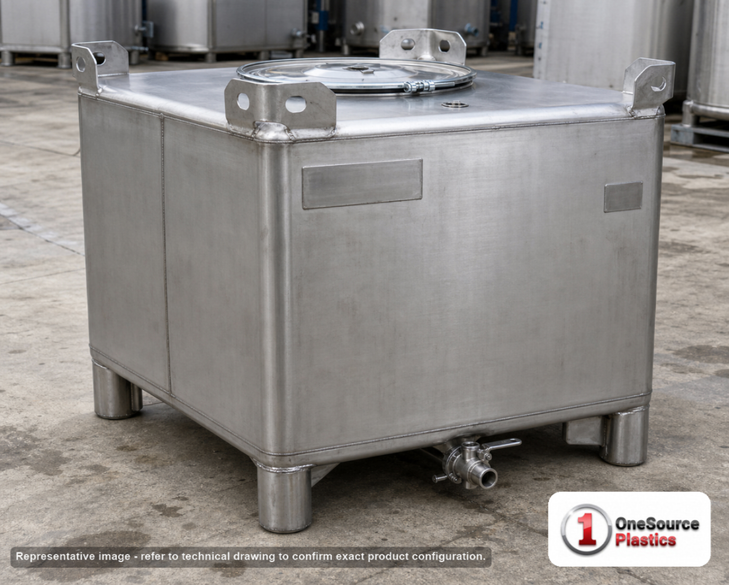
The Snyder 6984000B51307 is a 245 gallon 304 stainless steel Supertainer IBC tote tank in silver, listed at 42 inches long, 48 inches wide and 35.25 inches tall, and 389 pounds empty. The plan is the same rectangle the bigger Supertainers use; the difference is entirely in the height, and at 35.25 inches this is a low vessel by any standard. The sheet gives 2,043 pounds for 245 gallons of water at 8.34 pounds per gallon and publishes no other load figure, no specific gravity rating, no maximum operating temperature and no warranty term. The published fittings are a 2 inch access port, a 2 inch 316 stainless ball valve and a 22 inch vented manway, and there is no drain, no sump, no gauge and no sight glass on the sheet. It is steel throughout and nothing here applies plastic wording to it. No stacking, lifting, pressure or transport rating is published and none is claimed. Freight class 125, LTL, shipping from Michigan.
Want it on the pad this month? Check freight to your ZIP, add it to your cart above, and 866-418-1777 will confirm the ship date.
Shorter batches, heavier products, and the duty that picks 245
Two hundred and forty five gallons is chosen by plants that want a full pallet footprint of product without a full pallet height of it, and there are two duties that keep coming back. The first is a heavy liquid. Density is what fills a tote long before volume does: a product much denser than water reaches a handling limit at a lower level, and a shorter vessel is the sensible answer to that rather than a taller one filled halfway. The sheet publishes no specific gravity rating for this tote, so we make no claim about what it will carry; tell us the product and its density at enquiry and we will confirm it against the part before anything is ordered. The second duty is headroom. At 35.25 inches this tote goes under fill heads, conveyor runs, mezzanine soffits and doorways that a 47 inch vessel will not pass, and it can be filled by hand from a drum or a hose at a comfortable working height instead of off a step. Both duties turn up in the same places: food and beverage ingredient handling, chemical blending and dosing, coatings and lubricant production, laboratory and pilot manufacture, and any plant moving batches between a make-up area and a filling line. What makes the size work is the arithmetic, not the preference. Two hundred and forty five gallons is a quantity to match against the batch you actually make and the frequency you actually make it, which is what the tank sizing calculator is for, and against the headspace a warming or gassing product will want, which the tank sizing guide sets out. Weight comes into the siting decision as well: 389 pounds empty and 2,043 pounds full of water go through whatever floor, rack, scale or deck the tote stands on, and that is a number to check rather than assume. If the underlying question is whether a tote is the right container at all next to drums or a fixed tank, settle it with the container against tank guide before buying either.
The 245 in stainless, the 245 in carbon steel, and two plastic totes
| Part | Gallons | Material as the sheet names it | Length x width x height | Empty weight |
|---|---|---|---|---|
| 6984000B51307 (this tote) | 245 | 304 stainless steel | 42 x 48 x 35.25 in | 389 lb |
| 6984000B32217 (same envelope, carbon steel) | 245 | carbon steel | 42 x 48 x 35.25 in | 389 lb |
| SII-6630023B97202 (plastic, stackable) | 220 | HDPE plastic | 45 x 45 x 48 in | 243.1 lb |
| SII-6040001B97204 (plastic, stackable) | 275 | HDPE plastic | 46 x 46 x 62 in | 354.2 lb |
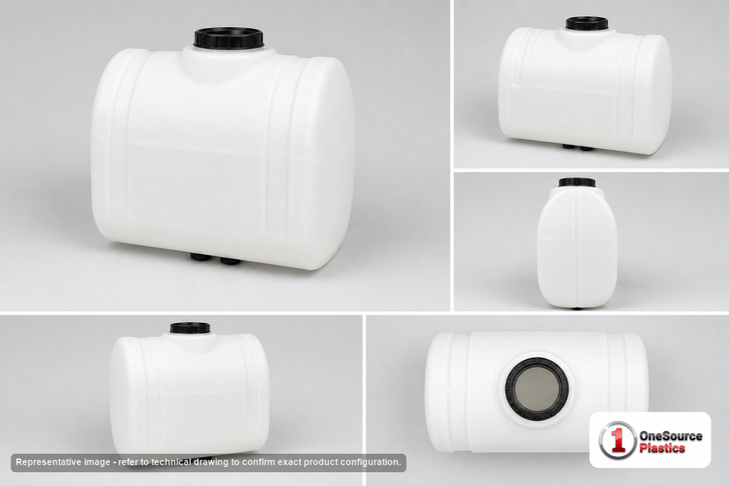
Two of these four are steel and two are plastic, and the sheet is clear about which is which, so this table is too. The second row is this tote's direct counterpart: a 245 gallon carbon steel Supertainer on the identical 42 by 48 by 35.25 inch envelope at the identical 389 pounds. Material is the entire published difference, and it is the one to think about, because carbon steel and stainless steel behave differently with a wet product and under a wash cycle. The bottom two rows are plastic totes, named as plastic on the sheet and never merged with the steel Supertainers here. SII-6630023B97202 holds 220 gallons on a 45 inch square plan at 48 inches tall and 243.1 pounds; SII-6040001B97204 holds 275 gallons at 46 inches square, 62 inches tall and 354.2 pounds. Both are much lighter empty than either steel tote and both are taller, which is the shape trade that comes with the material. The honest comparison is this. If the vessel will be cleaned and reused indefinitely, if the product is aggressive or valuable, or if the inside has to be verifiable, that argues for the steel rows. If empty weight, initial cost or a stackable plastic format is what matters, the two plastic rows are there and the sheet names their dimensions plainly. Height is the other tiebreaker: at 35.25 inches this steel 245 is the shortest thing in the table by a wide margin, and in a low building that decides it on its own.
Which wall for your chemical? Call 866-418-1777 with the name and the concentration, or send a quote request and we will pick the row.
A 2 inch valve under 35 inches of tote
- The discharge, and where it sits: a 2 inch 316 stainless ball valve on a vessel only 35.25 inches tall. That is the fitting to plan around, and the low height is what makes it different from the taller totes. There is less liquid head pushing on it, so a gravity transfer is gentler and slower, and a receiving container has to fit under a valve that is lower off the ground than usual. Measure that clearance before the tote is set in position.
- Drain path: the sheet publishes no sump and no separate drain, so the ball valve is the whole bottom route. With a shallow vessel the residual left behind is spread across a wide floor rather than pooled, which is worth knowing when you plan the rinse.
- Raising it: where the discharge has to run to a drum, a pump suction or a filling head, this tote is a candidate for a stand or a rack. Whatever raises it carries 2,043 pounds when the vessel is full of water, and that is a structural decision, not a shelf.
- The inlet: a 2 inch access port, the closed fill route alongside the manway.
- The top: a 22 inch vented manway on a 35.25 inch vessel, which is an unusually comfortable combination. It is reachable from the floor by most people, so cleaning and inspection do not need a step, and the vent on it is the air path a pump needs. Keep it clear.
- Not published: no level gauge, no sight glass, no dip tube, no specific gravity rating, no maximum service temperature and no warranty term.
Tell us the liquid and the density at order time so the seat, the gasket and any coupling we add are chosen for it. Where the tote feeds a dosing pump, the pump skid design guide covers the suction geometry, the drip pan and the leak detection around it, and a low tote deserves that attention because the pump has less head to work with.
Dosing rooms and metering skids that refill from one tote
A short 245 gallon steel tote does its best work as the supply vessel beside a metering operation: a chemical dosing room at a water or wastewater plant, a treatment skid at a cooling tower or boiler house, an additive station on a production line, a laundry or wash plant dosing set, a plating or finishing line, and ingredient dosing in food and beverage manufacture. In all of them the tote is refilled on a cycle and drawn down continuously, and the reason it is short is that the room is small and the ceiling is low. One habit pays for itself here: put the tote where it can be swapped without breaking the skid apart, and leave the room to walk all four sides of it with a light. A vessel that can be inspected in place gets inspected; one wedged in a corner does not. Where the dosing chemical is a regulated waste rather than a product, the guide to secondary containment for hazardous waste tank systems sets out the leak detection options and the inspection cadence, and our chemical compatibility reference is where the liquid itself gets checked.
Three hundred and eighty nine pounds, 35 inches shipped, class 125
Michigan is the shipping state the sheet gives, no plant town appears on it, and none is named here. It moves LTL at freight class 125 with no NMFC number on the sheet, and it shipments at 42 inches long, 48 inches wide and 35 inches high against the tote's own 35.25 inch height. Price the lane to your ZIP with the freight cost estimator; the listed price is before freight. At 389 pounds this is the lightest steel Supertainer in its batch and still far beyond a manual lift, so have a forklift, a pallet truck or a lift gate arranged before the truck is booked, and take it under the base rather than by the manway or the valve. The low shipment is the good news at the receiving end: a shade under three feet tall goes through most roller doors and into most vehicles standing upright, which is not true of the taller totes. Set it level, fill it with clean water and hold that 2,043 pound load while you check the manway seal, the access port and the valve joint; on a shallow vessel a slow weep at the valve shows up as a spreading film rather than a drip, so look at the floor as well as the fitting. Cycle the valve against the water before any product goes in. Then measure the clearance under the valve with the tote in its final position and write that measurement on the tote itself; it is the number that decides what can be filled from it, and it is the one people guess at forever afterwards. Walk the base after the first hard rain; a pad that shifts shows it at the edge first.
Freight and documents
Ships from: Marked Tree, AR; Merced, CA; Lincoln, NE. LTL freight is quoted to your ZIP with the freight cost estimator or by phone at 866-418-1777. The listed price is before freight.
Technical drawing (PDF) for Snyder Industries 6984000B51307.
Ready to order?
Add it to your cart at the top of this page, get LTL freight to your ZIP, request a written quote, or call 866-418-1777. The listed price is before freight.