Two hundred and forty-five gallons, thirty-five and a quarter inches tall
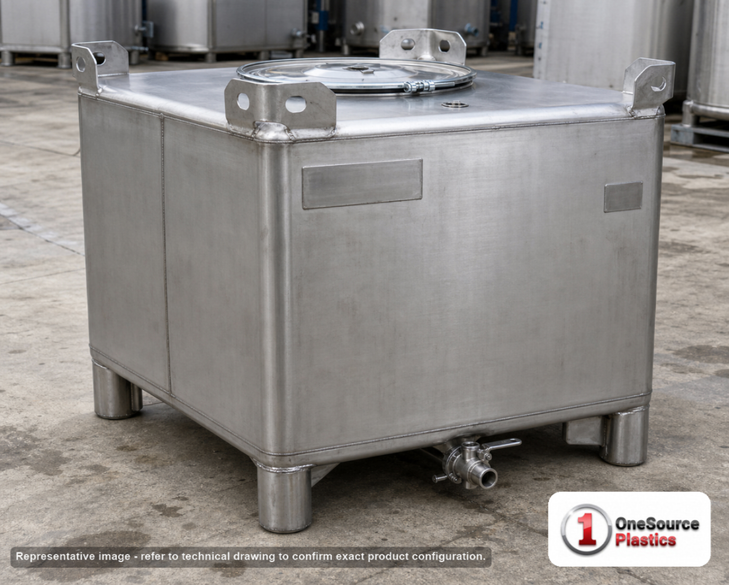
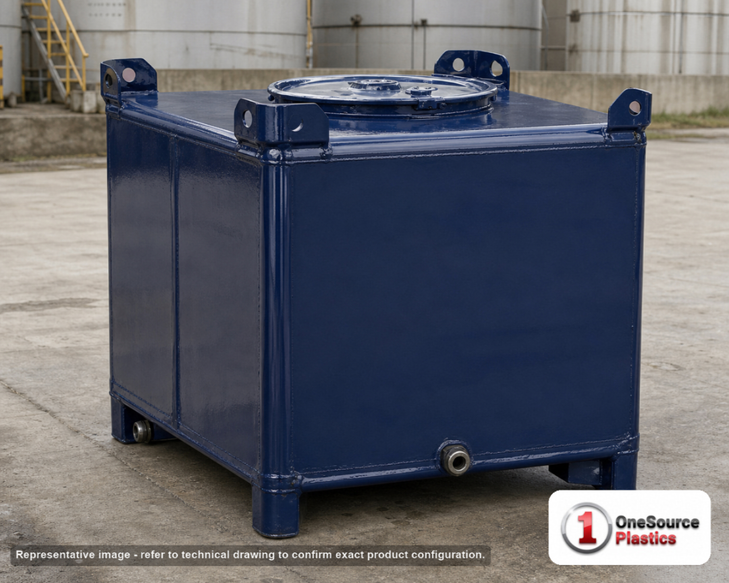
Thirty-five and a quarter inches is the number that defines the Snyder 6984000B32217. It is a 245 gallon carbon steel Supertainer IBC tote tank in dark blue, listed at 42 inches long, 48 inches wide and 35.25 inches tall, at 389 pounds empty, and it is the shortest vessel in this range. Carbon steel means no resin grade, no cross-link, no wall rating and no specific gravity figure, and the sheet gives none of them. The fittings are the family's three: a 2 inch access port as the inlet, a 2 inch 316 stainless ball valve as the outlet on a carbon steel body, and a 22 inch vented manway on top. The sheet gives 2,043 pounds for 245 gallons of water at 8.34 pounds per gallon. It publishes no maximum operating temperature, no warranty term, no maximum contents figure, no plant and no NMFC number, and this page claims no pressure rating, no stacking load, no fork pocket, no coating and no lining. Freight class 100, shipping from Michigan.
Buying on a purchase order? Request a written quote and we will return it with freight to your ZIP; card buyers add the 245 gallon tank to the cart above.
The shortest carbon steel tote on the sheet
Put this one beside its siblings and the case makes itself out of one dimension. It holds 245 gallons on the same 42 by 48 inch plan the taller members of the range use, which means it takes the full footprint for a modest volume. That sounds like a poor trade until you look at the height. At 35.25 inches this vessel is under three feet tall, and the 22 inch manway on top of it is at waist to chest height: a person opens it, fills it, samples it, puts a light and an arm inside it and washes it out standing on the floor, with no step, no platform and no access equipment carrying its own inspection regime. It goes under a bench, a conveyor, a tank skirt or a mezzanine. It sits on a low trolley without becoming top-heavy, and it loads on a flat bed without being the tallest thing there. The sibling list shows the two other ways to buy roughly this volume and both are different animals. 6984000B51307 is the same 245 gallons on the same 42 by 48 by 35.25 inch shell at the same 389 pounds, in 304 stainless; it is stainless, it is named that way, and the choice between it and this carbon steel record is made on the contents and the wash regime. SII-6630023B97202 is a plastic stackable tote holding 220 gallons on a 45 inch square standing 48 inches at 243.1 pounds, and SII-6040001B97204 is a plastic stackable tote holding 275 gallons on a 46 inch square standing 62 inches at 354.2 pounds. Those are plastic, taller and lighter, and they are never merged into the steel family here. So the honest framing is this: buy the steel tote where the vessel has to be cleaned, inspected and returned to service for years, and buy this height where something above the tote or the reach to its lid is what binds. Check the volume against your turnover in the tank sizing calculator and take the headspace discipline from the tank sizing guide.
A stainless twin and two plastic totes
| Part | Gallons | Length x width x height | Empty weight |
|---|---|---|---|
| 6984000B32217 (this tote, carbon steel) | 245 | 42 x 48 x 35.25 in | 389 lb |
| 6984000B51307 (same shell, 304 stainless) | 245 | 42 x 48 x 35.25 in | 389 lb |
| SII-6630023B97202 (plastic stackable tote, square plan) | 220 | 45 x 45 x 48 in | 243.1 lb |
| SII-6040001B97204 (plastic stackable tote, taller again) | 275 | 46 x 46 x 62 in | 354.2 lb |
Read this table across the height column rather than the gallon column and it tells you what the sheet is really offering. The volumes barely move: 220, 245, 245, 275. The heights move a great deal, from 35.25 inches to 62. The weights move the other way, from 389 pounds down to 243.1 on the lightest. The first two rows are the same vessel in two materials, carbon steel here and 304 stainless alongside, on the same shell at the same weight, and the sheet publishes nothing else to separate them; order the number your paperwork names and we will confirm the record against the part. The last two rows are plastic stackable totes on square plans, and this page describes them as plastic because that is what they are listed as. They are lighter by a hundred pounds or more and they stand a foot to well over two feet taller. That is the same volume arranged for a different constraint: a site with headroom that lifts by hand truck and wants a light vessel. This tote is arranged for the opposite constraint, a site where the vertical space is spoken for and the vessel is expected to be washed and used again for years. Both are legitimate purchases. The mistake is to choose on the gallon figure, because on this sheet the gallon figure is very nearly the same across every row.
Ready to choose a row? Add the 245 gallon tank to your cart above with freight quoted to your ZIP, or 866-418-1777 will confirm it against the site first.
The manway that is nearly the whole top face
- The lid: 22 inches of vented opening on a vessel 35.25 inches tall and 42 by 48 inches on plan. A large share of the top face is access, which makes this the easiest member of the range to inspect, swab, wash and drain properly, and it is why a short tote often gets chosen for a product that has to be verified clean between batches.
- The vent: the manway is listed as vented. On 245 gallons drawn down through a 2 inch valve the air demand is modest, but the principle does not change. Keep the path clear and never blank it to stop a smell.
- Headspace: a shallow vessel has a shallow air space. Fill to leave room rather than to the rim.
- The inlet: a 2 inch access port as listed, with the coupling arrangement confirmed against the part before it ships.
- The outlet: a 2 inch 316 stainless ball valve on a carbon steel body. On a tote only 35.25 inches tall the valve sits low, so check the clearance beneath it for a hose, a pail or a trolley before you decide what the vessel stands on.
- Limits: the sheet gives no service temperature, no warranty term, no pressure rating, no stacking load, no coating and no lining, so this page asserts none.
A short vessel makes the fittings easy to reach and easy to knock, so keep the route past the valve clear of trolleys and pallet trucks and the tote will keep its outlet joint dry.
Low rooms, benches and 245 gallon draws
Two hundred and forty-five gallons under three feet tall turns up wherever the space above the vessel is already spoken for: under benches and conveyors, inside containerised and skid-mounted plant, in pilot and scale-up areas, under mezzanines in blending and make-up rooms, in plating and finishing shops with low soffits, and on low trolleys that move a working quantity to a line and back. It is also the size that suits a product too specific or too valuable to buy in several hundred gallon lots, where a smaller steel vessel that can be cleaned and verified between batches beats a bigger one that is never fully emptied. The small volume is rarely the limitation people expect; the flat, wide 389 pound shape is what wins the argument, and it is why this tote ends up in rooms nothing else will fit. Before you settle on the tier at all, the container against tank buying guide compares drums, cubes, totes and fixed tanks on turnover and handling, and the drum against tote against bulk tank break-even analysis runs the annual volume, the turnover frequency and the bulk chemical cost per gallon against each other. Check what the 245 gallons will be against our chemical compatibility reference before ordering.
The lowest shipment in the range
The sheet gives the freight class as 100 and Michigan as the state it ships from, with no plant and no NMFC number, so no origin beyond the state is named here. Price the move to your ZIP with the freight cost estimator; the listed price is before freight. This is the simplest unit in the range to receive: 42 by 48 inches on the deck and only 35.25 inches tall, which loads flat, sits beside other freight rather than over it, and clears any door the truck itself could reach. At 389 pounds empty it is still a forklift job under the base rather than a two-person lift, and it is never lifted by the 22 inch manway. Set it on flat, continuous, level support in the position it will work in, then fill it with clean water, hold the 2,043 pound load, and read the manway seal, the access port and the 2 inch valve joint. Check the clearance under the valve with water actually in the vessel, because on a tote this low the container you drain into is the thing that turns out not to fit. Where the floor under it would need recovering after a release, the Captor containment comparison is where to settle the containment question, and where the contents are a regulated waste, the secondary containment rule for hazardous waste tank systems gives the leak detection options and the inspection cadence. Mark the clear height it needs on the floor where it lives, because the shortest tote in a fleet is the one that gets parked somewhere nobody can open it. Leave room to walk all the way around it; the side of the tank nobody can see is the side that leaks.
Freight and documents
Ships from: Marked Tree, AR; Merced, CA; Lincoln, NE. LTL freight is quoted to your ZIP with the freight cost estimator or by phone at 866-418-1777. The listed price is before freight.
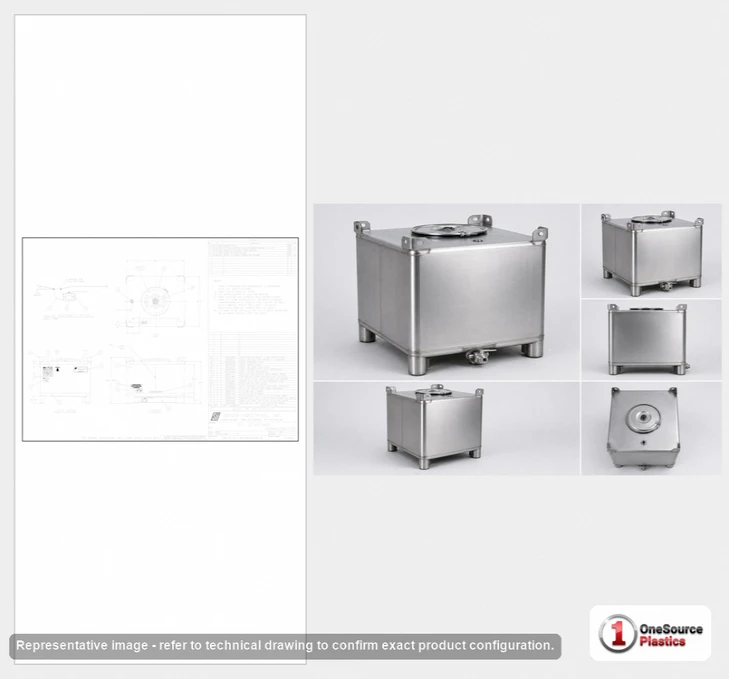
Technical drawing (PDF) for Snyder Industries 6984000B32217.
Ready to order?
Add it to your cart at the top of this page, get LTL freight to your ZIP, request a written quote, or call 866-418-1777. The listed price is before freight.