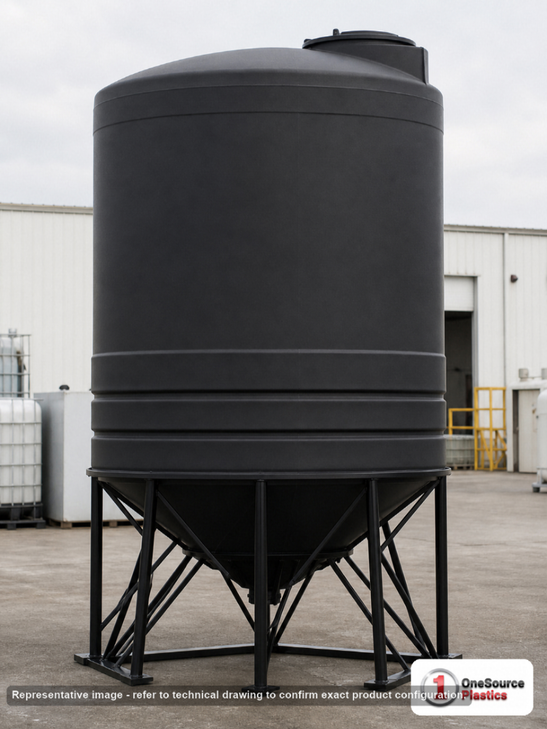
Twenty-six hundred gallons on a seven and a half foot circle, rated 1.9
The Snyder 5100000N51 is a 2,600 gallon black heavy duty cone bottom tank, listed 90 inches long, 90 inches wide and 139 inches tall, at 570 pounds empty and 570 pounds shipping. Heavy duty is the maker's own name word, and the sheet backs it with numbers rather than description: the material field reads High Density Linear Polyethylene, the wall is rated at a specific gravity of 1.9, and the max contents figure is 41,200 pounds against 21,684 pounds of water at 8.34 pounds per gallon. The colour is listed as black. The opening on top is an 18 inch threaded vented manway. The outlet field reads 1 Manway / Lid, which names an opening rather than a discharge, and no discharge size is published on this sheet. The service limit is 100 F / 37 C. The sheet gives no cone angle field, no inlet, no stand, no warranty term and no structural lug or flange detail, and none of those is claimed here.
Need it before the next delivery? Call 866-418-1777 for the ship date, or get freight to your ZIP and add it to your cart above now.
A hundred and thirty-nine inches before anything holds it up
Read that height as the starting point rather than the finished one. The shell is 139 inches, and a cone bottom tank has no flat bottom to stand on, so a stand carries it and the stand goes underneath all of that. This sheet publishes no stand, no legs, no skirt, no support ring and no bolt pattern, which means the support is a separate item with its own drawing, its own lead time and its own price, and no stand height, rated load or stand material is stated on this page for that reason. Work it out before the tank is ordered rather than after it arrives, using the stand compatibility matrix and a call to us to confirm the fit against this part number. Then the plant room arithmetic, which is where these decisions are actually made. Your total is the stand, plus 139 inches of shell, plus clearance above the manway, and separately the room under the cone for whatever the discharge feeds. Measure from the lowest fixed thing over the spot and work down. Outdoors the constraint changes from ceiling to restraint and wind exposure on a slender column, and the day to deal with that is the day the stand is designed. What the narrow shape buys you is the floor plan: 90 inches across is seven and a half feet, so 2,600 gallons sits inside a footprint smaller than many people assume, and on a congested plant floor or inside a tight bund that is usually the reason this shape exists at all. What it costs is concentration of load. The pad takes 570 pounds of empty tank, 21,684 pounds of water and 41,200 pounds at the rating through a handful of stand feet inside that small circle, so the foundation is designed with a bearing area at each foot and not poured to suit a drawing. Settle the volume before the structure with the tank sizing calculator, and take the freeboard from the tank sizing guide, because on a dense product the headspace you leave is the margin you keep.
Four 2600s, a shorter 2500 and a taller 3000
| Part | Gallons | Length x width x height | Empty weight |
|---|---|---|---|
| 5100000N51 (this tank, heavy duty, rated 1.9) | 2600 | 90 x 90 x 139 in | 570 lb |
| 5100000N42 (XLPE heavy duty listing) | 2600 | 90 x 90 x 139 in | 570 lb |
| 5100000N40 (XLPE listing, lighter) | 2600 | 90 x 90 x 139 in | 500 lb |
| 5100000N46 (XLPE listing, lighter) | 2600 | 90 x 90 x 139 in | 500 lb |
| 5110000N40 (step down, shorter shell) | 2500 | 90 x 90 x 125 in | 375 lb |
| 5150000N40 (step up, taller shell) | 3000 | 90 x 90 x 144 in | 500 lb |
Everything in this table stands on the same 90 inch circle, which makes it an unusually clean comparison: only the height and the rating change. Four rows are the identical 2,600 gallon shell at 139 inches, separated by empty weight and by the name the sheet prints on each, 570 pounds on the two heavy duty listings and 500 pounds on the two XLPE listings. The sheet offers no account of that and this page will not invent one. The reason to take this particular listing is the rating: a specific gravity of 1.9 with 41,200 pounds of max contents is what covers a product heavier than water, and if yours is not heavier than water, one of the lighter listings is the more honest buy. Nobody should pay for wall they will never load. The last two rows are the size question rather than the rating question, and because the circle never changes, they are purely a height decision. 5110000N40 holds 2,500 gallons at 125 inches, so it gives back more than a foot of height for a batch that is barely smaller. 5150000N40 holds 3,000 gallons at 144 inches and costs you height for the extra volume. Where your ceiling is tight, that ladder of heights on one footprint is worth reading carefully, because you can often buy the batch you need at the height the building allows without changing the pad, the bund or the aisle at all.
Need a different size? Every tank in the table is in stock programs; ask for a quote on the one that fits, or call 866-418-1777.
The discharge the sheet does not size, and the access it does
- The outlet field: it reads 1 Manway / Lid on this sheet, which names an opening and not a discharge. We print the field exactly as it reads and assert nothing further: no outlet dimension, no thread, no bulkhead and no valve. Tell us the line size, the valve type and the product, and we will confirm what this part number carries before anything is ordered.
- What hangs below the cone: the valve, any reducer and the first length of pipe go on their own steelwork off the stand, never on the tank, with a flexible connector at the first joint. With 41,200 pounds of rated contents above it, the low point of a full column is the wrong place to hang dead weight.
- The cone angle: this sheet publishes none and the product name carries none, so this page states none. If the drainage behaviour of a settling product is what decides your purchase, ask us to confirm the geometry against the part number.
- Access on top: an 18 inch threaded vented manway at 139 inches plus the stand, which puts it well above head height in every installation. A platform or fixed ladder with a fall protection plan belongs in the same drawing as the structure, and the fill should land at a coupling at working level.
- The vent: it comes with the manway on this sheet rather than as a separate item. On a tank being pumped down, the air path is what protects the wall, so keep it clear, inspect it whenever the tank is opened, and never blank it to control a smell.
- Structural detail, inlet, warranty and NMFC: this sheet publishes none of them, and none is claimed here. Ratings are a specific gravity of 1.9, 21,684 pounds of water at 2,600 gallons, 41,200 pounds of max contents, and 100 F / 37 C.
On a column this tall the level instrument is the only honest picture of what is in the top of it, and retrofitting the wrong one costs more than choosing well did: the level gauge selection guide for chemical service compares radar, ultrasonic, hydrostatic and magnetostrictive on the failure modes rather than the brochures. A bulk vessel is also read by people who did not order it, so settle the labelling at the same time with the tank label and signage guide. And what happens under it after a release is a containment question rather than a tank question: the Captor containment comparison is the place to start it.
Dense product in a narrow column
A 1.9 rated cone on a small footprint goes to the operations with a heavy product and no floor to spare. Concentrated mineral and salt solutions, spent acid and pickling liquor in a metals plant, thickened sludge and settled solids at a treatment works, heavy liquid fertiliser and crop input blends at an agricultural retailer, mineral and wash plant slurry, and batch make-up in chemical manufacturing where the vessel changes product and cannot afford to leave a heel behind. On a flat bottomed tank every one of those changeovers leaves a layer, and at 2,600 gallons that layer is a disposal ticket and a contamination risk in the next batch. The cone removes the argument by giving the vessel one low point to drain toward. The caution that belongs with the shape is stratification: a slender column separates more readily than a wide shallow one, so plan the draw point and the mixing arrangement together rather than one after the other. Settle the chemistry first in our chemical compatibility reference, because the gasket and valve answer comes from the product and not from the vessel.
Chemical service ratings
The resin is rated for the liquids below at the concentrations shown; the fitting and gasket called out are the ones to order with the tank. Verify the exact service on the linked page or in the chemical compatibility database before ordering.
- Acetic Acid (60%)
- Aluminum Sulfate (50%)
- Calcium Chloride (40%)
- DEF (32.5%, 316SS fittings)
- Ethylene Glycol (100%)
- Ferric Chloride (50%)
- Ferric Sulfate (60%)
- Ferrous Sulfate (20%)
- Hydrochloric Acid (37%, Viton gaskets)
- Hydrofluoric Acid (48%, Viton)
- Hydrofluosilicic Acid (26%, Viton)
- Hydrogen Peroxide (50%, Viton)
- Magnesium Chloride (30%)
- Peracetic Acid (30%, 316SS fittings with Aflas gaskets)
- Phosphoric Acid (85%, Viton)
- Polyaluminum Chloride
- Potassium Carbonate (50%)
- Potassium Hydroxide (saturated)
- Propylene Glycol
- Sodium Bisulfate
- Sodium Bisulfite
- Sodium Carbonate (30%)
- Sodium Hypochlorite (under 16.5%, Viton)
- Sodium Thiosulfate (40%)
- Sulfuric Acid (98%, CPVC fittings with Viton gaskets)
- Urea Solution (50%)
- Zinc Orthophosphate and Ozonated Water (up to 10 PPM, PVC fittings with EPDM gaskets).Two of these are concentration ceilings, not blanket approvals: sodium h
Five hundred and seventy pounds, Nebraska origin
Moulded at Lincoln, Nebraska, with Nebraska given as the origin state on the sheet, so the plains and the Midwest are the short lane and the coasts are the long ones. The freight class reads 400, a numeric class rather than a mode, and no NMFC number is published. The shipping size measures 90 inches by 90 inches by 139 inches at 570 pounds, which is a large, light package rather than a heavy one, and that is exactly the shape that surprises people when the freight quote arrives. Price your own ZIP with the freight cost estimator; the listed price is before freight. It travels lying down and is stood up at your end, so the standing operation belongs in the plan with a machine and a person nominated for it. The sheet publishes no crane, no rigging, no permit and no escort detail, and none is stated here; agree the offload arrangement and the window with us before the truck is booked. Have the stand set, levelled and anchored first, because there is nowhere sensible to park a cone bottom tank while a foundation is finished. Lift under the body with slings, never by the manway, and keep it restrained the moment it stands upright. Then prove the whole installation with clean water rather than product: hold the 21,684 pound load, walk the manway seal, the cone joint, the stand feet and the pad edge with a torch, and leave it standing full overnight before anything is connected. Check the anchor bolts and the strap tension again a week later, because ground settles a little under a new load and the fixing that was tight on day one is the one that is loose on day eight. Keep the first delivery's paperwork with the tank; strength and date on day one is the baseline for every batch after.
Freight and documents
Ships from: Lincoln, NE. LTL freight is quoted to your ZIP with the freight cost estimator or by phone at 866-418-1777. The listed price is before freight.
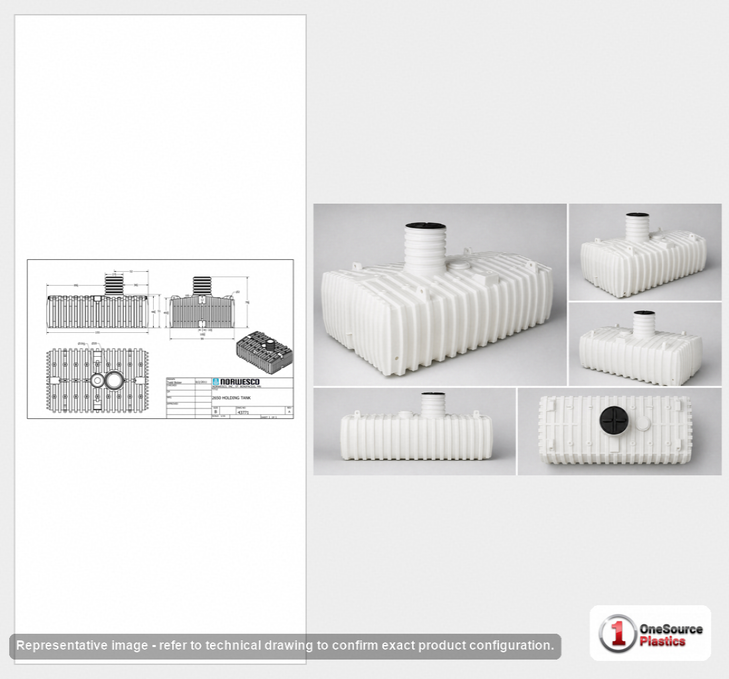
Technical drawing (PDF) for Snyder Industries 5100000N51.
See this tank
Interactive 3D model with live fill. This tank has an interactive 3D model built to its manufacturer dimensions. Rotate it, and set a fill level to see how much liquid it holds at any height. Open the 3D view on the product photo above. Download the 3D model (GLB).
Ready to order?
Add it to your cart at the top of this page, get LTL freight to your ZIP, request a written quote, or call 866-418-1777. The listed price is before freight.