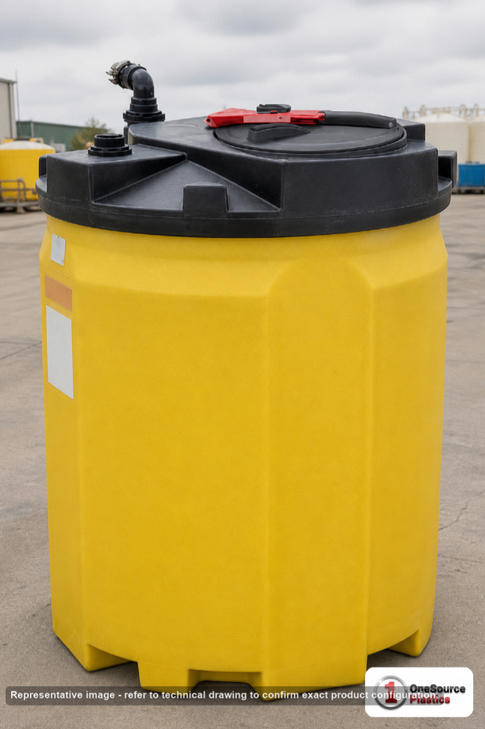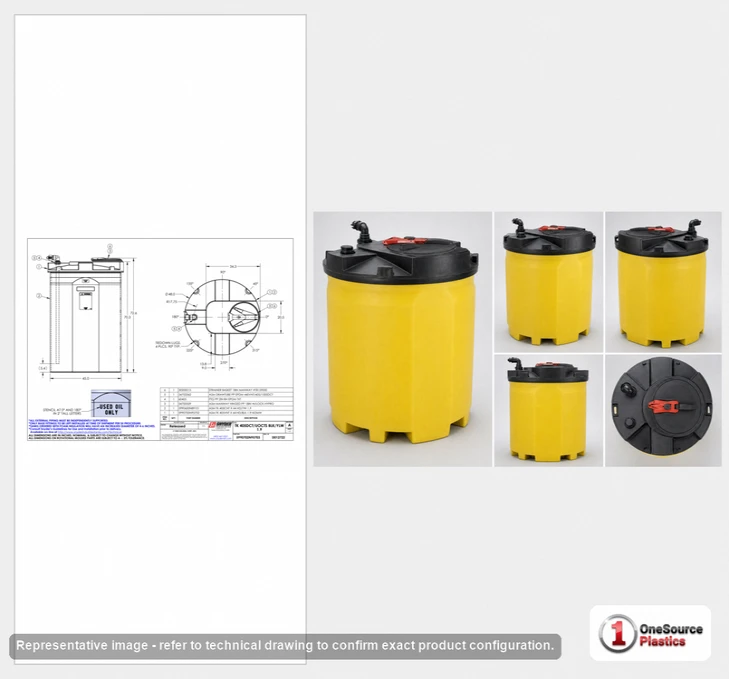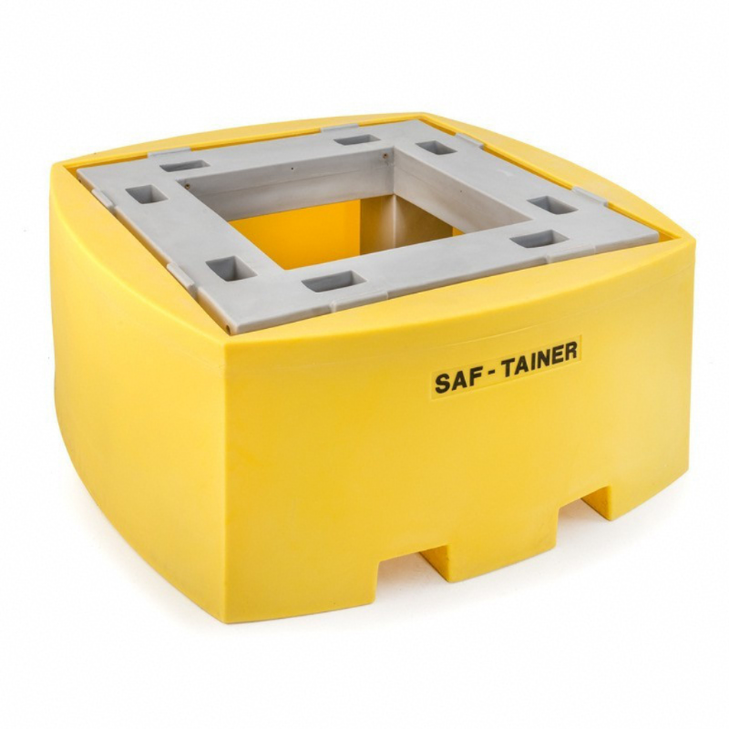
A yellow containment tray with a wrap, sixty six inches square
The Snyder SII-6270000B88204 is a 485 gallon plastic containment tray with wrap, in polyethylene, yellow, listed at 66 inches long, 66 inches wide and 30 inches tall, at 314 pounds empty and 315 pounds to ship. Snyder files it under containment basins and trays and gives its application as catch basins. The word wrap is in the product name and that is the entirety of what the sheet says about it; no detail, no dimension and no description of the wrap is published, so none is stated here. The gallon figure is the tray's own, printed as the sheet gives it, and filled with water at 8.34 pounds per gallon the sheet works out to 4045 pounds. There is a 16 inch entry under both lid size and manway. The maximum operating temperature is given as 120 F / 48 C. There is no warranty term. Freight reads LTL in the class field with LTL as the ship mode as well, under NMFC 156600-06, from Lincoln, Nebraska, with Michigan and Nebraska named as shipping states, shipping at 66 by 66 by 30 inches.
Talk to a person first? 866-418-1777 reaches a tank specialist, not a call center; or see freight to your ZIP and add the 485 gallon tank to your cart above.
The duty: catching what a container lets go
A containment tray does one job and it does it while nothing is happening. It sits under a drum, a tote, a small tank, a pump skid or a transfer point, and for months at a time it holds nothing but dust. Then a fitting weeps, a hose is pulled off under pressure, a drum is knocked, a valve is left cracked over a weekend, and the tray is the difference between a mess on a floor somebody can mop and a release that runs to a drain. That is the duty, and it is why the specification that matters is the footprint and the depth rather than anything clever. This one is 66 inches square and 30 inches tall, which is a genuinely large tray: five and a half feet on a side is enough deck to stand more than one container on, and two and a half feet of height is a deep sided basin rather than a shallow drip pan. The sheet gives it 485 gallons and that is the figure we print; what it means for your site is a question for your own procedure and your own regulator, and we will not answer it for you on a product page. Work out what you have to hold, in writing, and then check it against the number the maker publishes. The second thing the duty asks for is the thing people forget until the first incident: how the tray gets emptied. A basin that has caught something has to be pumped out, and 66 inches square at 30 inches deep is not a thing anybody tips up. Decide in advance whether that is a drum pump on a trolley, a vacuum truck, or a small transfer pump kept for the purpose, and make sure there is room to get whatever it is alongside the tray. Then decide who does it and how quickly, because the value of containment is entirely in the response, not in the plastic. The third question is where it goes. A tray is only containment if the thing it protects is actually over it, and yellow is the sheet's colour for a reason: a bright basin on a grey floor is visible from across a plant, which keeps a pallet truck away from the rim and keeps the drums where somebody put them. Mark the floor around it and keep the rim clear.
Three trays, three footprints, one sheet
| Part | Capacity on the sheet | Dimensions | Empty weight |
|---|---|---|---|
| SII-6270000B88204 (this tray, yellow, with wrap) | 485 gal | 66 x 66 x 30 in | 314 lb |
| SII-1007900N97802 containment tray with pump shelf | 390 gal | 76 x 62 x 28 in | 200 lb |
| SII-1006200N97801 containment tray | 590 gal | 92 x 92 x 22 in | 175 lb |
The three trays on this sheet are three different shapes of the same idea, and the dimensions tell you more than the gallon figures do. This one is square at 66 inches and the deepest of the three at 30 inches, which is the shape for a tight footprint where the depth has to do the work. The 390 gallon tray is rectangular at 76 by 62 inches and 28 inches tall, and its name adds a pump shelf, which is a feature this tray's name does not carry and which we therefore do not claim for it. The 590 gallon tray is the widest and by far the shallowest, 92 inches square at 22 inches tall, and it is the one for a long bench or a row of drums where floor area is available and headroom or step-over height is not. Weights run the other way from what you might expect: 314 pounds here against 200 and 175 pounds on the other two. The sheet gives those figures and we print them without explaining the spread. Choose on the footprint you actually have and the step-over height your people can live with, then check the published capacity against your own written requirement.
Neighboring size a better fit? Every row links to its own page; freight to your ZIP is quoted on each, or call 866-418-1777.
What the sheet lists on it, and what it leaves blank
- The drain path: none published. There is no outlet field on this sheet, so this page names no drain, no valve, no bung and no size. If your procedure calls for a drained basin, say so when you enquire and we will confirm what is available before you order.
- The opening: the sheet carries 16 inches under both lid size and manway. We print that figure because it is on the sheet; the sheet does not describe it further, and this page does not call it a lid, a cover or a sealed opening.
- Service limit: 120 F / 48 C as the maximum operating temperature field gives it. That is a temperature ceiling for the tray, not a statement about anything it might catch.
- Material and colour: polyethylene, yellow. No resin grade is named because none is published, and no chemical compatibility statement is made anywhere on this page.
- Size and weight: 66 inches square, 30 inches tall, 314 pounds empty and 315 pounds to ship. At 314 pounds it is not a two person lift; plan the placement once and leave it there.
- What is not rated: no warranty term appears on this sheet. No pressure, no load rating and no fork pocket detail is published either, so none is claimed.
Tell us what is standing on it and what your own written procedure requires it to hold. On a tray the paperwork decides the part far more often than the catalogue does.
Where a tray sits and who has to empty it
The natural homes for a 66 inch square basin are the places where liquid changes hands. Under a pair of drums at a decanting bench. Under a tote at a dosing station where a pump runs unattended. Under a small day tank or a transfer pump in a plant room where the floor drains somewhere you would rather nothing went. In a store where incompatible products are kept apart and each group sits on its own basin. At a workshop fill point where the operator is filling a machine from a container by hand and the spill, when it comes, comes at ankle height. Snyder's own application entry for this part is catch basins, and that is the right way to think about it: it is the floor of the operation, not a piece of equipment. Two habits make the difference between a tray that works and a tray that is furniture. The first is that it stays empty: rain, wash water and condensation all collect in a basin, and a tray already holding an inch of water has given away the capacity it was bought for. Check it on a schedule and pump it out. The second is that the containers stay on it. A drum that has been rolled a foot off the rim is a drum with no containment under it, and that is the state most trays are found in during an inspection. Paint the floor, keep the area clear, and look at it every time somebody walks past.
Lincoln and Michigan, three hundred and fifteen pounds on the truck
The freight class field reads LTL and the ship mode field reads LTL as well, so the sheet gives a mode where a class would normally sit and this page asserts no numeric class. The NMFC entry reads 156600-06. It ships at 66 by 66 by 30 inches around a part weighing 315 pounds to ship, which puts it firmly on a truck rather than in a van: a full pallet footprint, a lift truck or a pallet jack at your end, and a person with a tape measure to check the door before the delivery is booked. Price the lane to your ZIP with the freight cost estimator; the listed price is before freight. When it lands, put it where it is going to live before you put anything on it, because 314 pounds of empty tray moves easily on forks and awkwardly by hand. Then set the containers on it, mark the floor around the rim, and write the emptying check into the same round that reads the gauges. Once it is full and holding, leave it alone for a day before the plumbing goes on; a settled tank is a quiet one.
Freight and documents
Ships from: Lincoln, NE. LTL freight is quoted to your ZIP with the freight cost estimator or by phone at 866-418-1777. The listed price is before freight.
Technical drawing (PDF) for Snyder Industries 6270000B88204.
See this tank
Product video. Watch the Snyder Industries 485 Gallon Plastic Containment Tray with Wrap video (68 seconds) with dimensions, fittings and shipping notes.
Ready to order?
Add it to your cart at the top of this page, get LTL freight to your ZIP, request a written quote, or call 866-418-1777. The listed price is before freight.