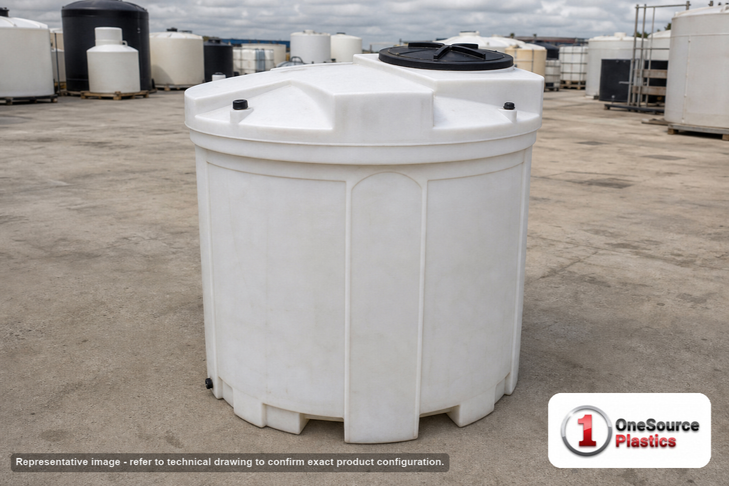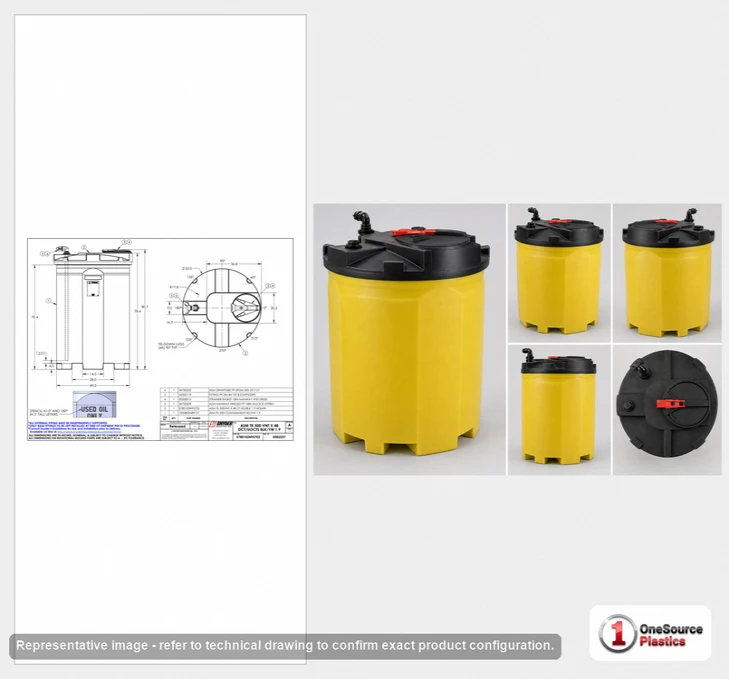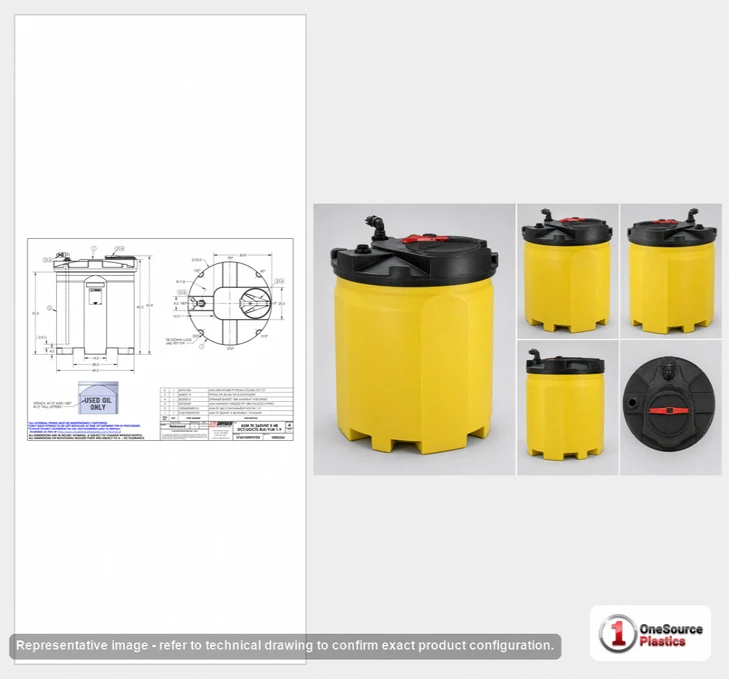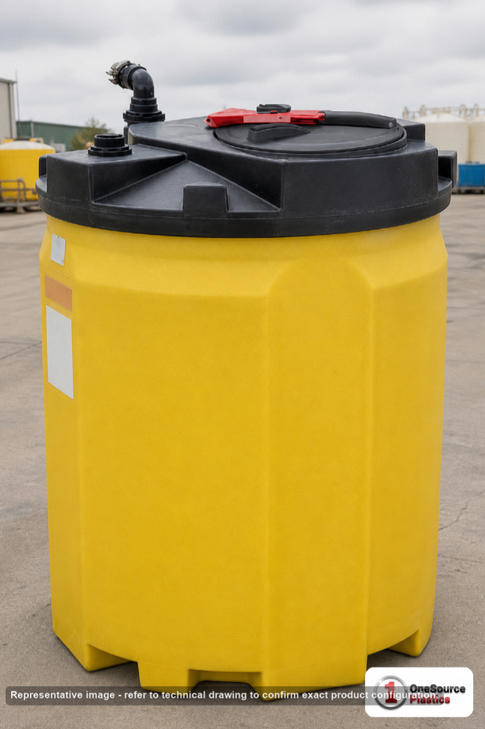
405 gallons of used oil in a yellow containment tank, 48 inches square
Yellow, square and built for the back of a shop: the Snyder SII-5990702N95703 is a 405 gallon used oil containment tank in high density linear polyethylene, 48 inches by 48 inches on the floor and 73 inches tall, 250 pounds empty. Waste oil arrives by the bucket and the drain pan, so the top of this tank is an 18 inch hinged lockable manway with a strainer basket, and it leaves by a 2 inch male camlock with an internal draw pipe at the bottom. The sheet also lists a 2 inch inlet. Full of water it carries 3378 pounds at 8.34 pounds per gallon; the wall is rated at a specific gravity of 1.9, or 6418 pounds of contents. Service limit 120 F / 48 C, a 3 year warranty, freight class LTL, NMFC 156600, molded at Chowchilla, California.
Spec sheet in hand? Call 866-418-1777 and read us the liquid and the pad; or get freight to your ZIP and add it to your cart above.
Chowchilla to the shop floor: one plant, one shipment, a 48 inch footprint
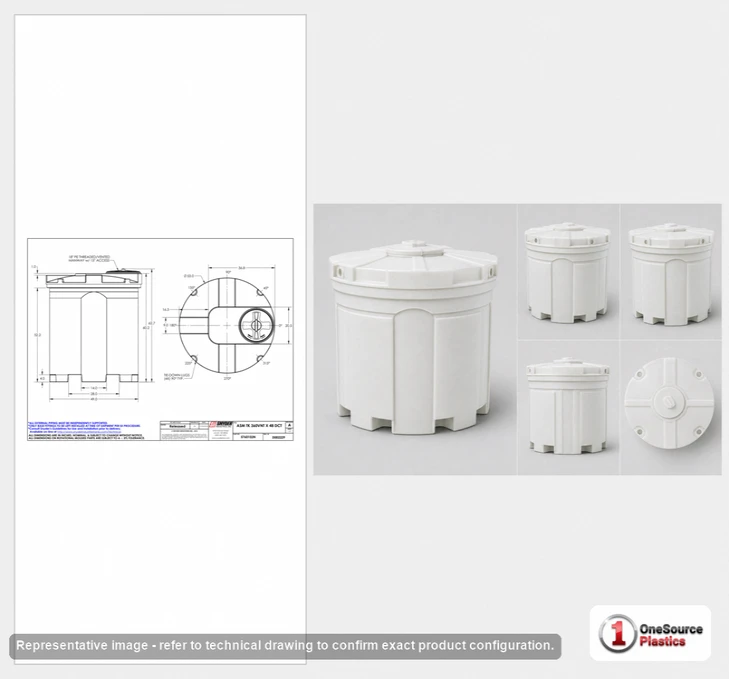
One plant makes this tank, Chowchilla in California, and one shipment brings it: 48 inches by 48 inches by 73 inches, 250 pounds, freight class LTL with NMFC 156600 on the bill. The lane matters more than the class here, because a single-plant item is priced by distance and a western buyer gets the short haul, so put your ZIP into the freight cost estimator before you compare it against anything; the listed price is before freight. What the freight also tells you is how this tank installs, which is the reason people choose this shape over a drum farm. A 48 inch square base goes through a roll-up door, down a shop bay, onto a bunded pallet or into a corner that a round tank wastes, and 250 pounds empty is a pallet-jack and forklift item rather than a crane item. Nothing about the delivery needs a permit and nothing about the install needs a pour, but the floor under it still carries the whole load: 3378 pounds full of water, or 6418 pounds of contents at the rated specific gravity of 1.9, sitting on 48 inches by 48 inches of whatever it is standing on. Level and continuous is the requirement, and where that is a slab rather than a shop floor, the engineering framework is in the concrete pad sizing guide. Put it where the oil actually is. A used oil tank set fifty steps from the lifts gets bypassed, and a bypassed tank means drums on the floor, which is the condition you bought the tank to end. Then size it for the interval that matters, which on waste oil is not consumption but collection: how much the shop generates between pickups, and what happens if a pickup slips a week. Run that in the tank sizing calculator and take the reserve discipline from the tank sizing guide, because a waste tank that reaches full has nowhere to send the overflow.
The 405 against the 360 and the 500
| Part | Gallons | Length x width x height | Empty weight |
|---|---|---|---|
| SII-5990702N95703 (this tank, square footprint) | 405 | 48 x 48 x 73 in | 250 lb |
| SII-5760102N95703 (double wall, shorter) | 360 | 53 x 53 x 63 in | 234 lb |
| SII-5780102N95703 (double wall, taller) | 500 | 53 x 53 x 81 in | 280 lb |
Three yellow tanks, one decision, and it is about the footprint and the second wall rather than the gallons. This one is the narrowest of the three at 48 inches square, which is five inches less in both directions than the 53 inch pair, and in a shop that five inches is a door, an aisle or a bay line. It is also the shortest way to 405 gallons here at 73 inches tall and 250 pounds empty. The two siblings are listed as double wall waste oil tanks on their own sheets: the SII-5760102N95703 holds 360 gallons at 63 inches tall and 234 pounds, which is the one to take when the ceiling or the fill height is tight, and the SII-5780102N95703 holds 500 gallons at 81 inches and 280 pounds, which is the one when the pickup interval is long and the floor can spare the width. A second wall and a floor bund are two answers to the same requirement, and which one your site needs is a regulatory question rather than a preference. If the answer is a bund under a single wall tank, this is the smallest floor plan of the three to bund. If the answer is contained at the vessel, the siblings say double wall on their sheets and this one does not, so this page claims no containment beyond what its own sheet gives: a hinged lockable manway, a strainer basket, and a 2 inch camlock that can be capped.
Two rows look the same? The difference is the wall; call 866-418-1777 with the liquid and we will say which, or ask for a quote on both.
An 18 inch hinged lockable manway with a strainer basket
- Fill opening: an 18 inch hinged lockable manway with a strainer basket, which is the single most useful thing on this tank. Eighteen inches takes a drain pan poured in by hand rather than a hose alone, the hinge means nobody sets a loose lid down on a dirty floor, the basket catches the rags, gasket scraps, filter debris and shop grit that would otherwise end up in the draw line, and the lock is what keeps the tank from becoming the neighbourhood's disposal point. Empty the basket on a schedule, not when it overflows.
- Outlet: a 2 inch male camlock with an internal draw pipe, as the sheet lists it. The draw pipe is why a pickup truck can empty the tank through one fitting, and the camlock is why that takes seconds; keep the cap on it, keep a spare gasket for it, and keep it where a hauler can reach it without moving equipment.
- Inlet: 2 inches, as listed, for a piped or pumped feed from a pan, a lift or a drain station rather than over the top.
- Access and height: the manway is at 73 inches, so a step is part of the install if people pour into it; plan that before the tank is in a corner.
- Service limit: 120 F / 48 C. Warranty: 3 years, both as given.
Hot oil is the thing to think about on a used oil tank, because a drain pan that just came off a warm engine is the hottest liquid this tank will ever see, and the sheet gives 120 F / 48 C as the limit. Let a pan cool before it goes in, and make that a rule people actually follow rather than a sign on the wall. Keep the camlock capped between pickups and the manway locked between uses. Log the level, because the only two bad days for a waste oil tank are the day it overflows and the day the hauler arrives to find it half full. And keep the area around the outlet clean enough to see a drip: on a yellow tank an oil stain shows early, which is a feature worth using.
Drain pans, waste oil collection and the containment rules
The duty is collection rather than storage: a service bay or quick-lube collecting drained oil between hauler pickups, a farm or ranch shop consolidating what comes out of tractors and trucks, a municipal or district garage, a fleet yard, a marina, a mine or quarry shop, a plant collecting used lubricant off gearboxes and hydraulics. In every one of them the tank is the point where a shop's housekeeping either holds or falls apart, and in most of them it is also a regulated point. What the rules ask for around a tank holding a regulated waste, how leak detection can be done and how often the thing has to be looked at, are set out in the RCRA secondary containment and leak detection article, and it is worth reading before the tank is placed rather than after, because where a tank sits decides how hard containment is to add. Tell us the liquid at order and the fittings and gaskets are matched to it. The wall is rated at a specific gravity of 1.9 on the sheet, which is the figure to check a heavy or loaded waste stream against, and the tank gives 6418 pounds of contents at that rating against 3378 pounds of water in the same 405 gallons.
One plant, 250 pounds, and a door wide enough
Chowchilla, California is the only plant on this sheet, and the tank travels as LTL freight at NMFC 156600, shipped 48 inches by 48 inches by 73 inches at 250 pounds. Measure the door and the route before the truck is booked: 48 inches wide is the number that decides whether this tank walks into the bay on a pallet jack or gets carried around the building, and 73 inches tall is the number that decides whether it goes under a mezzanine or a duct run. The freight cost estimator prices the lane to your ZIP and the listed price is before freight. Unload with forks under the load, set it on its finished position rather than beside it, and water test it once before any oil goes in, watching the camlock, the inlet fitting and the base while it stands full. Then set the two habits that keep a waste oil tank out of trouble: the basket gets emptied on a schedule and the hauler's number goes on the tank itself. Mark the vent and the outlet on the outside of the shell so nobody caps the wrong one in the dark.
Freight and documents
Ships from: Chowchilla, CA. LTL freight is quoted to your ZIP with the freight cost estimator or by phone at 866-418-1777. The listed price is before freight.
Technical drawing (PDF) for Snyder Industries 5990702N95703.
See this tank
Interactive 3D model with live fill. This tank has an interactive 3D model built to its manufacturer dimensions. Rotate it, and set a fill level to see how much liquid it holds at any height. Open the 3D view on the product photo above. Download the 3D model (GLB).
Product video. Watch the Snyder Industries 405 Gallon Used Oil Containment Tank video (59 seconds) with dimensions, fittings and shipping notes.
Ready to order?
Add it to your cart at the top of this page, get LTL freight to your ZIP, request a written quote, or call 866-418-1777. The listed price is before freight.