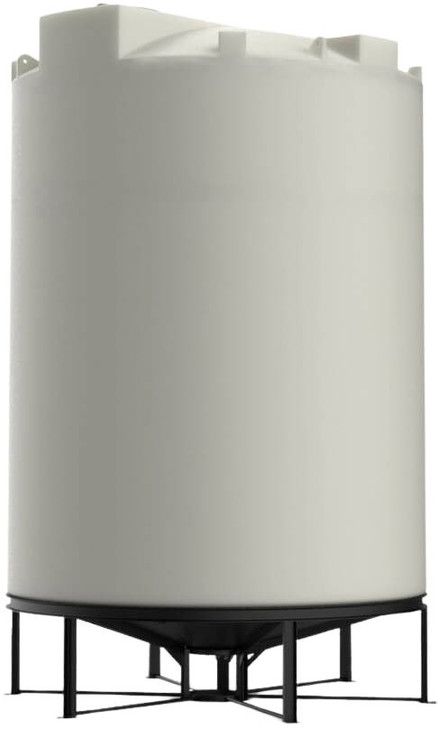
Five thousand gallons, 166 inches to the top, stand included
The Snyder 8050200C75507 is a 5000 gallon cone bottom tank with a stand, moulded in natural white polyethylene, listed at a 102 inch diameter and 166 inches overall height, and 1,380 pounds empty. Read the height as the whole assembly, because that is how the sheet gives it: one figure to the top of the tank with the stand under it, not a tank figure and a stand figure to be added together. The wall is rated at a specific gravity of 1.7, and the sheet gives 41,700 pounds for 5,000 gallons of water at 8.34 pounds per gallon with 70,890 pounds of max contents. The only opening published is an 18 inch threaded vented manway. The service limit is 100 F / 37 C and the warranty is listed as a 3 Year Warranty. What the sheet does not publish is worth stating plainly once: no cone angle, no outlet, no inlet, no length or width beyond the 102 inch diameter, and no stand height, stand load rating or stand material. Those are figures we confirm against the part rather than estimate. Freight is LTL at class 300 with no NMFC number listed, out of Marked Tree, Arkansas.
Spec sheet in hand? Call 866-418-1777 and read us the liquid and the pad; or get freight to your ZIP and add it to your cart above.
What the floor under a 102 inch cone has to carry
Where it sits is the first question on this tank and the one that decides whether the purchase works. A cone bottom vessel has no flat base to stand on, so the whole load leaves the tank through a structure and enters your floor at a small number of feet. This part number is the version that arrives with that structure, which changes the site problem from a fabrication job into a setting job, but it does not remove it. The numbers you are designing to are on the sheet. Empty, the assembly is 1,380 pounds. Filled with water the sheet gives 41,700 pounds, and at the 1.7 rating it gives 70,890 pounds of max contents. That is the load, and it arrives concentrated rather than spread, which is the opposite of how a flat-bottomed vertical behaves on the same slab. A slab poured for a flat tank is not automatically a foundation for this one, and the difference is not a detail: point loads punch, distributed loads settle. Get the surface designed for the feet you actually have, level across all of them, with no shimming and no packing at one corner to make a bubble read true. The framework for that surface, and the boundary where a general slab recommendation stops and an engineer starts, is set out in the concrete pad sizing guide for above-ground polyethylene tanks. Height is the second site constraint and this one is generous rather than extreme. At 166 inches the whole assembly stands a shade under fourteen feet, which is a height most industrial bays, pole barns and open pads carry without argument, and the fill point sits at the top of that. Measure to the lowest obstruction on the route and at the final position, not just at the door, because a sprinkler main or a light fitting is what usually stops a tank three feet short of where it was meant to go. On a 102 inch circle the plan is eight and a half feet across, so allow working room all the way round for the discharge arrangement, for access to the manway, and for whatever lifting equipment has to reach it later. Two more site decisions belong here rather than after delivery. The first is the stand itself. Because this listing includes one, the comparison people ask us about is what a supplied stand does against a fabricated steel frame, and the steel frame against polyethylene stand decision tree works that through on the terms that decide it. Where a plant already runs cones from more than one maker and wants them on common supports, the cone bottom stand compatibility matrix is the cross-maker reference. The second is containment. A vessel holding five thousand gallons over a floor, a yard or a drain is a vessel whose release path is worth arguing about before it is full, not afterwards. Size the volume itself against your real batch and turnover in the tank sizing calculator, and take the freeboard a warming or gassing product needs from the tank sizing guide.
One part number, and what the sheet leaves out
| Part | Capacity | Diameter and overall height | Empty weight |
|---|---|---|---|
| 8050200C75507 (this tank, with a stand, rated 1.7) | 5000 gallons | 102 in diameter, 166 in tall | 1,380 lb |
| Any other part number | not listed on this sheet | not listed on this sheet | not listed on this sheet |
This is the honest table, and the second row is the useful one. Unlike most sheets in the cone bottom range, this one carries no sibling list at all: no smaller capacity, no larger capacity, no alternate colour and no alternate resin is published alongside it, so nothing is compared here that the sheet does not give us to compare. We will not lend this part number's dimensions or its weight to any other listing, and we will not lend another listing's figures to this one. That matters more than it sounds, because a stand changes weight, and a weight taken off the wrong row is a weight the rigger plans around. What you can still do is choose deliberately. We list cone bottom tanks with a stand and without one across a range of capacities, and the two decisions in front of you are the volume and whether the structure comes with the tank or gets fabricated on site. This listing settles the second one in the simplest way available: the stand arrives with the vessel, on one order, at one published weight, which is the argument for buying it this way. Where a plant drawing, a spares list or an existing installation already names a specific part number, order that part number and ask us to confirm the published figures against it before it ships. Where the volume is still open, work it from your batch size and turnover rather than from what fits the space, because a cone bought a size too small is emptied and refilled twice as often, and a cone bought a size too large is a vessel that never runs clean.
Two rows look the same? The difference is the wall; call 866-418-1777 with the liquid and we will say which, or ask for a quote on both.
An 18 inch manway on top and no outlet on the sheet
- The outlet, the valve and the drain: this sheet publishes no outlet, no inlet, no bulkhead and no valve, so no size, thread or hardware is claimed on this page. On a cone bottom vessel that is the fitting that matters most, because the line size at the apex sets the drain time and the drain time sets whether a changeover takes minutes or the better part of a shift. Tell us the line size, the valve type, the pump and the product, and we will confirm what this part number carries before anything is ordered.
- Supporting what hangs below the cone: the valve, any reducer and the first length of pipe are carried on their own steelwork off the stand, never off the tank. With 70,890 pounds of max contents above it, the static head at the apex of a full vessel is not where you want to discover that a valve was hanging on the moulding.
- The angle: no cone angle appears on this sheet and no angle appears in the product name, so this page states none. A steeper cone moves material that packs or bridges; a shallower one keeps the vessel lower for the same volume. Where that choice is still open, ask us against your product rather than reading it off a photograph.
- Access: an 18 inch threaded vented manway at the top of a 166 inch assembly, which means a platform, a fixed ladder and a fall protection arrangement designed alongside the tank rather than bolted on afterwards.
- The vent path: the manway is listed as vented, and that vent is what protects the wall while a pump draws the column down or a delivery fills it. Keep it clear, inspect it whenever the manway is opened, and never blank it to hold an odour in.
- Limits: 100 F / 37 C, a specific gravity rating of 1.7, and a 3 Year Warranty. That is the extent of what this sheet publishes about service.
Name the product when you order. On a cone discharge the gasket, the valve body and the seat material all follow the chemistry, and on a vessel this size the cost of getting that generic never lands on the fitting.
Batch plants that load out by gravity
Five thousand gallons over a cone is bought by operations that empty the vessel on purpose and then put something else in it: liquid fertiliser and crop input blending at an ag retailer, mixing and batching on a chemical process line, polymer and thickened sludge duty at a treatment works, mineral and slurry handling at a wash plant, fermentation and settling in food and beverage production, and completion fluid storage where a load-out has to leave the tank clean. The common thread is the changeover rather than the product. A flat floor at this volume leaves a heel behind every time, and that heel is a disposal ticket and a contamination risk on the next batch rather than a housekeeping annoyance. The cone is what removes it, and the stand is what makes the cone usable, which is why these two are sold as one item. If your product settles hard or carries solids, say so when you enquire; the discharge arrangement and the mixing arrangement will matter more to you than the tank does.
Rated liquids and the fittings to order with them
The resin carries a rating for each liquid below at the concentration shown, and each line names the wetted fitting and gasket to specify. Confirm the service you actually run on the chemical page or in the chemical compatibility database before ordering.
- Acetic Acid (60%)
- Aluminum Sulfate (50%)
- Calcium Chloride (40%)
- DEF (32.5%, 316 stainless fittings)
- Ferrous Sulfate (20%)
- Magnesium Chloride (30%)
- Sodium Carbonate (30%)
- Urea Solution (50%), and Ozonated Water (up to 10 PPM).Fittings for these run PVC or PP with EPDM gaskets.Note the outlet spec on this SKU is not listed
- Sodium Hypochlorite (bleach, under 16.5%) is the one people most often try to put in a 1.7 tank and shouldn't - it calls for a 1.7 SG build with Viton gasket
- Hydrochloric Acid (37%)
- Phosphoric Acid (85%), and
- Hydrogen Peroxide (50%).
- Sulfuric Acid (98%) goes further still, wanting a CPVC fitting body rather than PVC, and
- Peracetic Acid (30%) needs Aflas gaskets, not Viton.
- Ferric Chloride (50%) and
- Ethylene Glycol (100%) are also 1.7 SG chemistries.If your product is on that list, ask us to size a higher-SG tank instead.Cross-check any chemistry in ou
Marked Tree to your yard at 1,380 pounds
This assembly is moulded at Marked Tree, Arkansas, and Arkansas is the only state on the sheet, which puts the mid-South on a short lane and the coasts on a planned one. The freight class is given as 300 and the sheet carries no NMFC number at all. Shipped it is listed at 102 inches wide and 166 inches tall at 1,380 pounds. Price the lane to your ZIP with the freight cost estimator; the listed price is before freight. A load that is both tall and heavy is booked rather than ordered: agree the route, the delivery window and the unloading equipment before the tank leaves the plant, because a site that has not decided how an eight and a half foot wide assembly comes off a trailer is a site that pays for a second visit. Have the lifting equipment standing and the foundation finished, cured and level before the truck arrives. Set it, check it is plumb in two directions, anchor it, and only then fill it with clean water and hold that 41,700 pound load long enough to read the manway seal, the discharge joint, the stand feet and the surface under them, in that order. Walk it again the next morning before you call it commissioned. Then paint a datum mark on one leg and photograph it: everything you check later is checked against the day it was set. Mark the vent and the outlet on the outside of the shell so nobody caps the wrong one in the dark.
Freight and documents
Ships from: Marked Tree, AR. LTL freight is quoted to your ZIP with the freight cost estimator or by phone at 866-418-1777. The listed price is before freight.
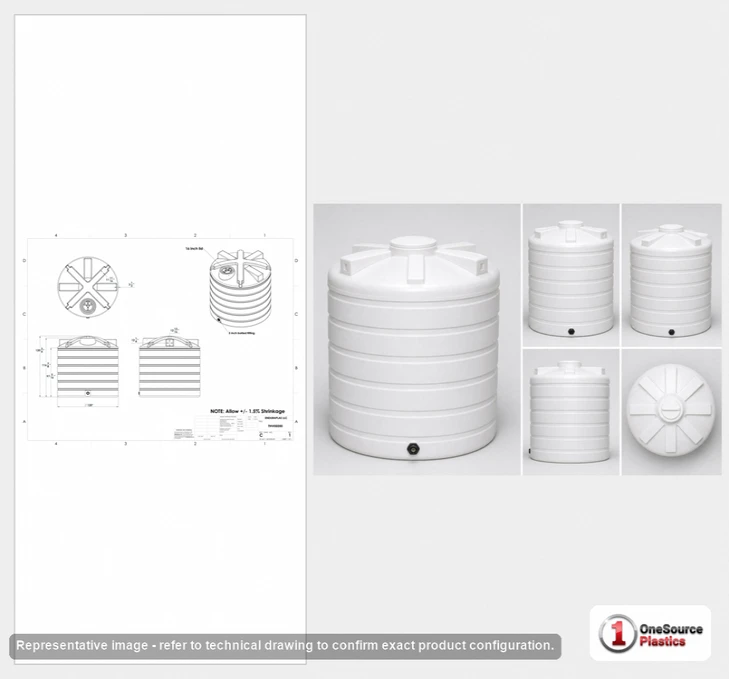
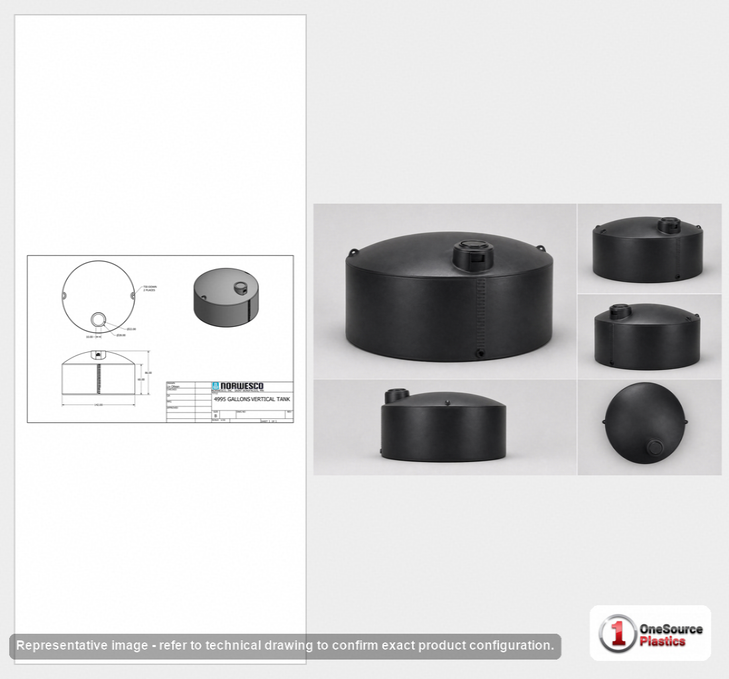
Technical drawing (PDF) for Snyder Industries 8050200C75507.
Ready to order?
Add it to your cart at the top of this page, get LTL freight to your ZIP, request a written quote, or call 866-418-1777. The listed price is before freight.