Five thousand gallons of cone bottom on a 102 inch plan
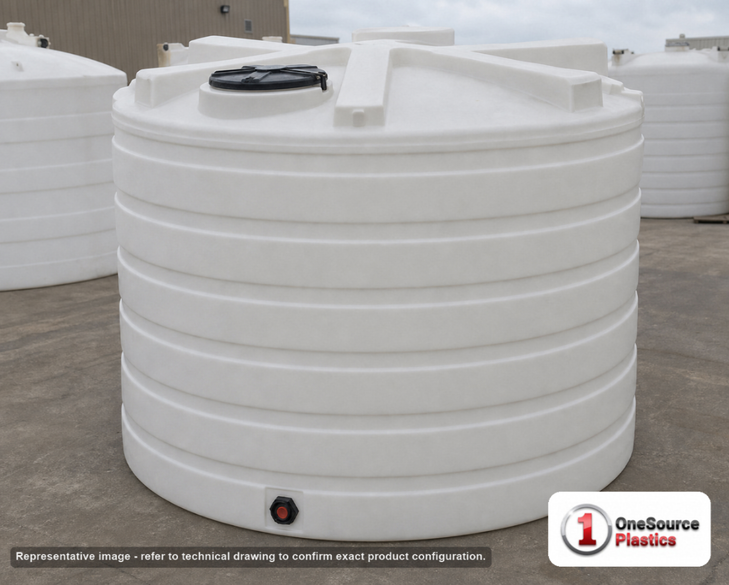
Five thousand gallons, a 102 inch circle and 166 inches of height: the Snyder 8050200C75501 is a cone bottom tank in natural white polyethylene, listed at 102 inches long by 102 inches wide by 166 inches tall and 1,300 pounds empty. The wall is rated at a specific gravity of 1.7, and the sheet gives 41,700 pounds for 5,000 gallons of water at 8.34 pounds per gallon with 70,890 pounds of max contents. The opening on top is an 18 inch threaded vented manway, and the outlet field on this sheet reads "1 Manway / Lid", which names an opening and not a pipe size; we print it as given and claim no outlet dimension. The service limit is 100 F / 37 C and the warranty is listed as a 3 Year Warranty. No cone angle appears on the sheet and none appears in the name, so this page states none. No stand is included and none is published. Freight is LTL at class 300 with no NMFC number, out of Marked Tree, Arkansas.
Ordering for a plant or a bid? Request a written quote with freight to your ZIP for the file; a single 5000 gallon tank goes straight to the cart above.
Setting a cone that does not stand on its own bottom
Begin with the support, because this listing is the tank on its own and the structure under it is yours to specify. A cone bottom vessel transfers everything it holds into a frame, and that frame then puts the load into your floor at a handful of bearing points. The sheet gives you the three numbers that design is built around: 1,300 pounds empty, 41,700 pounds full of water, and 70,890 pounds of max contents at the 1.7 rating. Those are point loads once a stand is under them, and a slab that happily carries a flat-bottomed vertical of the same volume may be entirely wrong for this one. The concrete pad sizing guide for above-ground polyethylene tanks sets out the framework and says clearly where a general recommendation ends and an engineer's drawing begins. Then the stand. Two questions decide it: how high the outlet needs to be off the floor, and whether the frame is bought or fabricated. The outlet height is the one people get wrong, because it is set by what the tank discharges into. A gravity drop straight into a tote, a nurse tank or a truck needs real clearance under the apex; a pumped transfer needs far less and wants the suction as low as it can sensibly go. Decide that before the frame is drawn, not after the tank is delivered. On the second question, the steel frame against polyethylene stand decision tree compares the two honestly, and where a site runs cones from several makers on common supports, the cone bottom stand compatibility matrix is the cross-maker reference. Height and footprint come next. The tank alone is 166 inches, a shade under fourteen feet, and the stand adds to that, so measure to the lowest obstruction at the final position and add the frame before you commit. The 102 inch plan is eight and a half feet across; leave working room all the way round it, including room for the lift that will one day have to take it out again. Two site questions close this out. Where the vessel stands over ground or a drain that would have to be recovered after a release, the containment comparison argues that properly instead of assuming it away. And where the tank is going to hold something the site has to label, the tank label and signage guide reconciles the several marking schemes that turn up on one vessel. Confirm the volume itself against your batch and turnover in the tank sizing calculator, and take the freeboard discipline from the tank sizing guide.
The 4600, this 5000 and a 5500 in a narrower shell
| Part | Gallons | Length x width x height | Empty weight |
|---|---|---|---|
| 8050200C75501 (this tank, rated 1.7) | 5000 | 102 x 102 x 166 in | 1,300 lb |
| 8050100C75501 (same plan, shorter) | 4600 | 102 x 102 x 154 in | 1,200 lb |
| 7040000N40 (narrow and tall, cross-linked name) | 5500 | 90 x 90 x 241 in | 1,500 lb |
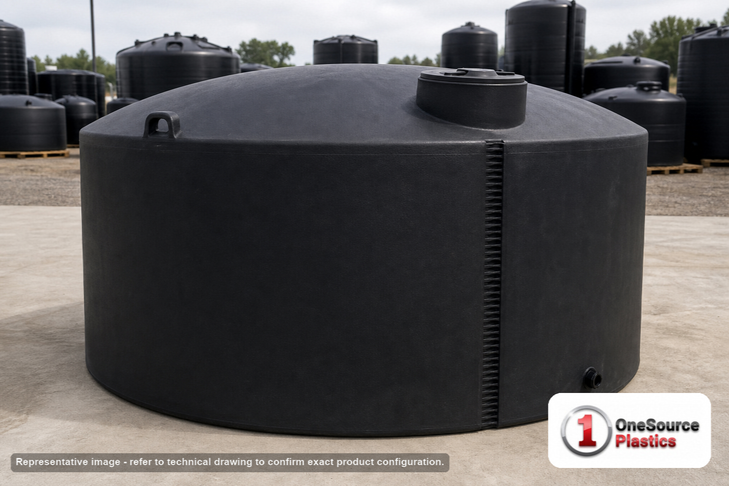
Three tanks, and the choice between them is a shape decision rather than a volume decision. 8050100C75501 sits on the identical 102 inch plan and is a foot shorter at 154 inches, holding 4,600 gallons at 1,200 pounds. That is the tank to buy when the footprint is fixed by an existing pad or an existing frame and the ceiling is the thing you are short of, and the four hundred gallons it gives up is the price of the headroom. Buy this 5000 when the same plan is available and the roof is not the binding constraint, because you get the extra volume on ground you have already committed and on a stand that is solving the same problem either way. 7040000N40 is the interesting row. It holds 5,500 gallons, only five hundred more than this tank, in a 90 inch circle, but it needs 241 inches to do it, which is very nearly twenty-one feet before a stand is added under it. That is a slender column: it wants a taller structure, a better anchored one, and a building or an exposure that can take the height. What it buys you is floor. Where the plan area is genuinely the scarce resource, that narrow shell puts more gallons on less ground than anything else in the group. Where the ceiling is the scarce resource, this tank on its wide 102 inch plan is the right answer and the 4600 is the fallback. Read the two constraints in that order, because a cone is the one tank shape where the structure, not the vessel, decides whether an installation is straightforward or expensive.
Need the taller or the wider one? Every row links to its page with freight to your ZIP on each; 866-418-1777 will check the ceiling and the pad.
Where the outlet field says manway and nothing else
- The outlet, the valve and the drain path: the outlet field on this sheet reads "1 Manway / Lid". That names an opening, not a pipe size, and we will not turn it into one. No thread, no flange, no bulkhead and no valve is claimed here. Before the pump or the drop line is specified, tell us the duty and the line size you need and we will confirm what this part number actually carries.
- Drain time: on a cone the line size at the apex sets how long a five thousand gallon changeover takes, and on a gravity discharge it sets it far more than the angle does. Time the drain with clean water on the day it is commissioned and write the figure on the tank; every batch plan afterwards depends on it.
- What hangs below: the valve, any reducer and the first length of pipe are carried on their own steelwork off the stand, never off the moulding, and a flexible connector at the first joint keeps a transfer pump's vibration out of the wall.
- Access and filling: an 18 inch threaded vented manway on top is the only opening the sheet publishes, which makes it the fill route, the inspection route and the cleaning route at once. At 166 inches before a stand, that is a platform and a fixed ladder, designed with the frame rather than after it.
- The vent: the manway is listed as vented. That path is the wall's protection while a pump draws the column down, so keep it clear and inspect it every time the manway is opened.
- Level: no sight tube, no gauge and no graduation is published on this sheet. On a vessel nobody can see into, the reading technology is a real decision, and the level gauge selection guide for chemical service compares the approaches on their merits.
- Limits: 100 F / 37 C, a specific gravity rating of 1.7, and a 3 Year Warranty.
Tell us the product and its temperature at order time. Everything on that list above is chosen against the chemistry, and a fitting specified generically is the part that fails first on a vessel that never fails.
Changeover duty in ag retail and process plants
This size and shape goes where a vessel is emptied deliberately and then refilled with something different: liquid fertiliser and crop protection blending at an ag retail site, mixing and batching on a chemical process line, polymer make-up and thickened sludge at a water or wastewater works, mineral and slurry duty at a wash plant, food and beverage settling and fermentation, and drilling and completion fluid storage where a load-out has to leave the tank clean. What they share is a heel problem. At five thousand gallons, the residue a flat floor leaves behind is not swept out, it is pumped, disposed of and documented, and it carries into the next batch if it is not. A cone removes the problem structurally rather than procedurally, and that is the entire argument for paying for the shape and the frame it needs. One habit is worth forming from the first week: record the drain time and the last-gallon behaviour for each product you run through it, because the second product is always the one that surprises the operators.
Listed chemical service for this shell
The maker's list for this resin: each liquid, the concentration it is rated to, and the fitting and gasket that go on the order. Verify your own service on the linked page or in the chemical compatibility database before ordering.
- Acetic Acid at 60% - PP/PVC fittings, EPDM gaskets
- Aluminum Sulfate at 50% - PVC fittings, EPDM gaskets
- Calcium Chloride at 40% - PVC fittings, EPDM gaskets
- DEF at 32.5% - 316SS fittings, EPDM gaskets. DEF requires 316SS wetted metal, not brass or carbon steel - this is the most common DEF fitting m
- Ferrous Sulfate at 20% - PVC fittings, EPDM gaskets
- Magnesium Chloride at 30% - PVC fittings, EPDM gaskets
- Sodium Carbonate at 30% - PVC fittings, EPDM gaskets
- Urea Solution at 50% - PP/PVC fittings, EPDM gaskets
- Ethylene Glycol
- Ferric Chloride
- Ferric Sulfate
- Hydrochloric Acid
- Hydrofluoric Acid
- Hydrofluosilicic Acid
- Hydrogen Peroxide
- Peracetic Acid
- Phosphoric Acid
- Polyaluminum Chloride
- Potassium Carbonate
- Potassium Hydroxide
- Propylene Glycol
- Sodium Bisulfate
- Sodium Bisulfite
- Sodium Hypochlorite
- Sodium Thiosulfate
- Sulfuric Acid and
- Zinc Orthophosphate. The gasket also changes with the chemistry: Hydrochloric Acid, Hydrofluoric Acid, Hydrofluosilicic Acid, Hydrogen Peroxide, Phosphoric Ac
A class 300 move out of Arkansas
This tank is moulded at Marked Tree, Arkansas, and Arkansas is the only state its sheet lists. The freight class reads 300 and the sheet carries no NMFC number; shipped, it is listed at 102 by 102 by 166 inches and 1,300 pounds. Price the lane to your ZIP with the freight cost estimator; the listed price is before freight. Fourteen feet tall on a trailer is a dimensional move rather than a routine one, so agree the route, the window and the offloading equipment before it leaves the plant, and have a forklift or a crane with the reach and the rating standing when it arrives. Take it under the body, never by the manway. The stand should already be set, levelled and anchored, because a cone on the ground is a cone on its apex and that is not how it is designed to rest. Once it is on the frame, fill it with clean water and hold the 41,700 pound load while you read the manway seal, the apex joint and every foot of the frame. Do not skip the second walk the following morning. Finally, agree with the site who signs off the first fill, and put that name on the commissioning record; a tank with no named owner is a tank nobody inspects. A strap that is checked once a season is a strap that holds; put it on the same calendar as the gutters.
Freight and documents
Ships from: Marked Tree, AR. LTL freight is quoted to your ZIP with the freight cost estimator or by phone at 866-418-1777. The listed price is before freight.
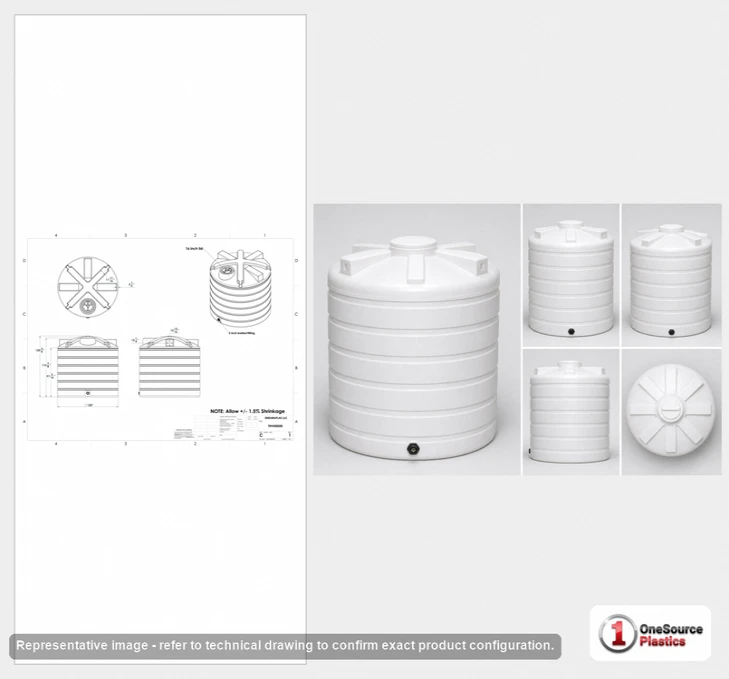
Technical drawing (PDF) for Snyder Industries 8050200C75501.
See this tank
Interactive 3D model with live fill. This tank has an interactive 3D model built to its manufacturer dimensions. Rotate it, and set a fill level to see how much liquid it holds at any height. Open the 3D view on the product photo above. Download the 3D model (GLB).
Ready to order?
Add it to your cart at the top of this page, get LTL freight to your ZIP, request a written quote, or call 866-418-1777. The listed price is before freight.