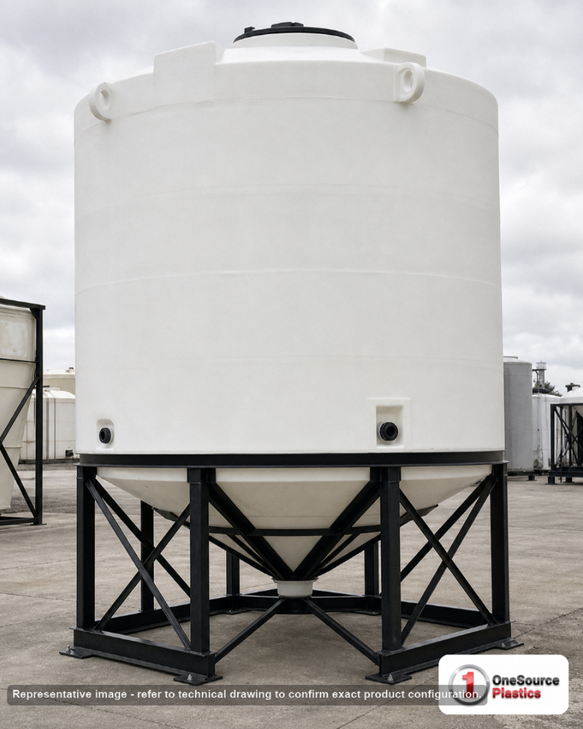
Eleven thousand five hundred gallons over a 30 degree cone
The Snyder SII-5340100N45 is an 11,500 gallon 30 degree cone bottom tank in white polyethylene, listed at a 142 inch diameter and 214.5 inches tall, at 3,600 pounds empty. The name gives the 30 degree slope and this page cites it from there; the sheet's own cone field is empty and no other geometry is claimed. This is the largest cone bottom vessel we list, and everything about owning one starts with the fact that a cone cannot stand on its own bottom. The wall is rated at a specific gravity of 1.9, and the sheet gives 95,910 pounds for 11,500 gallons of water at 8.34 pounds per gallon with 182,229 pounds of max contents. The only opening published is an 18 inch threaded vented manway. The service limit is 120 F / 48 C and the warranty is listed as a 3 Year Warranty, which makes this one of only two sheets in its batch with a term on it. No outlet, no inlet and no stand appear on this sheet, so this page asserts none of the three.
Need it before the next delivery? Call 866-418-1777 for the ship date, or get freight to your ZIP and add it to your cart above now.
An oversize load out of Lincoln, and what that lane costs you
Start with the truck, because on a tank this size the truck decides the project. The sheet lists the freight as OVS, which is a mode and not a numeric class, out of Lincoln, Nebraska, with Nebraska given as the shipping state. Shipped it is 215 inches long by 142 inches wide by 142 inches high. One hundred and forty-two inches of width is wider than a standard trailer bed, and that single number is what turns a delivery into a permitted oversize move with a route, a schedule and a set of rules about when it can travel. None of that is a problem; all of it is a lead time. The sites that get this wrong are the ones that order the tank and then discover the yard gate, the last hundred yards of track, the overhead line or the turn into the compound will not take a load 142 inches wide. Walk that route before the order with a tape and a photograph of every pinch point, and price the lane to your ZIP with the freight cost estimator so the number is on the table from the start; the listed price is before freight. The second thing the lane forces you to settle early is the unload. Three thousand six hundred pounds empty is a crane or a large forklift with the reach to take a 214.5 inch tall vessel off a trailer and set it down under control, and that machine has to be booked for the delivery window rather than found on the day. Then there is what it stands on, and here the sheet is silent in a way that matters: it publishes no stand. A 30 degree cone bottom has no flat base to sit on, so the vessel is carried in a stand or a structure, and that structure is a separate engineered purchase sized to the loaded weight, not an afterthought. Tell us the duty and we will take the stand question properly rather than guess a part. The foundation under the stand is the next question, and on a poured pad rather than an engineered footing the tank sizing calculator and the tank sizing guide will get your volume and freeboard right while the civil work gets sized by somebody looking at the actual loads.
Five 11,500 gallon listings and the 13,000 above them
| Part | Gallons | Length x width x height | Empty weight |
|---|---|---|---|
| SII-5340100N45 (this tank) | 11,500 | 142 x 142 x 214.5 in | 3,600 lb |
| 5340100N42 (heavy duty listing) | 11,500 | 142 x 142 x 215 in | 3,600 lb |
| 5340100N40 (lighter listing) | 11,500 | 142 x 142 x 215 in | 2,850 lb |
| 5340100N46 (lighter listing) | 11,500 | 142 x 142 x 215 in | 2,850 lb |
| SII-5320100N43 (smaller cone) | 7,400 | 142 x 142 x 160 in | 1,600 lb |
| 7490100N49 (larger cone) | 13,000 | 142 x 142 x 238 in | 3,250 lb |
Four listings in this table hold 11,500 gallons on the same 142 inch diameter, at 3,600, 3,600, 2,850 and 2,850 pounds. The sheet gives those weights and explains nothing about them, so we print what it says and leave the reasoning alone. What is worth saying out loud is the practical consequence: if your site already runs one of these, order the part number you already have, so the manway, the gasket and the stand you own carry straight across. This tank is one of the two heaviest listings in that group. The genuinely different rows are the last two. SII-5320100N43 holds 7,400 gallons on the identical 142 inch diameter at 160 inches tall and 1,600 pounds, which is the tank to buy when the building, the bund or the crane reach caps your height: same floor circle, considerably less to lift, considerably less liquid. 7490100N49 goes the other way at 13,000 gallons, again on 142 inches of diameter, standing 238 inches and weighing 3,250 pounds. That is the cleanest comparison in the whole table, because all three tanks take exactly the same circle of ground and the only thing you are actually buying with the extra volume is height. Decide against the ceiling, the crane, the stand and the bund, in that order, and the choice between them usually makes itself. Where a process wants two vessels rather than one large one, say so early; two 7,400s and one 13,000 are very different projects on the civil side.
Need a different size? Every tank in the table is in stock programs; ask for a quote on the one that fits, or call 866-418-1777.
An 18 inch vented manway, and the fittings the sheet leaves out
- The fill opening: an 18 inch threaded vented manway at the top, which is the only opening this sheet publishes. Eighteen inches is a proper working access, taking a fill line, a dip, a lance and an arm, and on a vessel 214.5 inches tall it is reached from a platform or a ladder cage rather than from the ground. Plan the access with the stand, not after it.
- The vent in that manway: the manway is listed as vented, and on a tank this size the vent path is the single most important thing to keep clear. A large vessel being filled or drawn down moves a great deal of air, and a blocked vent is the mechanism behind most polyethylene tank failures that look mysterious afterwards.
- The outlet: this sheet publishes no outlet and no inlet, so no size, no position and no bulkhead is stated here. On a cone bottom the discharge arrangement is designed with the stand, the valve and the pump together, so tell us the duty and the fluid and we will specify it against the tank rather than print a fitting the sheet does not carry.
- The stand: no stand, no stand height and no cone dimension beyond the 30 degrees in the name appears on this sheet. A stand for an 11,500 gallon cone is an engineered item bought for the loaded weight, and we will not attach a part number to it here.
- Support for everything downstream: the valve, the pump, the meter and the pipework stand on their own steel. A polyethylene wall carries liquid, not hardware, and at this scale that rule is not negotiable.
- Limits and term: 120 F / 48 C, a specific gravity rating of 1.9, and a 3 Year Warranty. That is the whole of what this sheet publishes as limits, and this page claims nothing beyond it.
Name the fluid when you order, because at 182,229 pounds of rated contents the gasket, the valve body and the fitting material are not details. Where the vessel is going to hold a regulated product and somebody has asked what a contained arrangement is actually worth against the steel alternative, the contained polyethylene versus steel comparison argues it on the terms that decide it rather than on a slogan.
Settled solids, batch chemistry and a bottom that empties
Nobody buys a cone bottom for the storage. They buy it for the discharge. At 11,500 gallons the duties are process rather than warehouse: batch chemistry at a plant that mixes and then draws the whole batch off, agricultural liquid fertiliser and crop protection blending where settled product has to be recovered rather than stirred forever, mining and mineral processing where solids report to the bottom, food and beverage processing where a vessel must empty completely between products, municipal and industrial treatment where sludge or polymer is thickened and drawn off, and any duty where a flat-bottomed tank means a person with a hose at the end of every campaign. The reason to get the angle right is the same in all of them: the slope is what decides whether your specific material actually reports to the outlet or sits on the wall. That is a material question, not a marketing one, and the cone bottom angle selection guide works through the shallow, medium and steep options against what is being stored. Read it before you commit the civil work, because the stand and the foundation are sized around the tank you choose and neither is cheap to change afterwards.
Which liquids, at what concentration, with which fitting
Each entry pairs a rated liquid with its concentration limit and the fitting and gasket to order alongside the tank. The full rating sits on the linked page and in the chemical compatibility database before ordering.
- Acetic Acid (60%) - PP/PVC fittings, EPDM gaskets
- Aluminum Sulfate (50%) - PVC fittings, EPDM gaskets
- Calcium Chloride (40%) - PVC fittings, EPDM gaskets
- DEF (32.5%) - 316SS fittings, EPDM gaskets
- Ethylene Glycol (100%) - PVC fittings, EPDM gaskets
- Ferric Chloride (50%) - PVC fittings, EPDM gaskets
- Ferric Sulfate (60%) - PVC fittings, EPDM gaskets
- Ferrous Sulfate (20%) - PVC fittings, EPDM gaskets
- Hydrochloric Acid (37%) - PVC fittings, Viton gaskets
- Hydrofluoric Acid (48%) - PP/PVC fittings, Viton gaskets
- Hydrofluosilicic Acid (26%) - PP/PVC fittings, Viton gaskets
- Hydrogen Peroxide (50%) - PVC fittings, Viton gaskets
- Magnesium Chloride (30%) - PVC fittings, EPDM gaskets
- Peracetic Acid (30%) - 316SS fittings, Aflas gaskets
- Phosphoric Acid (85%) - PVC fittings, Viton gaskets
- Polyaluminum Chloride - PVC fittings, EPDM gaskets
- Potassium Carbonate (50%) - PVC fittings, EPDM gaskets
- Potassium Hydroxide (saturated) - PVC fittings, EPDM gaskets
- Propylene Glycol - PP/316SS fittings, EPDM gaskets
- Sodium Bisulfate - PVC/PP fittings, EPDM gaskets
- Sodium Bisulfite - PVC/PP fittings, EPDM gaskets
- Sodium Carbonate (30%) - PVC fittings, EPDM gaskets
- Sodium Hypochlorite (
- Sodium Thiosulfate (40%) - PVC fittings, EPDM gaskets
- Sulfuric Acid (98%) - CPVC fittings, Viton gaskets
- Urea Solution (50%) - PP/PVC fittings, EPDM gaskets
- Zinc Orthophosphate - PP/316SS fittings, EPDM gaskets
Three thousand six hundred pounds on an oversize trailer
This tank is moulded at Lincoln, Nebraska, which puts the plains, the upper Midwest and the corn belt on a short lane and everywhere else on a planned one. Get the lane priced to your ZIP with the freight cost estimator before anything else is committed, and remember the listed price is before freight. At 3,600 pounds empty the unload is a crane or a heavy forklift with genuine reach, rigged under the body and never around the cone or through the manway. Have the stand set, levelled and signed off before the tank arrives, because there is nowhere sensible to put an 11,500 gallon cone on the ground while you finish the steelwork. Once it is seated, fill it with clean water in stages and walk the stand, the seat and the discharge joints at each stage rather than only at the top. A vessel this size tells you everything it is going to tell you during the first water fill, and water is the cheapest liquid you will ever put in it. Keep the first delivery's paperwork with the tank; strength and date on day one is the baseline for every batch after.
Freight and documents
Ships from: Lincoln, NE. LTL freight is quoted to your ZIP with the freight cost estimator or by phone at 866-418-1777. The listed price is before freight.
Technical drawing (PDF) for Snyder Industries 5340100N45.
See this tank
Interactive 3D model with live fill. This tank has an interactive 3D model built to its manufacturer dimensions. Rotate it, and set a fill level to see how much liquid it holds at any height. Open the 3D view on the product photo above. Download the 3D model (GLB).
Product video. Watch the Snyder Industries 11500 Gallon 30 Degree HDPE Cone Bottom Tank in White video (75 seconds) with dimensions, fittings and shipping notes.
Ready to order?
Add it to your cart at the top of this page, get LTL freight to your ZIP, request a written quote, or call 866-418-1777. The listed price is before freight.