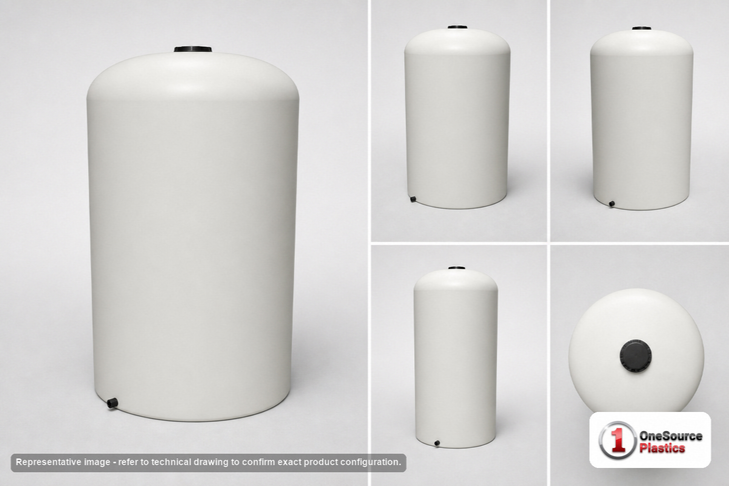
5000 gallons at a 1.9 rating, 102 inches across and 154 inches tall
The Snyder SII-1002100C26 holds 5000 gallons in a white polyethylene shell 102 inches across and 154 inches tall, and its sheet lists it at 1,056 pounds empty, molded at Philippi, West Virginia. The wall is rated at a specific gravity of 1.9, which is 79,230 pounds of contents against 41,700 pounds for the same 5000 gallons of water at 8.34 pounds per gallon, and that rating is the heaviest in this shell's family. Fittings as listed: an 18 inch threaded vented manway on top and a 3 inch polypropylene female NPT bulkhead outlet at the base. Freight is class 400 as an oversize load and the listed price is before freight. This sheet publishes no service limit and no warranty term, so this page states neither; ask us and we will get Snyder's current terms in writing.
Buying for a site, a fleet or a district? Request a written quote with freight to your ZIP, or add it to your cart above and call 866-418-1777 with any question on the fit.
The heavy figure in a shell of four: 1,056 pounds against 950
Four part families share this 102 by 154 inch shell, and the honest way to choose between them starts with the figure on each sheet rather than with the story. Three of them, the 1002100C34, the 1002100C37-BLACK and the 1002100N40, are listed at 950 pounds. This molding is listed at 1,056 pounds. The sheet gives both numbers and this page prints what it says; we do not explain the difference and we do not interpret the suffix. What we will say is what the rest of the sheet supports: this is the white wall in the shell, rated at a specific gravity of 1.9, and 1.9 is a dense liquid rating, the kind bought for a heavy acid or a concentrated solution rather than for water. At that rating the contents figure is 79,230 pounds, and there is nothing in the family that carries more in this footprint. White is the second half of the decision. A white shell passes daylight, so the liquid line reads from the ground and a plant that checks a level by eye gets it for nothing; a liquid that light degrades belongs behind the black molding in this same shell instead. Under the tank, the arithmetic is unforgiving. Twelve feet ten inches of liquid standing on an eight and a half foot circle means the whole 79,230 pounds is carried by whatever the molded floor is touching, so the base is engineered, level, continuous and wider than the tank, and a berm is sized to the tank where the liquid is regulated. At better than twelve and a half feet tall and only 102 inches across, it is a sail while it is empty, so the banding or cabling goes to structure or to anchors set with the pad, tight before the first fill, checked after the first windy week and again after the first full summer. Access at the manway is 154 inches up, which means fixed access with a rail rather than a ladder leaned against a tank. Before any of that, confirm the volume is the right one: run 5000 gallons against your draw and refill in the tank sizing calculator, and take the reserve and the freeboard from the tank sizing guide.
One 102 by 154 inch shell, four part families
| Part | Gallons | Diameter x height | Empty weight |
|---|---|---|---|
| SII-1002100C26 (this tank, white, listed heavier) | 5000 | 102 x 154 in | 1056 lb |
| 1002100C34 (black, heavy duty) | 5000 | 102 x 154 in | 950 lb |
| 1002100C37-BLACK (black) | 5000 | 102 x 154 in | 950 lb |
| 1002100N40 (cross-linked polyethylene) | 5000 | 102 x 154 in | 950 lb |
| 5480000N40 (slim, tall) | 4900 | 90 x 202 in | 1450 lb |
| SII-32372 (same base, taller) | 5100 | 102 x 159 in | 1301 lb |
Inside the shell the choice is wall colour and part family, each molding rated as its own sheet says, and this one is the white molding listed at 1,056 pounds. Outside it, the family offers two neighbours worth pricing. The 5480000N40 is the slim, tall extreme: 4900 gallons on a 90 inch circle standing 202 inches, nearly seventeen feet, at 1,450 pounds, in cross-linked polyethylene, which buys a smaller footprint and more head at the cost of a serious strapping and access job. The SII-32372 stays on this tank's own 102 inch base and stands 159 inches for 5100 gallons at 1,301 pounds, which is the buy when a hundred more gallons is worth five more inches of height. Against both, this molding is the mid-height one on a base the yard can usually find, with the 1.9 rating and a white wall that shows the level.
Comparing against another maker? Send the competing spec to 866-418-1777 or a quote request and we will show the differences honestly.
The vent on a tank filled at tanker rate
- Vent and fill: one 18 inch threaded vented manway is everything at the top of this tank, and on a 5000 gallon vessel that takes a tanker load it is the vent that decides whether a fast delivery is safe. Air has to leave as fast as liquid arrives and come back as fast as a pump takes it out, so the vent path is kept clear, sized to the delivery pump rather than to the tank, and run outdoors where the liquid fumes. Fill down a dip tube to the floor instead of free-falling twelve feet ten inches onto the surface, which keeps splash, static and aerosol out of the headspace.
- Headspace: at a 1.9 rating the liquid is usually the aggressive one, and the band of wall in the vapor space above the line is where a tank ages first. Light it and look at it at every opening, and keep the manway shut in between.
- Access: 154 inches up. Fixed access with a rail for whoever opens it, and a fill coupling brought down to working level so a delivery driver is not climbing.
- Outlet: a 3 inch polypropylene female NPT bulkhead fitting at the base, as the sheet lists it, with the liquid named at order so the fitting, gasket and bolting are matched to it. Flexible connector on the first joint, first valve on its own support off the pad.
- Service limit and warranty: this sheet publishes neither, so this page asserts neither. Ask us for Snyder's current terms in writing before you specify a hot duty.
Twelve feet ten inches of standing liquid is the strongest suction head in this shell's family and it sits on the base fitting, the first joint and the first valve every hour of every day. Mount the pump below the outlet so the column keeps it flooded to the last inches, give it a straight run before the first elbow, and fit a low level float so it stops with liquid still over the fitting. Where the site freezes, protect the valve and the exposed run rather than the body. Keep a spare gasket for the outlet on the shelf; it is the part that fails on a holiday weekend.
Where a 5000 gallon 1.9 wall earns its keep
A 1.9 rating is bought for weight, so the duties are the dense ones: a plating or metals shop holding a concentrated acid, a water plant with a heavy coagulant or a dense chemical feed, a mining or industrial site with a brine or a heavy solution, a chemical distributor breaking bulk into a plant's day tanks, a fertilizer dealer with a dense liquid blend. The 5000 gallon vertical tank buyers guide walks the whole 5000 gallon field, shell by shell, and is the right place to start if the rating and the footprint are still open questions. Water sits well inside this wall, but stored water is not a fire reserve until the draw rate, the connection and the freeze protection make it one, which the fire-water reservoir design guide sets out honestly rather than optimistically.
Philippi, West Virginia at class 400
This molding ships from Philippi, West Virginia at class 400 as the sheet lists it, crated at 154 inches by 102 inches by 102 inches, moving as an oversize load. For an eastern or midwestern buyer that plant is the short lane, and on a load this shape the lane matters more than the class does: nearly thirteen feet of tank lying on a deck is a length and width problem, so check the gate, the turn and the overhead lines before the truck is booked. The freight cost estimator prices it to your ZIP and the listed price is before freight. Unload with slings under the body and a machine that can stand 1,056 pounds up on the finished pad, never a hook through the manway, and get the cables or bands on before that machine leaves the site. Fill with water to the manway once, hold it, and watch the base and the outlet fitting through the hold. Write the part number and the outlet size on the maintenance log the day it lands, because those two lines are what every later order for a gasket or a valve is built from. Save the pallet; a tank that ever has to move again is easier to move on it.