6,000 gallons, eleven feet tall on a ten foot circle, rated 1.5
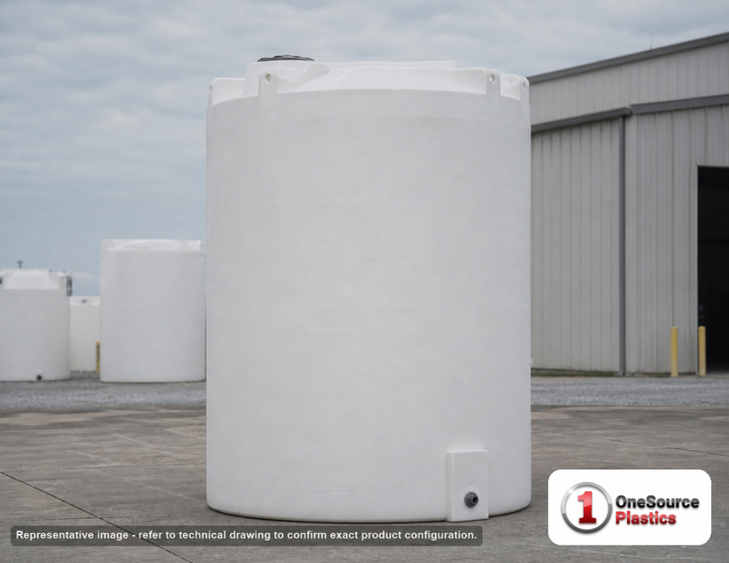
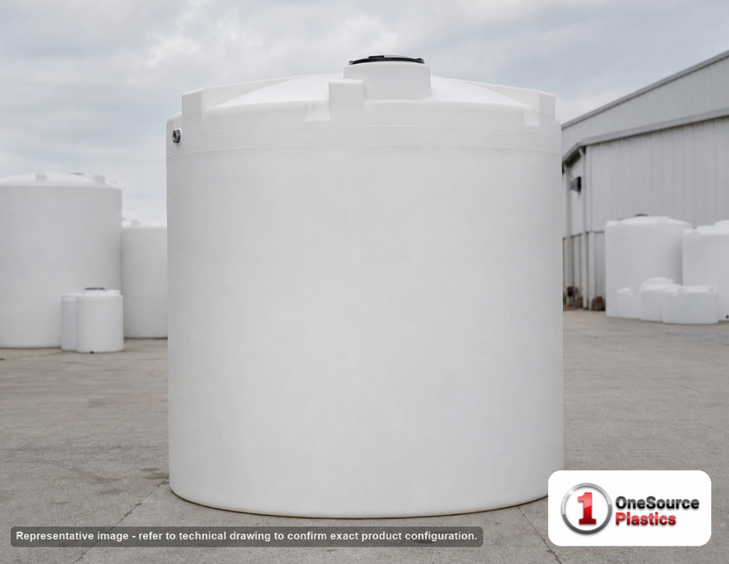
Ten feet across, eleven feet high, 6,000 gallons: the Snyder SII-7000000C37 is 120 inches in diameter and 132 inches tall, 1,155 pounds empty, white, in high density linear polyethylene. The sheet rates the wall at a specific gravity of 1.5 and gives the maximum contents as 75,060 pounds, against 50,040 pounds for the same 6,000 gallons of water at 8.34 pounds per gallon. It publishes a service limit of 120 F / 48 C and a 3 Year Warranty, which most sheets in this family do not. The fittings listed are a 3 inch polypropylene female NPT bulkhead outlet at the base and an 18 inch threaded vented manway on the crown; no inlet is given. Freight is class 400, moving as an oversize load, and the sheet names two plants, Lincoln, Nebraska and Philippi, West Virginia.
Spec sheet in hand? Call 866-418-1777 and read us the liquid and the pad; or get freight to your ZIP and add it to your cart above.
A ten foot pad, 75,060 pounds on it, and the cables that go on before the first fill
Read the site before the specification. The floor of this tank is a 120 inch circle, ten feet across, and at the rating on the sheet a full tank drives 75,060 pounds into it. A rotationally molded base bears on the whole surface it touches and on nothing else, so the slab decides the load path: level, continuous, in full contact, designed for the weight rather than poured by habit, and carried out past the wall instead of stopped at its edge. Work to the framework in the concrete pad sizing guide, and where the liquid is regulated, design the containment at the same time as the pad rather than bolting it on later. Grade the surround so a spill or an overflow leaves the slab instead of running along the joint between slab and soil, because that joint is where undercutting starts. Then the height. At 132 inches the tank stands eleven feet, which is low enough to sit inside a good many industrial bays and tall enough to be a sail while it is empty at 1,155 pounds, so restraint goes on before the first fill: cabled or banded to structure or to anchors set with the pad, tensioned before the water goes in, and retensioned after the first full summer, since polyethylene grows in sunlight and a strap set in spring will be slack by August. Above the crown, the 18 inch manway needs clear air to open at all, so measure the bay before the order and build fixed access with a rail if anyone is ever going to look inside. Last, size the volume to the duty rather than to the shape: a wall rated 1.5 is bought for a liquid heavier than water, so the useful arithmetic is what the liquid weighs, how much headspace it needs as it warms, and therefore how much of the 6,000 gallons is actually usable, which is the work the tank sizing calculator and the tank sizing guide are built for.
The 6,000 gallon shell in three walls, with a taller cross-link beside it
| Part | Gallons | Diameter x height | Empty weight |
|---|---|---|---|
| SII-7000000C37 (this tank, white, rated 1.5) | 6,000 | 120 x 132 in | 1,155 lb |
| 7000000C34 (black, heavy duty, same shell) | 6,000 | 120 x 132 in | 1,050 lb |
| 7000000C37-BLACK (black, same shell) | 6,000 | 120 x 132 in | 1,050 lb |
| 7140300N40 (cross-link, taller) | 6,000 | 120 x 145 in | 1,500 lb |
| 5250000N40 (smaller, wide and low) | 5,600 | 142 x 102 in | 1,150 lb |
| 8220000C34 (larger, black, heavy duty) | 6,200 | 120 x 140 in | 1,350 lb |
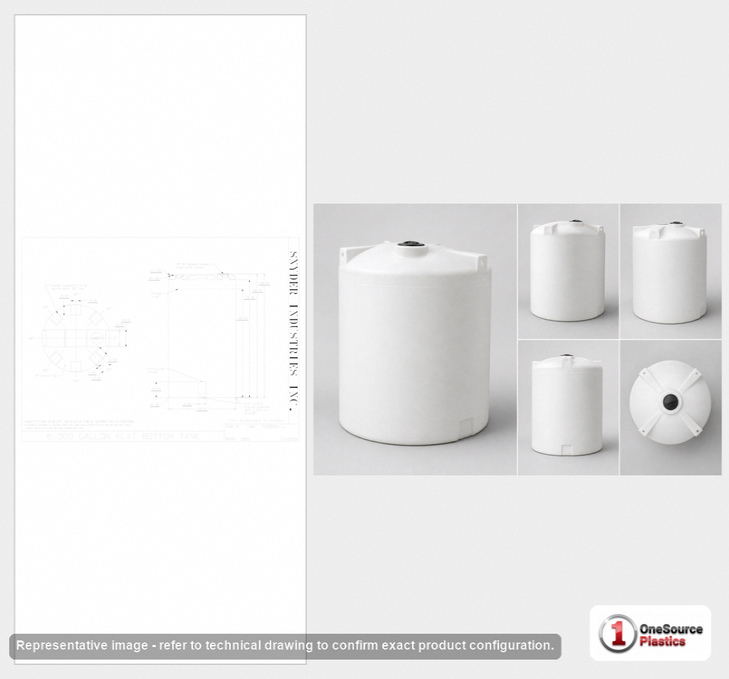
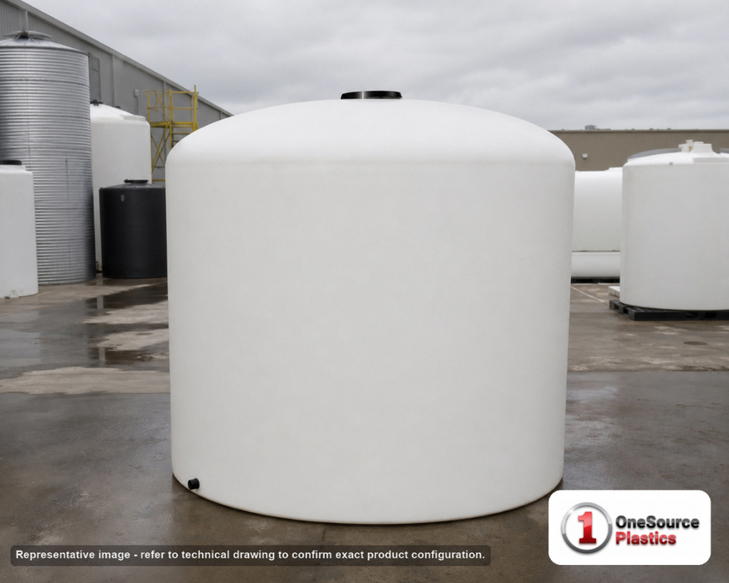
Three tanks hold 6,000 gallons on this exact 120 x 132 in shell, so the silhouette is not the decision. This one is the white wall listed at 1,155 lb where the two black grades in the identical shell are listed at 1,050 lb, and the sheet gives all three figures. The case for the white tank is visibility and commitment: an operator can read a shadow line through the wall on a bright day instead of opening the lid to answer a question, and this sheet is the one that publishes a rating of 1.5, a 120 F / 48 C ceiling and a 3 Year Warranty rather than leaving the fields empty. Black is the wall for a liquid that light degrades, at the price of seeing nothing from outside. If the chemistry calls for cross-linked polyethylene instead of the linear resin, 7140300N40 holds the same 6,000 gallons at 145 in and 1,500 lb, which is a foot more height and a heavier lift. Either side of the group the shape changes rather than the wall: 5250000N40 puts 5,600 gallons on a 142 inch base only 102 in tall, which is the buy when a roof caps the height and the floor is free, and 8220000C34 takes 6,200 gallons to 140 in at 1,350 lb on this same ten foot circle. Each of those carries the rating its own sheet publishes and this page asserts none of them.
Two rows look the same? The difference is the wall; call 866-418-1777 with the liquid and we will say which, or ask for a quote on both.
The 3 inch bulkhead outlet, and the 120 F ceiling written above it
- Outlet: a 3 inch polypropylene female NPT bulkhead fitting at the base, as the sheet lists it, and the only liquid connection the sheet names. Make the thread up once with a sealant matched to the service, then set a union or a flange a short way downstream so every later valve change happens on the pipe rather than on the tank. Keep a clear wrench path around it and keep it out of a buried box.
- Head and rating together: eleven feet of liquid stands over that fitting when the tank is full, and at a rating of 1.5 the pressure at the base is half again what the same height of water would give. Rate the valve, the gaskets and the first run of pipe for the liquid rather than for the tank, and carry the first valve on its own support off the pad.
- Pump: below the outlet on its own base, with a short falling suction run so the column keeps it flooded through the draw. Size it on the real density and viscosity, not on a water curve, and give it a cleanable strainer plus a run-dry cut-out that stops it with liquid still standing over the fitting.
- Service limit: the sheet prints 120 F / 48 C, which makes it a design input instead of an assumption. Hot fill, a process return above that figure, steam cleaning and a black-topped yard in July all get engineered against it, and where a liquid runs close to the ceiling the shade side of the building is worth more than it looks.
- Access and fill: an 18 inch threaded vented manway on the crown at 132 in, with fixed access and a rail for anyone who opens it, and the vent kept clear whenever a pump runs. The sheet lists no inlet, so specify the fill connection deliberately, at working level or as a drop pipe inside the shell, rather than tipping a delivery in through the lid from eleven feet up.
Two habits repay themselves on a tank this size. First, treat the vapour space as the wear point rather than the liquid, because that is where a polyethylene vertical usually shows its age; anything that concentrates vapour up there, a hot fill, an aggressive chemistry, a vent that cannot breathe, is a wall problem and not a nuisance. Second, instrument the level and log it. A reading taken at ground level and compared week to week tells you about pad settlement, thermal movement and slow loss long before anybody notices a stain on the concrete, and on a tank rated for a dense liquid a change in level is also a change in the load on the slab.
Process storage, wash water and bulk holding at a plant
6,000 gallons with a published rating and a published ceiling is the size a plant buys when a day tank is too small and a bulk vessel is too much commitment: process and utility water, bulk chemical and additive storage, brine and solution holding, fertiliser and crop input storage at a dealer, wash and rinse water for a wash bay or a packing line, and equalisation ahead of treatment. The practices that decide whether an installation lasts are the same at every size, and the buyers guides written around the smaller verticals are the cheap way to learn them: the 2000 gallon vertical buyers guide on pads, straps and pump layout, the 500 gallon vertical buyers guide on fittings and the first fill, and the buyers guide to the small day-tank verticals on where a holding vessel belongs in a system. Where the duty is water standing against fire rather than liquid held for work, the fire-water reservoir design guide sets out what turns stored gallons into a reserve anybody can count on.
Two plants, Lincoln and Philippi, and the lane that sets the cost
This sheet names two plants, Lincoln, Nebraska and Philippi, West Virginia, which is unusual and useful: an eastern buyer and a midwestern buyer are not both paying for the same long haul, and on an oversize load the lane is a bigger number than the class. We confirm which plant an order ships from at the time of the order rather than guessing at it here. Freight is class 400 as the sheet lists it, crated at 120 inches by 120 inches by 132 inches, moving as an oversize load. The freight cost estimator prices the lane to your ZIP, and the listed price is before freight. Plan the unloading before the freight: ten feet of width needs a gate wider than the tank and a place for the truck to stand, and 1,155 pounds needs a forklift or telehandler with slings under the body, never a hook through the manway. Set it straight onto the cured slab rather than parking it alongside, then fill it with clean water and hold it before any product goes near it, reading the pad edge, the base and the outlet thread through the hold. Note the delivery date against the 3 Year Warranty in your own records while the paperwork is still on the desk.
Freight and documents
Ships from: Lincoln, NE; Philippi, WV. LTL freight is quoted to your ZIP with the freight cost estimator or by phone at 866-418-1777. The listed price is before freight.
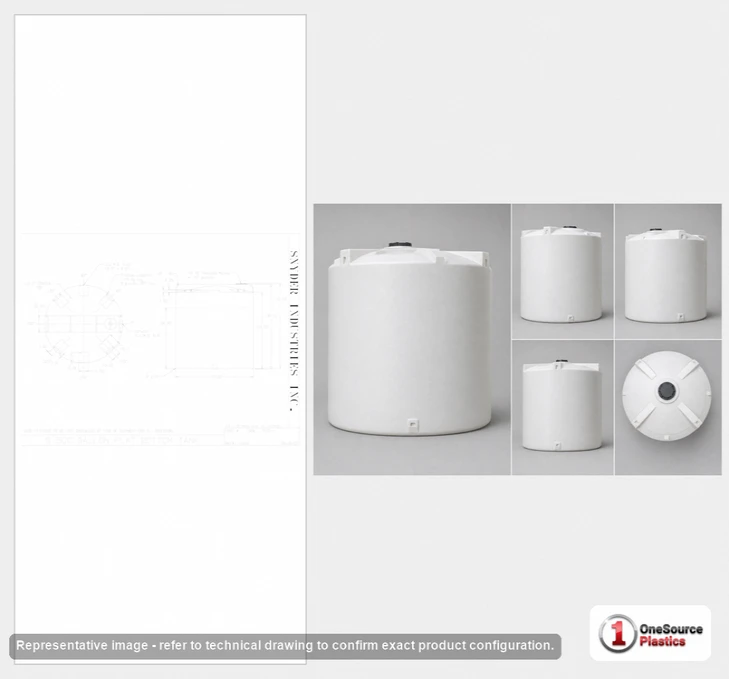
Technical drawing (PDF) for Snyder Industries SII-7000000C37.
See this tank
Interactive 3D model with live fill. This tank has an interactive 3D model built to its manufacturer dimensions. Rotate it, and set a fill level to see how much liquid it holds at any height. Open the 3D view on the product photo above. Download the 3D model (GLB).
Product video. Watch the 6000 Gallon Plastic Vertical Liquid Storage Tank in White video (62 seconds) with dimensions, fittings and shipping notes.
Ready to order?
Add it to your cart at the top of this page, get LTL freight to your ZIP, request a written quote, or call 866-418-1777. The listed price is before freight.