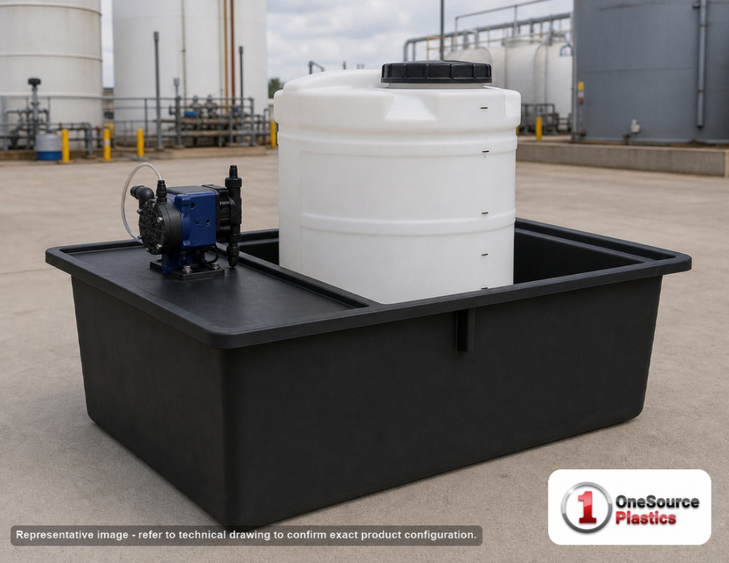
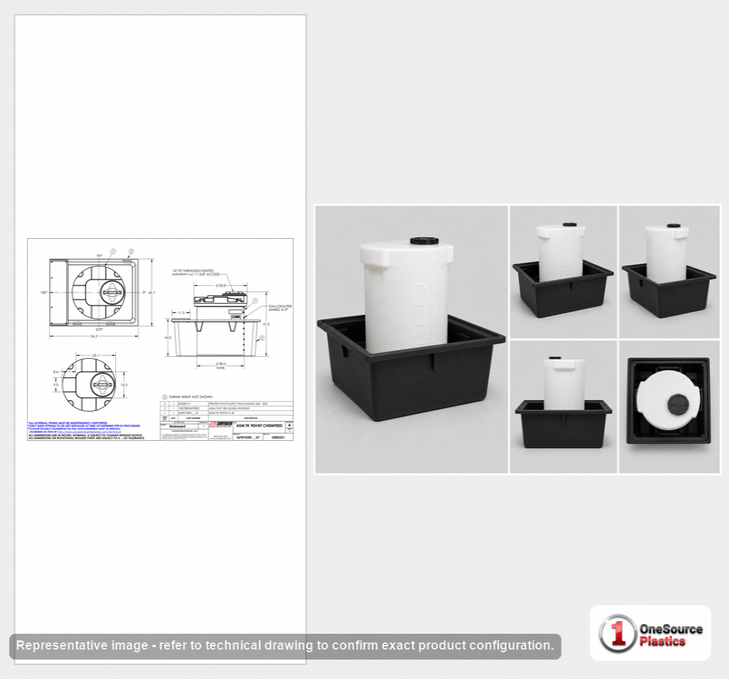
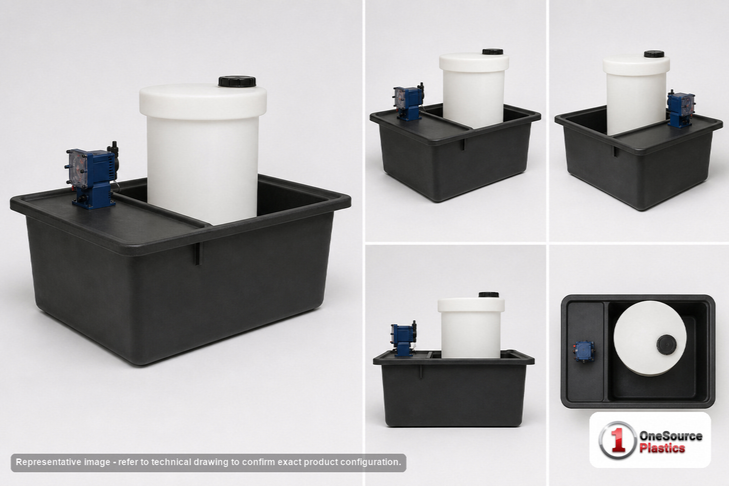
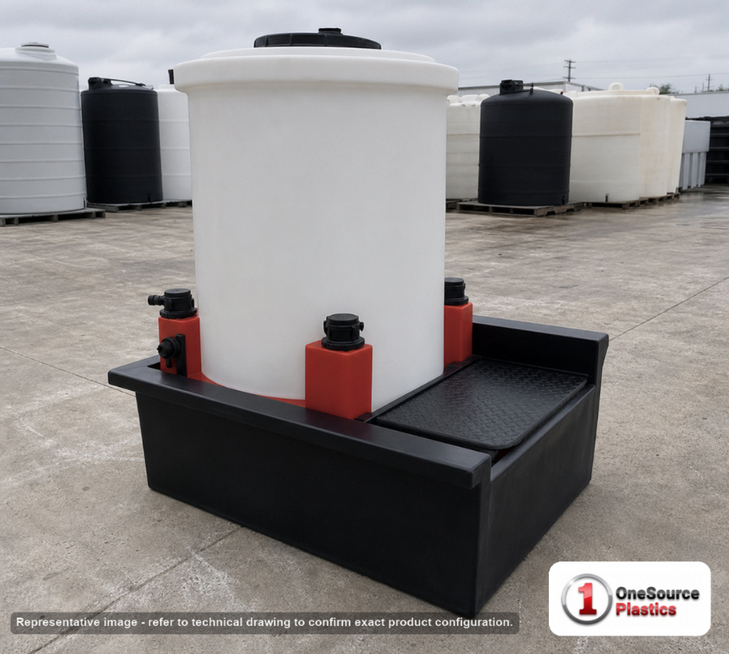
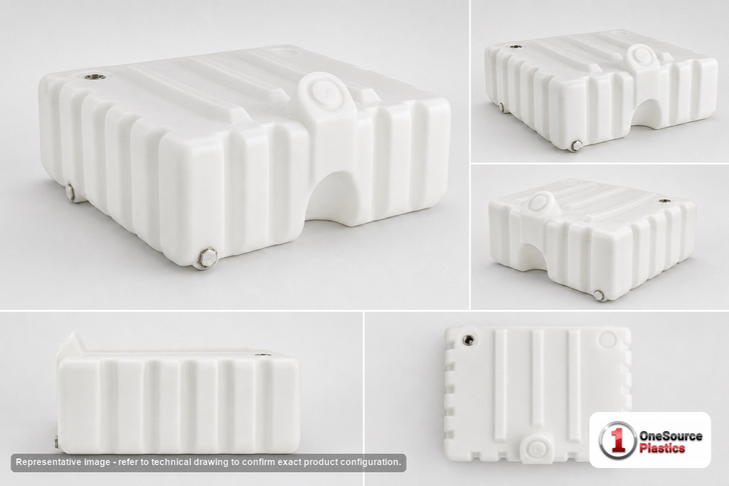
Ninety gallons on a stand, 57 inches tall with a 14 inch lid
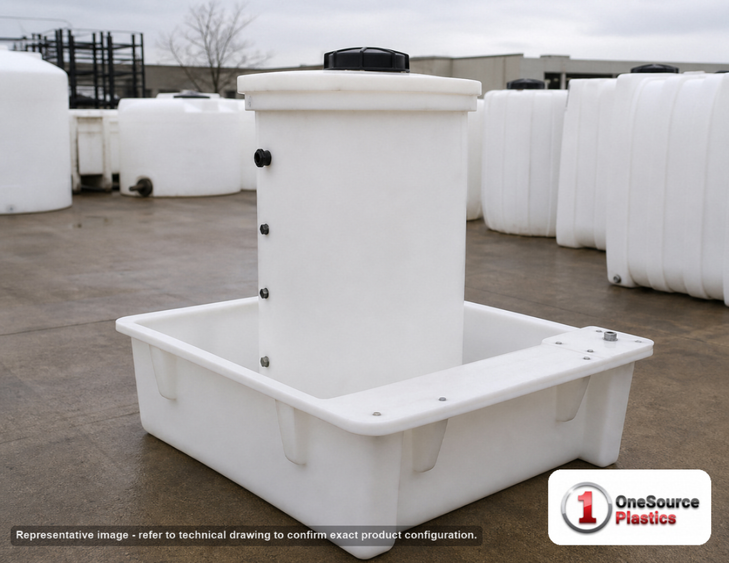
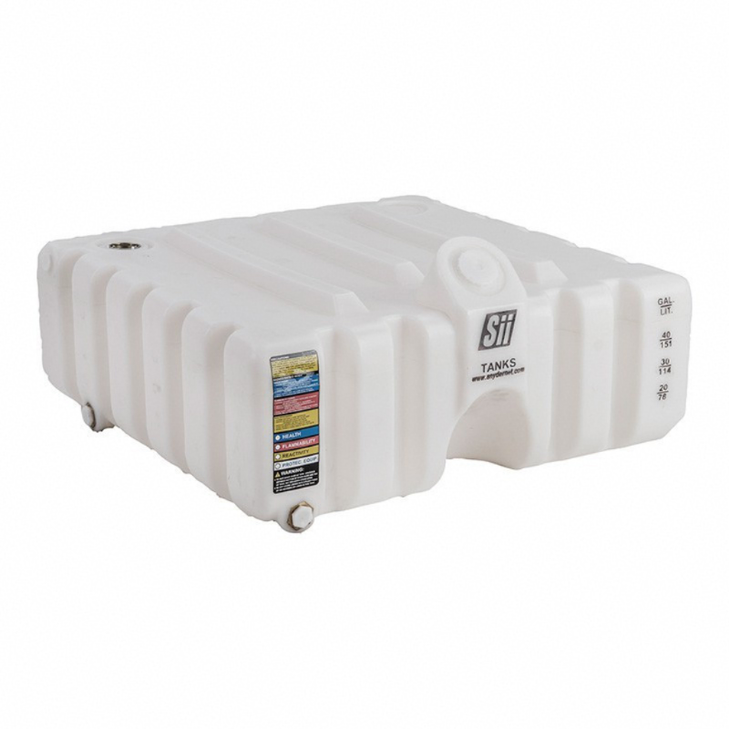
The lid is what sets the Snyder SII-5690104CFWS45 apart from the smaller stations: 14 inches of opening instead of 6. It is a 90 gallon chemical feed station tank in white high density linear polyethylene, supplied on its stand, 56 inches long, 43 inches wide, 57 inches tall overall, and 123 pounds as listed, shipping from Arkansas under Snyder's own product application of chemical feed station tanks. The wall is rated at a specific gravity of 1.9, so the sheet gives 751 pounds for 90 gallons of water at 8.34 pounds per gallon and 1,426 pounds of max contents. The service limit is 120 F / 48 C. No outlet size, no inlet size, no warranty term and no rating for the stand are published, so none is claimed here.
Need it before the next delivery? Call 866-418-1777 for the ship date, or get freight to your ZIP and add it to your cart above now.
A shipped 123 pounds out of Marked Tree, and the room it lands in
Consider the delivery before the specification, because that is what usually goes wrong with a station this size. It is molded at Marked Tree, Arkansas and the sheet gives the freight class as LTL: ordinary pallet freight, no permit, no oversize move, a short lane into the Mid-South and a reasonable one across the country. The shipped package is 56 by 43 by 57 inches at 123 pounds, which is a wide pallet rather than a tall one, and that width is the thing to measure. Four feet eight inches across has to get through the doorway, round the corner in the corridor and down the aisle to the spot, and a station that has to be tipped to make the turn is a station somebody drops. One hundred and twenty-three pounds is a forklift under the pallet or two people committed to the job, and it is the point where a site with no lift should have help arranged for the delivery slot rather than the day after. Once it is in the room, the stand earns the height: a metering pump goes below the draw-off and runs on a flooded suction, a container fits underneath for a decant, and the underside of the vessel is visible on a walk-past. The floor under the frame is flat, level and continuous, with no rock under a foot, carrying 751 pounds of liquid full of water and 1,426 pounds at the sheet's own rating. This sheet publishes no anchor pattern, foot detail or frame rating, so none is printed here; ask us to get that against the drawing for the part number if the deck is not ground-bearing concrete. And check that 90 gallons is the right volume rather than the flattering one: run your dosing rate and delivery interval in the tank sizing calculator and take the reserve and thermal freeboard from the tank sizing guide.
Ninety gallons at 41 inches or 57, and the 120 beside it
| Part | Volume | Listed height | Empty weight |
|---|---|---|---|
| SII-5690104CFWS45 (this one, with stand) | 90 gal | 57 in | 123 lb |
| SII-5690104CFWS42 (with stand, the 42 part number) | 90 gal | 57 in | 123 lb |
| SII-5690103CF45 (tank only, lower) | 90 gal | 41 in | 99 lb |
| SII-5690103CF42 (tank only, the 42 part number) | 90 gal | 41 in | 99 lb |
| SII-5700103CF42 (larger, tank only) | 120 gal | 51 in | 130 lb |
| SII-5680023CF42 (smaller feed station) | 60 gal | 58 in | 108 lb |
Inside the 90 gallon group the sheet gives one difference and it is the stand: 57 inches and 123 pounds with it, 41 inches and 99 pounds without it. Buy this one when the pump has to sit under the draw-off, when a drum or carboy has to fit beneath for a decant, or when you want the bottom of the vessel where you can see it; buy a CF part number when a ceiling, a shelf or a fixed fill point rules the height out, or when the plant already has its own frame or plinth. Against SII-5690104CFWS42 the sheet gives the same 57 inches and the same 123 pounds; the published difference is the part number and the wall, high density linear polyethylene here against cross-linked polyethylene on the 42, each with the rating its own sheet carries. The figures on this page, a specific gravity of 1.9 and a 120 F / 48 C limit, are this part number's. Sideways, the 120 gallon SII-5700103CF42 holds a third more on the same 56 by 43 inch plan at 51 inches and 130 pounds, which is the one to look at if deliveries are the nuisance rather than the floor; the 60 gallon SII-5680023CF42 is the step down for a smaller aisle. Volume is the only thing that changes across that range: the duty, the pump and the discipline are the same.
Need a different size? Every tank in the table is in stock programs; ask for a quote on the one that fits, or call 866-418-1777.
Fourteen inches of lid: the widest opening in the family
- The opening: a 14 inch lid, where the 60 gallon stations in this family carry 6. That is the difference between a port you fill and sample through and an opening you can genuinely clean through, get a hand and a brush into, and inspect properly. On a station that changes product, or one running a chemistry that leaves a film, it is the strongest single argument for this size.
- Filling at 57 inches: the lid is at chest height or above, so bring the fill line to a fixed coupling at working level rather than lifting a hose to the rim, and keep the vent path clear whenever a pump is drawing.
- The draw-off: no outlet size and no inlet size are published on this sheet, so none is printed. Tell us the chemical and the flow rate when you order and we confirm the fitting, gasket and valve against Snyder's drawing for this part number, in writing, before it ships.
- The pump the stand is for: below the draw-off, on its own base, with a short falling suction run, plus a low level float or probe that stops it with liquid still over the fitting. Valve on its own support, flexible connector at the first joint, union downstream of the valve.
- Laying out the top: a 14 inch opening invites people to put the fill, the vent, the level device and a return line through the same area and let them fight. Do it on paper first, in the order the top fitting placement guide sets out.
Use the bigger lid rather than admiring it. Open the station on a schedule, look at the inside of the wall and the bottom of the vessel, and clean what has settled before it becomes the reason a dosing pump loses its rate. Then close the loop with instrumentation and marking: the level gauge selection guide for getting the level onto a display the operator reads from the floor, and the tank label and signage guide for the marking that survives an inspection.
Bigger batches, longer between deliveries
Ninety gallons is the size a plant moves to when a smaller day tank has become a refill job somebody does too often: hypochlorite, caustic, acid, coagulant or polymer at a water or wastewater works; a sanitiser or additive tank on a food, beverage or dairy line; cooling tower treatment on a larger system; bulk detergent or acid at a wash or a commercial laundry; a dosing point in a plating or finishing shop. The extra volume buys a longer interval between deliveries and a steadier feed, and it costs a little more floor and a taller lift on the way in. It also puts more liquid behind every assumption about strength, so keep the sampling honest as the batches get bigger: the chemical sampling protocol article covers drawing from the same point, at the same depth, on the same cadence, and writing it down.
Chemical service ratings
The resin is rated for the liquids below at the concentrations shown; the fitting and gasket called out are the ones to order with the tank. Verify the exact service on the linked page or in the chemical compatibility database before ordering.
- sodium hypochlorite
- sulfuric acid
- ferric chloride
- hydrochloric acid and
- DEF. If you sample the dosing line, follow our
Class LTL under NMFC 156600-02, 123 pounds shipped
Shipping from Arkansas, molded at Marked Tree, with the freight class given on the sheet as LTL under NMFC 156600-02 and a shipped package of 56 by 43 by 57 inches at 123 pounds. The freight cost estimator prices the lane to your ZIP, and the listed price is before freight. Measure the width before the truck is booked, arrange the lift for the slot, and take it off with the forks under the frame rather than by the lid or a sling around the vessel. Stand it in its final position on level floor, then water-fill it once and hold it while you read the floor under every foot, the lid seal and every joint you have made, and drain it dry before the chemical arrives. Open the 14 inch lid and look inside on the day it goes into service, so that you know what clean looks like on this vessel before anything has been in it. Keep the first delivery's paperwork with the tank; strength and date on day one is the baseline for every batch after.
Freight and documents
Ships from: Marked Tree, AR. LTL freight is quoted to your ZIP with the freight cost estimator or by phone at 866-418-1777. The listed price is before freight.
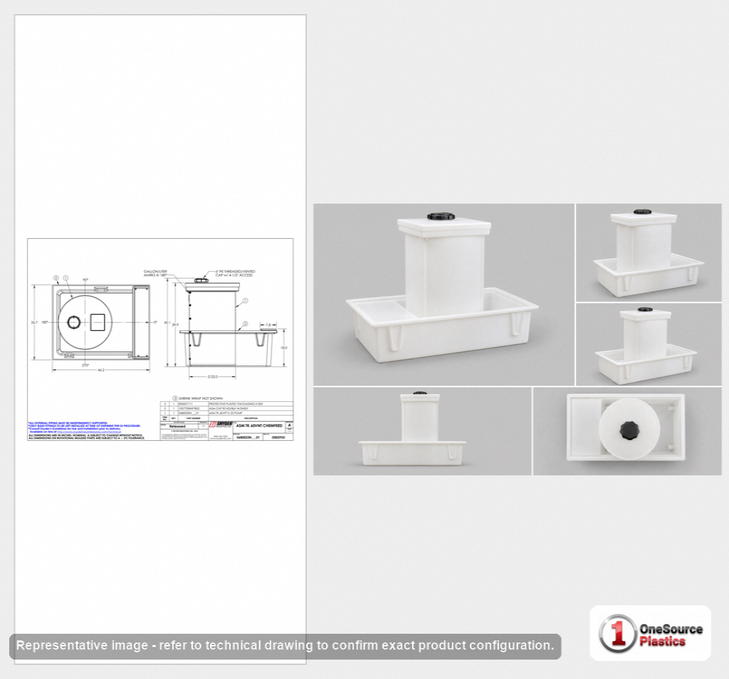
Technical drawing (PDF) for Snyder Industries 5690104CFWS45.
See this tank
Product video. Watch the Snyder Industries 90 Gallon HDLPE Chemical Feed Station Tank with Stand in White video (70 seconds) with dimensions, fittings and shipping notes.
Ready to order?
Add it to your cart at the top of this page, get LTL freight to your ZIP, request a written quote, or call 866-418-1777. The listed price is before freight.