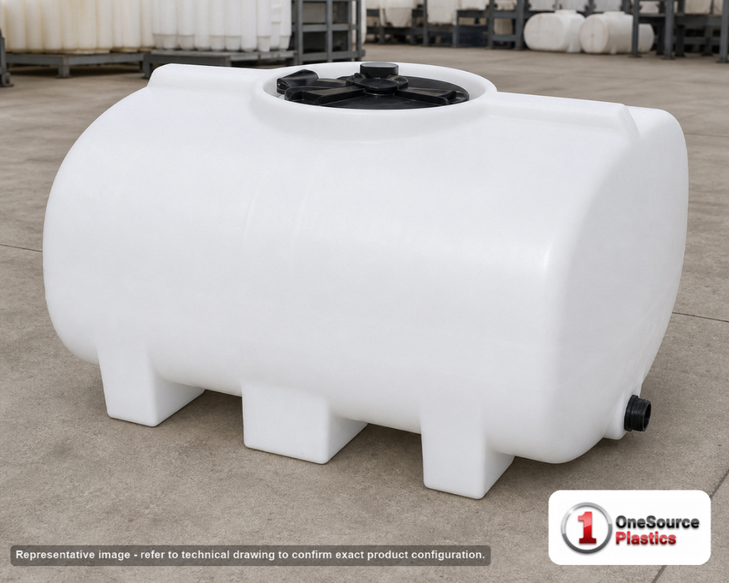
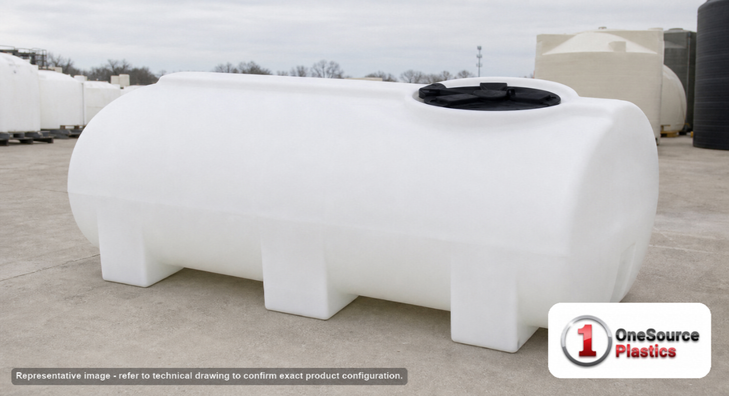
The Enduraplas 300 Gallon Yellow Horizontal Sump Bottom Leg Tank is a transport-ready polyethylene tank built for hauling liquid where there is no permanent plumbing - a field sprayer support tank, a nurse-tank module, or a mobile chemical fill station. The horizontal leg design sits flat and stable on a trailer or skid, the integral legs cradle the body so it does not roll, and the sump bottom pulls product toward the outlet so you drain closer to empty. At 74 inches long by 46 inches wide by 34 inches tall, this 300 gallon horizontal leg tank carries its load in a low, road-friendly profile that loads and unloads without a crane.
Will it work for your liquid
This is a yellow polyethylene tank rated to 1.9 specific gravity, which means it is engineered to carry dense liquids - heavy ag chemistry, fertilizer blends, and brines - not just water. Empty it holds 300 gallons; filled with plain water that is roughly 2,502 pounds of contents, and the 1.9 SG rating supports up to about 4,754 pounds of dense product at full volume. Use that max-rated contents weight to size your trailer, axles, and tie-downs, and confirm the running gear can carry the loaded number, not the water number. The footprint is 46.0 x 74.0 inches - check it against your trailer deck or skid frame before you commit. The Tank Sizing Calculator and Tank Sizing Guide will help you match volume and weight to the rig you are running. No factory fitting package is listed in our data for this tank, so you spec the outlet, bulkhead, and gasket yourself - match each part to your liquid using the compatibility chart below.
Chemical compatibility
This is a polyethylene tank rated at 1.9 specific gravity, recorded as high-density linear polyethylene (HDLPE) but not yet fully confirmed against the crosslinked alternative - confirm HDLPE versus XLPE with us before you put aggressive oxidizers or strong acids in it, because the two resins behave differently with that chemistry. Compatibility always depends on concentration and temperature, so read it off the OEM chemical-resistance chart for the exact strength you are running.
Within the pack data, this tank pairs with a wide range of products. For acids, plan on acetic acid at 60% (PP/PVC fittings, EPDM gaskets), hydrochloric acid at 37% (PVC, Viton), hydrofluoric acid at 48% (PP/PVC, Viton), hydrofluosilicic acid at 26% (PP/PVC, Viton), phosphoric acid at 85% (PVC, Viton), and sulfuric acid at 98% (CPVC, Viton). For coagulants and salts: aluminum sulfate at 50%, calcium chloride at 40%, ferric chloride at 50%, ferric sulfate at 60%, ferrous sulfate at 20%, magnesium chloride at 30%, polyaluminum chloride, and zinc orthophosphate (PVC or PP/316SS, EPDM). It also handles DEF at 32.5% and urea solution at 50% (use 316SS or PP/PVC, EPDM), ethylene glycol at 100% and propylene glycol (PVC or PP/316SS, EPDM), and a set of caustics and sulfur salts including potassium carbonate at 50%, potassium hydroxide (saturated), sodium carbonate at 30%, sodium bisulfate, sodium bisulfite, and sodium thiosulfate at 40%. Oxidizers - hydrogen peroxide at 50% (PVC, Viton), peracetic acid at 30% (316SS, Aflas), sodium hypochlorite below 16.5% (PVC, Viton), and ozonated water up to 10 PPM (PVC, EPDM) - demand careful fitting and gasket selection and tighter monitoring. Match the fitting and gasket material to the chemical exactly as listed, and start at the chemical compatibility index.
The mistake to avoid
The most common error on a 1.9 SG haul tank is sizing the trailer to the water weight and then loading a dense product. A fertilizer blend or a concentrated acid weighs far more than water per gallon, and the pack-rated max contents of roughly 4,754 pounds is what your axles and straps actually have to hold - not the 2,502-pound water figure. The second is grabbing the wrong gasket. Most salts, glycols, and caustics run EPDM, but the aggressive chemistry does not: sulfuric acid is the lone CPVC-and-Viton case, peracetic acid is the lone 316SS-and-Aflas case, and the other oxidizers and strong acids (peroxide, hydrochloric, hydrofluoric, hypochlorite) need Viton - not whatever is on the shelf. Because this tank is built for transport, also secure it as a non-roadable trailer load and review the general DOT and ag-exemption framework below before you run it loaded.
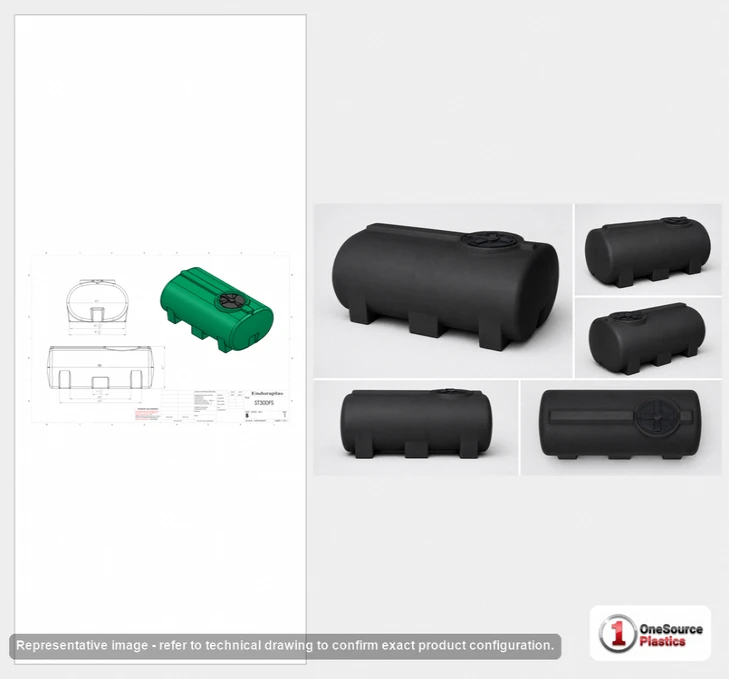
This tank ships LTL freight from the Enduraplas plant in Neche, North Dakota, quoted live to your ZIP - get your number on the Freight Cost Estimator or call 866-418-1777. For sizing and transport context, see the Tank Sizing Guide, plus the general DOT non-roadable-trailer and 49 CFR ag-exemption framework (illustrated with Norwesco leg tanks) in our applicator and leg tanks for fertilizer and portable utility tank 49 CFR classification guides, and the fertilizer-blend stratification guide. Reference the technical drawing on this page for the exact sump, outlet, and leg layout before you plumb it.
Freight and documents
Ships from: Neche, ND. LTL freight is quoted to your ZIP with the freight cost estimator or by phone at 866-418-1777. The listed price is before freight.
See this tank
Interactive 3D model with live fill. This tank has an interactive 3D model built to its manufacturer dimensions. Rotate it, and set a fill level to see how much liquid it holds at any height. Open the 3D view on the product photo above. Download the 3D model (GLB).
Product video. Watch the Enduraplas 300 Gallon Yellow Horizontal Sump Bottom Leg Tank video (70 seconds) with dimensions, fittings and shipping notes.
Ready to order?
Add it to your cart at the top of this page, get LTL freight to your ZIP, request a written quote, or call 866-418-1777. The listed price is before freight.