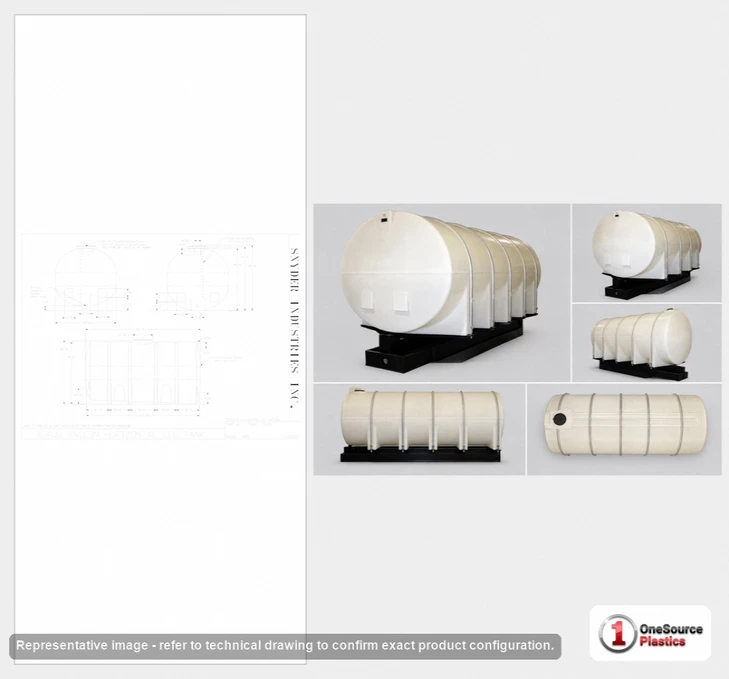
The Enduraplas 3500 Gallon Black Horizontal Leg Tank is built for moving heavy liquids down the road and across the yard. With a 3500-gallon capacity in a low-slung horizontal leg-tank body, it measures 179 inches long by 95 inches wide by 70 inches tall, riding on molded legs that let it sit flat on a trailer deck or skid. The black polyethylene wall blocks sunlight to slow algae growth, and the 1.9 specific gravity rating is where this Enduraplas horizontal tank earns its keep: it is engineered to haul liquids substantially denser than water, which is exactly what a fertilizer or chemical hauling operation needs.
Will this Enduraplas leg tank handle the job
Filled with plain water this tank carries about 29,190 pounds, but its real headroom is the 55,461-pound maximum rated contents weight that the 1.9 SG rating supports. That gap is roughly 26,271 pounds of additional dense-liquid capacity the 1.9 rating unlocks over a water-only tank of the same volume. Put another way, the wall is rated to about 15.85 pounds per gallon at full volume, so you can check your blend's actual pounds-per-gallon against that ceiling directly before you load. The 95 x 179 inch footprint and 70-inch height determine how it sits on your trailer and how your tie-downs and saddles need to be spaced, so confirm those numbers against your deck before you commit. For load planning by liquid and density, run the figures through our Tank Sizing Calculator and the Tank Sizing Guide. If you are spec'ing this for ag use, the background on horizontal leg tanks and DOT scope in our applicator and leg tanks for fertilizer writeup and the portable utility tank classification guide is worth reading first. Dimensions and tie-down geometry are shown on the technical drawing on this page.
Chemical compatibility
Resin grade unconfirmed in our data - confirm HDLPE versus XLPE cross-linked polyethylene with the manufacturer before any chemical service. Different polyethylene resins do not carry identical chemical-resistance profiles, so for a 1.9-SG haul tank that question changes the entire compatibility answer. With the resin confirmed, this tank's 1.9 rating supports a wide range of dense chemistries. Per the manufacturer's chemical-resistance chart, which is always concentration- and temperature-specific, compatible services include Acetic Acid (60%, PP/PVC fittings, EPDM gaskets), Aluminum Sulfate (50%, PVC, EPDM), Calcium Chloride (40%, PVC, EPDM), DEF (32.5%, 316SS, EPDM), Ethylene Glycol (100%, PVC, EPDM), Ferric Chloride (50%, PVC, EPDM), Ferric Sulfate (60%, PVC, EPDM), Ferrous Sulfate (20%, PVC, EPDM), Hydrochloric Acid (37%, PVC, Viton), Hydrofluoric Acid (48%, PP/PVC, Viton), Hydrofluosilicic Acid (26%, PP/PVC, Viton), Hydrogen Peroxide (50%, PVC, Viton), Magnesium Chloride (30%, PVC, EPDM), Peracetic Acid (30%, 316SS, Aflas), Phosphoric Acid (85%, PVC, Viton), Polyaluminum Chloride (PVC, EPDM), Potassium Carbonate (50%, PVC, EPDM), Potassium Hydroxide (saturated, PVC, EPDM), Propylene Glycol (PP/316SS, EPDM), Sodium Bisulfate (PVC/PP, EPDM), Sodium Bisulfite (PVC/PP, EPDM), Sodium Carbonate (30%, PVC, EPDM), Sodium Hypochlorite (under 16.5%, PVC, Viton), Sodium Thiosulfate (40%, PVC, EPDM), Sulfuric Acid (98%, CPVC, Viton), Urea Solution (50%, PP/PVC, EPDM), Zinc Orthophosphate (PP/316SS, EPDM), and Ozonated Water (up to 10 PPM, PVC, EPDM - verify directly, no dedicated page). At 1.9 SG this is already the heaviest wall rating offered for these services, so there is no higher-SG step-up to hold out for - what you see is the top of the line.
Match the fitting and gasket to the chemical
The fitting and gasket material change with the chemistry, and the pack data sorts into three distinct gasket tiers. EPDM covers the salts, glycols, DEF and urea - the bulk of the list on PVC fittings. Viton is the oxidizer and strong-acid tier: sodium hypochlorite, hydrogen peroxide, hydrochloric, hydrofluoric, phosphoric and sulfuric acid all call for it. Aflas is its own tier, required for peracetic acid only. On the fitting side, CPVC is the single upgrade beyond PVC, PP and 316 stainless, and it is needed solely for 98% sulfuric acid; DEF and peracetic acid run on 316 stainless. Matching the wrong elastomer to a strong oxidizer is the most common and most expensive mistake on a tank like this, so check each chemical's page before you order plumbing. Use the full chemical compatibility tool to verify your exact concentration and temperature, and if your blend tends to stratify, the fertilizer-blend stratification guide covers mixing protocol and field verification.
This Enduraplas horizontal leg tank ships LTL freight from the plant in Neche, North Dakota, quoted live to your ZIP - get your number instantly with our Freight Cost Estimator or call us at 866-418-1777. At this size and weight it moves on a flatbed or dedicated LTL line.
Freight and documents
Ships from: Neche, ND. LTL freight is quoted to your ZIP with the freight cost estimator or by phone at 866-418-1777. The listed price is before freight.
Ready to order?
Add it to your cart at the top of this page, get LTL freight to your ZIP, request a written quote, or call 866-418-1777. The listed price is before freight.